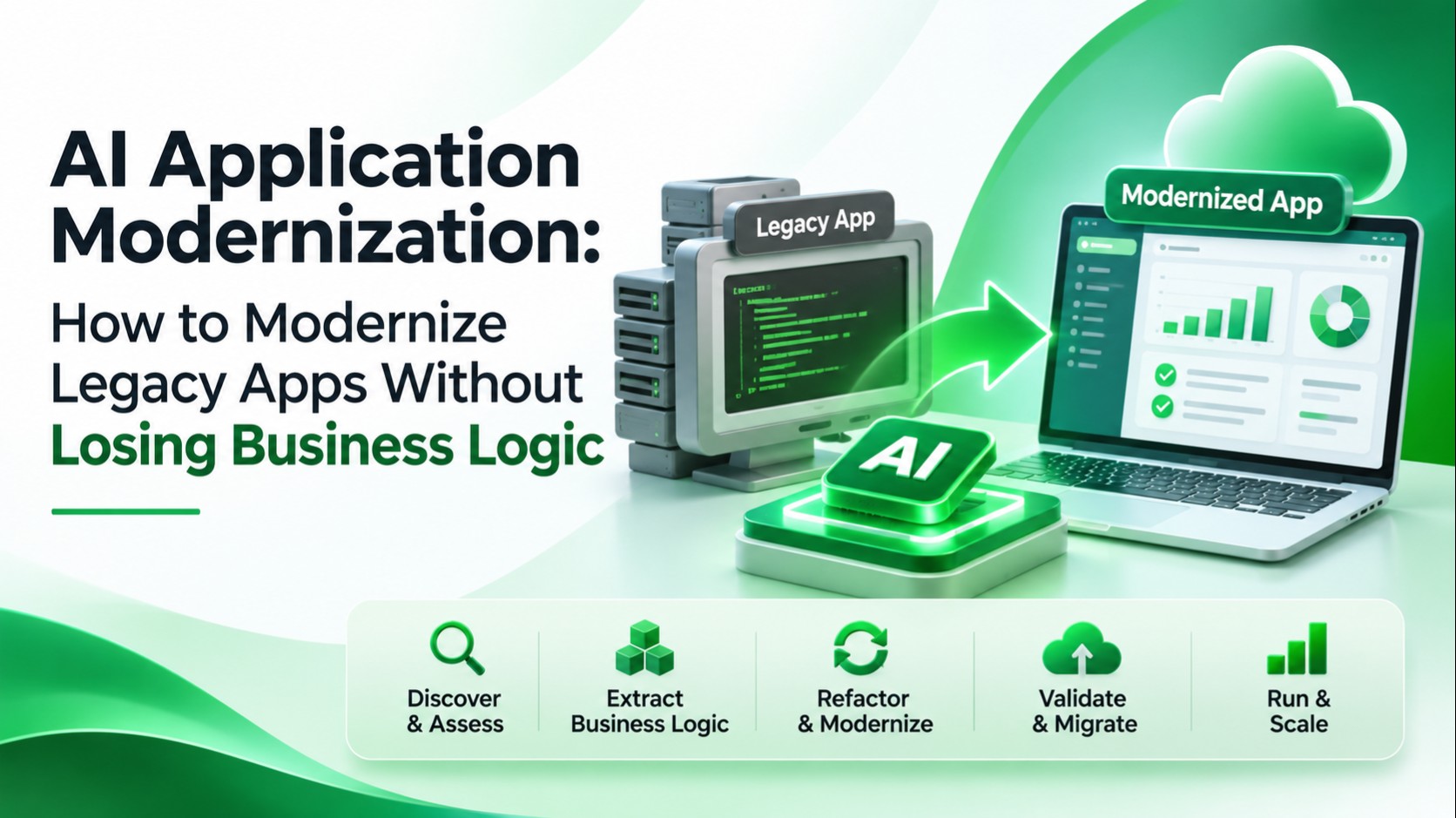
AI Application Modernization: How to Modernize Legacy Apps Without Losing Business Logic
AI can accelerate application modernization.
It cannot remove the need to understand the application.
That distinction is critical.
The difficult part of modernizing a legacy system is rarely translating one programming language into another. The difficult part is recovering years of embedded business logic, dependencies, data behavior, integrations, exceptions and operational assumptions — then proving that the modernized application still behaves correctly.
AI is most valuable when it helps teams understand and transform that system faster while preserving a rigorous validation process.
What Is AI Application Modernization?
AI application modernization uses AI-assisted engineering techniques to analyze, document, refactor, migrate, test and modernize legacy applications.
Typical use cases include:
- codebase analysis;
- dependency mapping;
- business-rule extraction;
- legacy language explanation;
- framework upgrades;
- code transformation;
- test generation;
- documentation recovery;
- database modernization;
- API creation;
- modernization planning.
Google Cloud's current application-modernization offering, for example, uses AI for assessment, business-rule extraction, code transformation and validation across mainframe, .NET and Java workloads. Google Cloud AI application modernization.
AI Modernization Is Not the Same as Enterprise AI Modernization
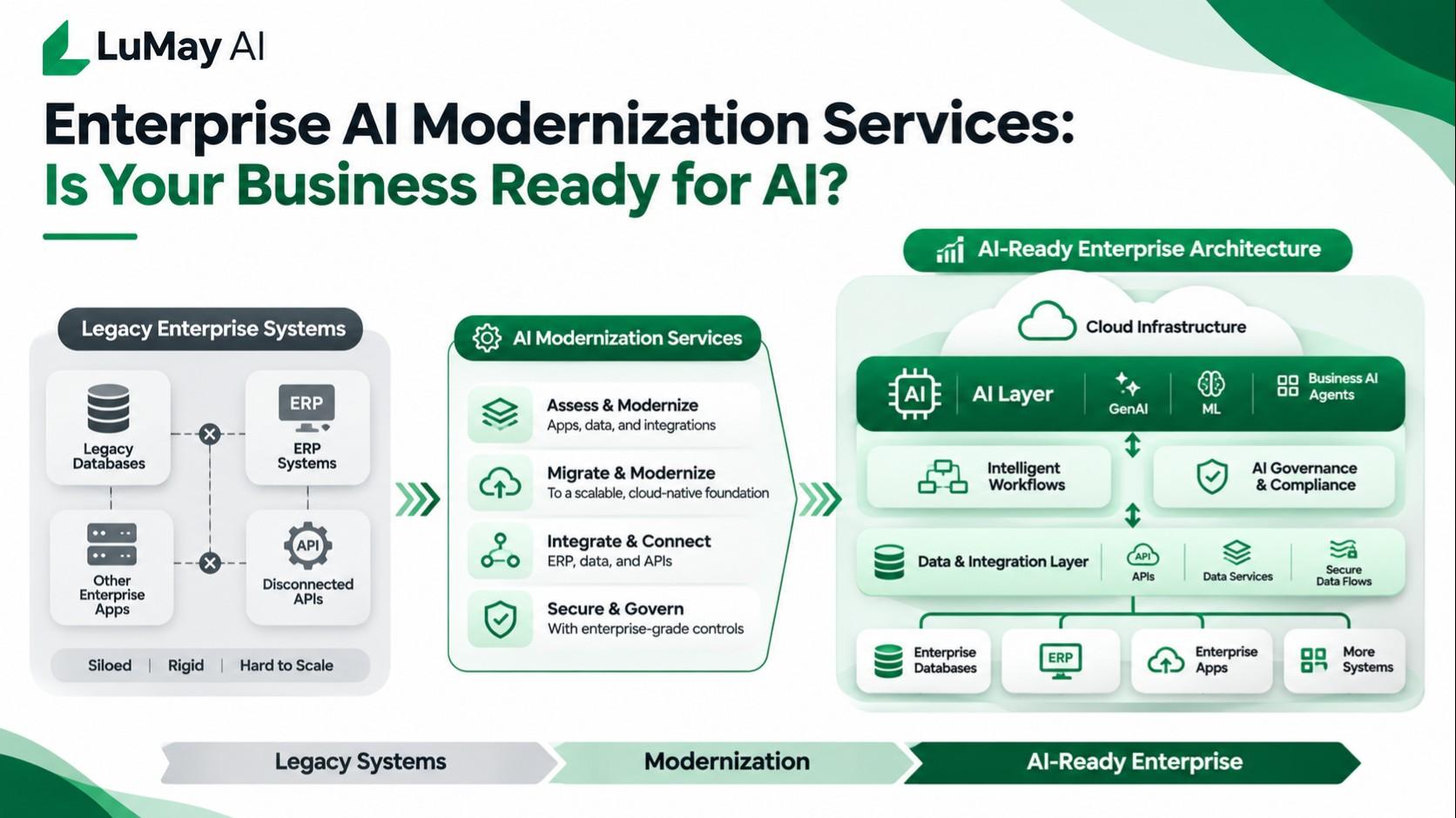
LuMay already has a broader article on Enterprise AI Modernization Services: Is Your Business Ready for AI?.
That article focuses on preparing enterprise architecture, data and systems for AI.
This article focuses on a different task:
How do you modernize an existing legacy application using AI-assisted engineering without breaking the business behavior the application already supports?
The 7-Stage AI Application Modernization Workflow
1. Discover the application
Before changing code, build an inventory.
Capture:
- languages;
- frameworks;
- runtime;
- databases;
- jobs;
- APIs;
- batch processes;
- queues;
- external integrations;
- user interfaces;
- deployment process;
- operational dependencies.
Do not trust the architecture diagram alone.
The running system is the source of truth.
2. Recover business logic
Legacy applications often contain rules that are poorly documented.
AI can help:
- summarize code;
- trace decision paths;
- identify validation logic;
- explain calculations;
- extract business rules;
- connect rules to data fields;
- compare implementation with available documentation.
Google Cloud's modernization guidance specifically highlights extracting business logic and translating complex rules into understandable formats before modernization. Google Cloud modernization overview.
Every extracted rule should still be reviewed by engineers and business owners.
3. Map dependencies
A legacy module may look isolated but depend on:
- shared database tables;
- scheduled jobs;
- files;
- message queues;
- mainframe transactions;
- identity systems;
- downstream reports;
- external vendor systems.
AI can assist with dependency discovery, but teams should validate the map using runtime telemetry and production evidence.
4. Choose the disposition
Not every application should be rewritten.
Common options include:
- retain;
- retire;
- rehost;
- replatform;
- refactor;
- rebuild;
- replace.
The right choice depends on business value, technical debt, risk, cost and strategic importance.
AI can accelerate analysis.
It should not make the investment decision by itself.
5. Transform incrementally
Avoid a large code-generation event followed by a single final test.
Break modernization into bounded units.
Examples:
- one service;
- one module;
- one transaction;
- one API;
- one batch job;
- one database component.
For each unit:
understand → transform → test → compare → approve
This reduces the size of failures.
6. Validate functional equivalence
The modern application must preserve the business behavior that matters.
Validation may include:
- unit tests;
- integration tests;
- contract tests;
- replay of production traffic;
- golden datasets;
- output comparison;
- performance tests;
- security testing;
- user acceptance.
Google Cloud's 2026 mainframe modernization guidance emphasizes iterative modernization and functional-equivalence validation rather than treating modernization as simple code conversion. Google Cloud: real-world mainframe modernization with AI.
7. Cut over with evidence
A cutover plan should define:
- traffic migration;
- rollback;
- data synchronization;
- user migration;
- operational monitoring;
- defect response;
- decommissioning criteria.
Do not retire the legacy system until the modernized workload has demonstrated acceptable behavior.
Where AI Helps Most
Code comprehension
AI can explain unfamiliar code and summarize modules faster.
Business-rule extraction
AI can identify conditional logic and calculation paths.
Documentation recovery
AI can generate a starting point for missing technical documentation.
Refactoring support
AI can assist with framework and language transformation.
Test generation
AI can propose tests from code paths and business rules.
Migration planning
AI can help cluster components by dependency and complexity.
The strongest use cases reduce engineering effort while preserving human review.
Where AI Can Create Risk
AI-generated modernization output can be wrong in subtle ways.
Typical risks include:
- omitted edge cases;
- changed rounding behavior;
- incorrect exception handling;
- lost transaction semantics;
- broken security assumptions;
- wrong dependency inference;
- changed database behavior;
- performance regressions;
- incomplete batch logic.
That is why code generation should be treated as a candidate change, not a validated migration.
Build a Modernization Evidence Pack
For each modernized component, retain:
- source component;
- extracted business rules;
- dependencies;
- transformation decision;
- generated/modified code;
- tests;
- comparison results;
- reviewer approval;
- deployment version;
- rollback plan.
This creates traceability between the old behavior and the new implementation.
Application Modernization Scorecard
| Dimension | Question |
|---|---|
| Business criticality | What happens if this application fails? |
| Technical debt | What makes the system difficult to maintain? |
| Documentation | How much of the business logic is understood? |
| Dependency complexity | How many systems rely on it? |
| Test coverage | Can functional equivalence be proven? |
| Data complexity | How difficult is migration and synchronization? |
| Security | Are unsupported components creating exposure? |
| Modernization value | What measurable outcome improves? |
Use the scorecard to decide sequencing.
Modernize the Highest-Confidence Slice First
The best first modernization target is not always the oldest application.
Look for a bounded component with:
- clear business value;
- understood dependencies;
- testable behavior;
- manageable data scope;
- meaningful technical debt;
- an operational owner.
That gives the team a chance to prove the modernization method before touching the most complex system.
What to Ask an AI Application Modernization Partner
Ask for evidence of:
- application discovery;
- code and dependency analysis;
- business-rule extraction;
- disposition planning;
- incremental transformation;
- automated and human review;
- functional-equivalence testing;
- data migration validation;
- rollback planning;
- operational handover.
A demo of AI rewriting code is not enough.
The hard part is proving that the modernized application preserves the business behavior the enterprise depends on.
Modernization Should Reduce Future Change Cost
The goal is not only to move old code onto a new runtime.
A successful modernization should make the system easier to:
- understand;
- test;
- deploy;
- secure;
- integrate;
- observe;
- change.
AI can accelerate the journey.
But the quality of the modernization still depends on disciplined architecture, testing, validation and ownership.
That is what turns AI-assisted code transformation into reliable application modernization.