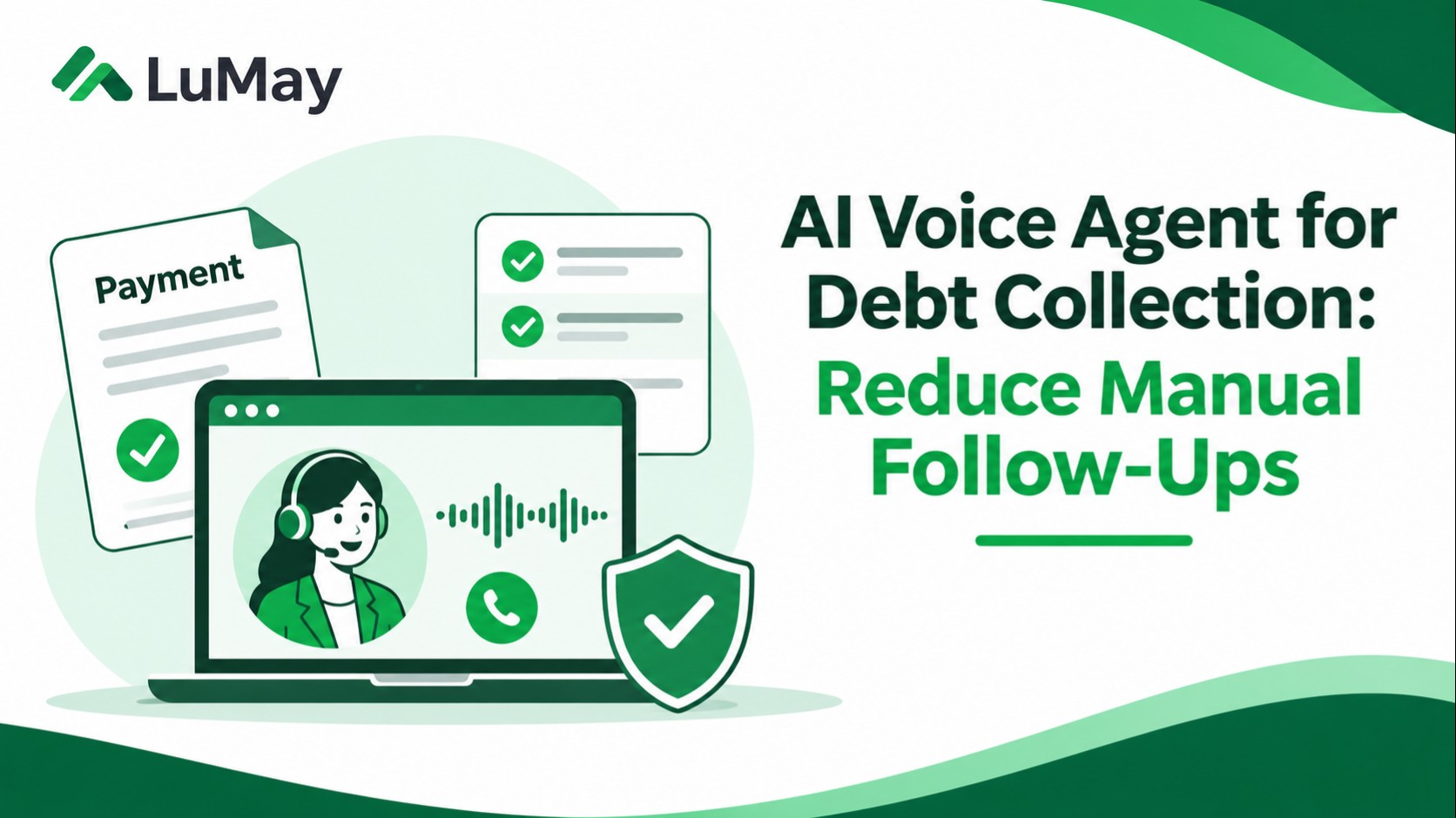
Debt-collection teams spend time making follow-up calls, answering routine account questions, recording contact outcomes, and routing disputes. A conversational system may support those tasks—but the real challenge is not making more calls. It is making only permitted, accurate, appropriately timed, respectful, and auditable calls.
An AI voice agent for debt collection can help manage authorized payment reminders, identity-safe account conversations, callback requests, and exception handoffs. It should never be deployed on the assumption that an AI-generated voice makes debt-collection or telephone-consent rules irrelevant.
What does an AI voice agent for debt collection do?
It is a conversational telephone system connected to approved account data and workflow rules. Depending on authorization, it may answer inbound payment questions, record a callback request, provide approved instructions after identity verification, relay a verified balance, or route a dispute to qualified staff.
Commercial business-to-business receivables, first-party consumer collections, and third-party consumer debt collection are not interchangeable legal categories. The applicable rules depend on the role, type of debt, place, and channel. This article gives operational planning guidance, not legal advice.
First distinguish three collections scenarios
| Scenario | Example | Required evaluation |
|---|---|---|
| Business receivables | Supplier calling a company about a commercial invoice | Contracts, privacy, applicable calling and commercial rules |
| First-party consumer servicing | Creditor reminding its own consumer of an installment | TCPA and other applicable federal/state consumer and servicing rules |
| Third-party consumer debt collection | Debt collector seeking payment of a covered consumer debt | FDCPA, Regulation F, TCPA, and applicable state rules |
Do not assume the FDCPA covers every business invoice, or that its absence means unrestricted AI calling.
Five workflows where a carefully controlled voice agent may help
1. Inbound account questions
After appropriate verification, provide permitted factual information from the authoritative system, such as a recorded payment status or where to request a statement. Do not improvise legal rights or balances.
2. Authorized payment reminders
Use approved contact preferences, call permissions, quiet hours, and status checks. A reminder should be suppressed when payment has already posted, a cease-communication request applies, or another legal or operational hold exists.
3. Payment arrangement requests
Collect a request for a callback or present only options explicitly authorized by the creditor and compliant with applicable law. Do not promise hardship approval or settlement without authority.
4. Dispute and hardship routing
Recognize expressions of dispute, inability to pay, attorney representation, wrong-party contact, or vulnerability. Record the issue neutrally and route to trained staff. Do not use emotional pressure or misleading threats.
5. Agent-assist and call summaries
Prepare an evidence-based summary for a human collector. Keep original records, timestamps, consent evidence, and verified downstream system outcomes.
Legal controls to assess before outbound calling
AI voice calls and TCPA consent
The FCC's February 2024 declaratory ruling confirms that TCPA restrictions for artificial or prerecorded voices encompass AI technologies generating human voices. Whether a particular call is permitted depends on the law's requirements, consent, exemptions, destination, and other facts. Obtain qualified legal analysis of the proposed program before launching it.
Call frequency and harassment
For covered consumer debt collectors, the CFPB explains that Regulation F uses rebuttable presumptions, not a universal seven-call entitlement or absolute cap. Calls more than seven times within seven consecutive days about a particular debt, or within seven days after a telephone conversation about it, can trigger a presumption of violation unless an exception applies. Even a call pattern below that threshold may be unlawful if it is harassing or abusive. See the CFPB's Debt Collection Rule FAQs.
Identity, privacy, and third-party disclosure
Do not announce debt details to someone who simply answers the phone. Apply verified-party checks and controls for voicemails, workplaces, shared phones, attorney representation, and other communication restrictions.
Debt validation, disputes, and cease requests
Covered collectors must follow applicable validation and dispute processes. The FTC's debt collection guidance explains consumer rights and the need to provide validation information. A system that hears “this is not my debt” should not continue a routine payment script as though nothing changed.
State law, recording consent, and security
State debt-collection rules, call-recording consent, data retention, access controls, licensing, and sector-specific obligations can be material. The agent must use current approved policies for each relevant jurisdiction.
A safer system architecture for collections calls
- Eligibility gate: confirm account, jurisdiction, communication permission, suppression flags, current status, and applicable time/frequency restrictions before dialing.
- Call setup: identify the caller appropriately and follow applicable disclosure and recording requirements.
- Identity verification: withhold protected account facts until the correct person is established under the approved process.
- Grounded dialogue: retrieve only authorized account data and approved scripts or policy content.
- Exception detection: recognize disputes, wrong-party contact, stop requests, hardship, representation, and uncertainty; suspend ordinary collection flow and escalate.
- Permitted action: request callback, provide approved payment-channel instructions, or create a review task; never invent a transaction or promise.
- Post-call verification: record the outcome and confirm any authorized system update, with controls for failures or duplicate actions.
For engineering and permission design, see LuMay's enterprise AI integration requirements and AI agent retry, stop, and escalation guide.
Worked example: an authorized reminder with an unexpected dispute
Illustrative scenario, not a legal opinion or customer result. Assume a collections operation has obtained the required legal review and documented permission to contact a particular account at a permitted time. The system checks the current payment status and applicable suppressions before placing the call.
After any required identification and verification, the person says, “I already paid this. Stop asking.” Instead of negotiating or repeating payment demands, the agent records the dispute, stops the ordinary reminder path, generates an appropriate human review task, and applies required communication controls. The ERP remains the source of truth; the conversation alone does not prove that payment posted or that a debt remains owed.
Metrics beyond outbound volume
| Metric | What to verify |
|---|---|
| Eligible contact rate | Calls with correctly validated permission and suppression checks |
| Verified-party contact rate | Appropriate identity resolution without wrongful disclosure |
| Dispute routing quality | Correct detection, routing, and follow-up |
| Complaint and opt-out rate | Consumer treatment and suppression performance |
| Payment outcome | Confirmed posted payments, not unsupported verbal promises |
| Human escalation | Successful handoff, context quality, and resolution |
Include both operational and consumer-protection measures. A higher dial volume is not evidence of better collection performance.
Questions to ask a debt-collection voice AI vendor
- How are consent, suppression, contact-time, and frequency rules enforced across phone numbers and debts?
- Can the system distinguish first-party, third-party, consumer, and commercial accounts?
- How does it verify identity before disclosure?
- What happens when the consumer disputes, asks to stop, or requests a human?
- Can it prove the exact approved data and policy version used during a call?
- How are wrong-party calls, wrong balances, payment uncertainty, and recording consent handled?
- Can reviewers pause the system and inspect complete audit trails?
- How are permissions, model changes, prompts, and regression tests managed?
How to start without creating unnecessary risk
Start with a legal and compliance review of a narrowly defined workflow. Validate the phone channel and the system of record, create scenario tests, exercise dispute and stop paths, use representative but protected data, and limit automation authority. Consider inbound, information-only use cases before high-stakes outbound campaigns where appropriate.
The point of an AI voice agent for debt collection is not to replace judgment or increase pressure. It is to make authorized routine communication more consistent while keeping sensitive decisions and exceptions accountable.
Frequently Asked Questions
Q1: What is an AI voice agent for debt collection?
A: A conversational system that can handle authorized collections-related calls, provide approved account information after verification, record responses, and route exceptions. Its use must comply with applicable laws.
Q2: Can an AI voice agent legally call people about debt?
A: That depends on the debt, collector role, jurisdiction, call purpose, telephone technology, consent, and other rules. Legal review is essential before outbound deployment.
Q3: Does the FDCPA apply to every business collecting unpaid invoices?
A: No. The FDCPA primarily regulates covered debt collectors collecting consumer debts; other rules may govern first-party collections and commercial receivables.
Q4: Can AI voice calls bypass TCPA consent requirements?
A: No. The FCC has clarified that AI-generated human voices fall within TCPA artificial or prerecorded voice restrictions; applicable consent requirements and exemptions must be evaluated.
Q5: How often can a debt collector call?
A: For covered consumer debt collection, Regulation F establishes rebuttable call-frequency presumptions, including more than seven calls in seven days about a particular debt and calls within seven days after a conversation, subject to exceptions.
Q6: Can the agent disclose an overdue balance immediately?
A: It should verify the appropriate party and follow disclosure restrictions before discussing protected debt details.
Q7: What should happen if a person disputes the debt?
A: The system should accurately record and route the dispute, stop or restrict further collection activity as legally required, and follow the applicable validation process.
Q8: Can an AI agent negotiate a settlement?
A: Only under explicitly approved legal and business rules; unusual terms or hardship cases should go to authorized specialists.
Q9: Can a voice agent take a payment?
A: It may route to an approved, secure payment system, but should avoid collecting full sensitive card data in ordinary transcripts and follow payment security controls.
Q10: What happens if the borrower asks for a human?
A: Offer timely transfer or callback and preserve the conversation context without pressuring the person to remain with automation.
Q11: How do you measure collection voice-agent performance?
A: Track verified contacts, appropriate resolutions, disputes routed, consent compliance, complaints, erroneous disclosures, and verified payments rather than promises alone.
Q12: How is collections AI different from a generic outbound sales agent?
A: Collections requires stricter identity, contact, conduct, disclosures, dispute, audit, and customer-treatment controls; sales outreach workflows are not an adequate template.
Sources and further reading
See the CFPB Regulation F FAQs, FTC debt collection FAQ, and FCC AI voice/TCPA declaratory ruling. This article is general information; obtain legal advice for the exact collection operation and jurisdictions.