Agentic Automation With Measurable Outcomes: Prove Business Value
Agentic automation becomes expensive when the organization measures activity instead of outcomes.
An agent can execute thousands of steps, call multiple tools and complete long chains of work while still failing to create meaningful business value.
The right question is not:
How autonomous is the agent?
It is:
Which business outcome changed, by how much, at what operating cost and within what risk boundary?
Why Agentic Automation Needs a Different Business Case
Traditional automation often targets stable, repetitive work.
The business case is straightforward: calculate transaction volume, time saved and implementation cost.
Agentic systems can handle more variable work. They may interpret context, choose actions, use tools, recover from failures and ask for human help.
That creates more value possibilities — and more measurement complexity.
AWS's October 2026 guidance on agentic automation argues that the classic RPA-style “hours saved” model misses much of the value of agents and recommends connecting each workflow to an existing business KPI, using bounded autonomy and explicit stop rules. AWS: Building the business case for agentic automation.
Measure the Workflow, Not the Agent
Start with the process the agent is supposed to improve.
Define:
Trigger → Work → Decision → Action → Outcome
For example:
Customer request → interpret issue → check account → choose resolution → perform approved action → customer problem resolved.
The agent is only one part of that chain.
Measure the end-to-end result.
Five Layers of Measurement
McKinsey's 2026 AI-value framework separates enterprise financial impact, strategic outcomes, adoption and technical enablers rather than treating model performance as the final measure. McKinsey: From promise to impact.
For an agentic workflow, a practical measurement stack looks like this.
1. Business outcome
What changed for the organization?
Examples:
- cost to serve;
- revenue conversion;
- invoice cycle time;
- order completion;
- claim processing time;
- customer retention;
- compliance exposure;
- time to resolution.
2. Workflow outcome
What changed inside the process?
Examples:
- fewer handoffs;
- shorter cycle time;
- fewer manual touches;
- lower rework;
- fewer backlog items;
- improved first-pass completion.
3. Human outcome
What changed for employees?
Examples:
- less repetitive work;
- faster review;
- fewer context switches;
- more cases handled per reviewer;
- lower escalation burden.
Do not automatically translate “time saved” into cash savings. The organization must decide how saved capacity is actually used.
4. Agent outcome
How effectively did the agent perform?
Examples:
- task success;
- tool-call success;
- correct routing;
- escalation precision;
- retry rate;
- hallucination or unsupported-action rate;
- recovery rate.
5. Operating cost
What does the workflow cost to run?
Include:
- model usage;
- infrastructure;
- orchestration;
- third-party APIs;
- monitoring;
- human review;
- incident handling;
- maintenance.
A workflow can improve quality while still being economically unattractive.
Establish the Baseline Before the Pilot
If you measure only after deployment, you cannot prove improvement.
Before building the agent, capture the current workflow.
A simple baseline table:
| Metric | Current state | Pilot target | Owner |
|---|---|---|---|
| Median cycle time | Baseline | Target | Operations |
| Manual touches per case | Baseline | Target | Process owner |
| Rework rate | Baseline | Target | Quality |
| Escalations | Baseline | Target | Team lead |
| Cost per completed case | Baseline | Target | Finance |
| Critical errors | Baseline | Guardrail | Risk |
Use the organization's actual data. Do not choose targets because they sound impressive.
Use Value Pools, Not One ROI Number
Agentic automation can create value in several places.
Capacity
Can the same team complete more work?
Speed
Does the process complete faster?
Quality
Are fewer cases corrected or reopened?
Revenue
Does the workflow improve conversion, retention or realization?
Risk
Does it catch policy violations, missing information or exceptions earlier?
Experience
Does the customer or employee complete the task with less friction?
Treat these as separate value pools before combining them into an economic case.
Define a Stop Rule Before You Scale
One of the strongest ideas in AWS's agentic-automation business-case guidance is a predefined stop rule.
Before the pilot begins, state what would cause the organization to stop or redesign the workflow.
Examples:
- critical error exceeds tolerance;
- cost per case exceeds the approved ceiling;
- reviewer corrections remain too high;
- escalation rate does not improve;
- integration failures exceed the operating threshold;
- users bypass the workflow;
- the target business KPI does not move.
A stop rule protects the organization from continuing a technically interesting project that is not creating enough value.
Measure Autonomy as a Risk Decision
More autonomy is not always better.
A useful model is:
Low risk + strong evidence → more automated action
Higher risk + weak evidence → more human review
Track where the agent operates autonomously and why.
For example:
| Action | Default mode | Reason |
|---|---|---|
| Retrieve approved data | Automated | Low-risk, reversible |
| Draft recommendation | AI-assisted | Human verifies |
| Update internal field | Automated if validated | Bounded write |
| Approve payment exception | Human approval | Material financial impact |
| Send sensitive legal response | Human approval | High-risk external action |
This makes autonomy measurable and governable.
Build an Outcome Instrumentation Plan
Every production agent should emit enough information to reconstruct the workflow.
Capture:
- request ID;
- task type;
- source systems used;
- tool calls;
- success/failure;
- retries;
- escalation;
- reviewer action;
- final outcome;
- operating cost;
- timestamps.
Then connect that execution record with the business KPI.
Without that link, teams end up with technical dashboards that cannot explain value.
A 6-Week Agentic Automation Pilot
Week 1: Choose the workflow
Use a clear prioritization framework.
LuMay's AI Use Case Prioritization Framework can help separate high-value workflows from attractive demos.
Week 2: Baseline and risk model
Define current performance, approval points and unacceptable failures.
Week 3: Build the bounded workflow
Connect only the systems required for the use case.
Keep the first autonomy boundary narrow.
Week 4: Test normal and failure cases
Test:
- missing data;
- contradictory data;
- unavailable tools;
- slow dependencies;
- permission denial;
- repeated failure;
- ambiguous requests.
Week 5: Controlled production
Run a limited volume with human oversight.
Capture execution and business outcome data.
Week 6: Value review
Compare the pilot with the baseline.
Decide:
scale → redesign → stop
Do not convert every successful experiment into a production program automatically.
Business Outcomes vs. Technical Metrics
Both matter, but they answer different questions.
Technical metrics: Is the agent functioning?
Workflow metrics: Is the process improving?
Business metrics: Is the improvement valuable?
A production program needs all three.
Gartner's 2026 research similarly argues that leaders need evidence-based narratives connecting AI to business outcomes, not only technical milestones. Gartner: Focus on the true value of AI.
What to Put in the Executive Dashboard
Keep the executive view small.
For each agentic workflow, show:
- business KPI;
- baseline;
- current performance;
- operating cost;
- major quality/risk metric;
- adoption/volume;
- decision: scale, hold, redesign or stop.
Executives do not need every prompt trace.
Operators do.
The Real Goal Is Accountable Automation
Agentic automation is valuable when it improves a business process while staying inside a controlled operating boundary.
That requires:
- a baseline;
- a named outcome;
- a process owner;
- a risk owner;
- measurable workflow performance;
- operating cost;
- a stop rule;
- an evidence trail.
The organization should be able to explain not only what the agent did, but why the workflow deserves to continue receiving investment.
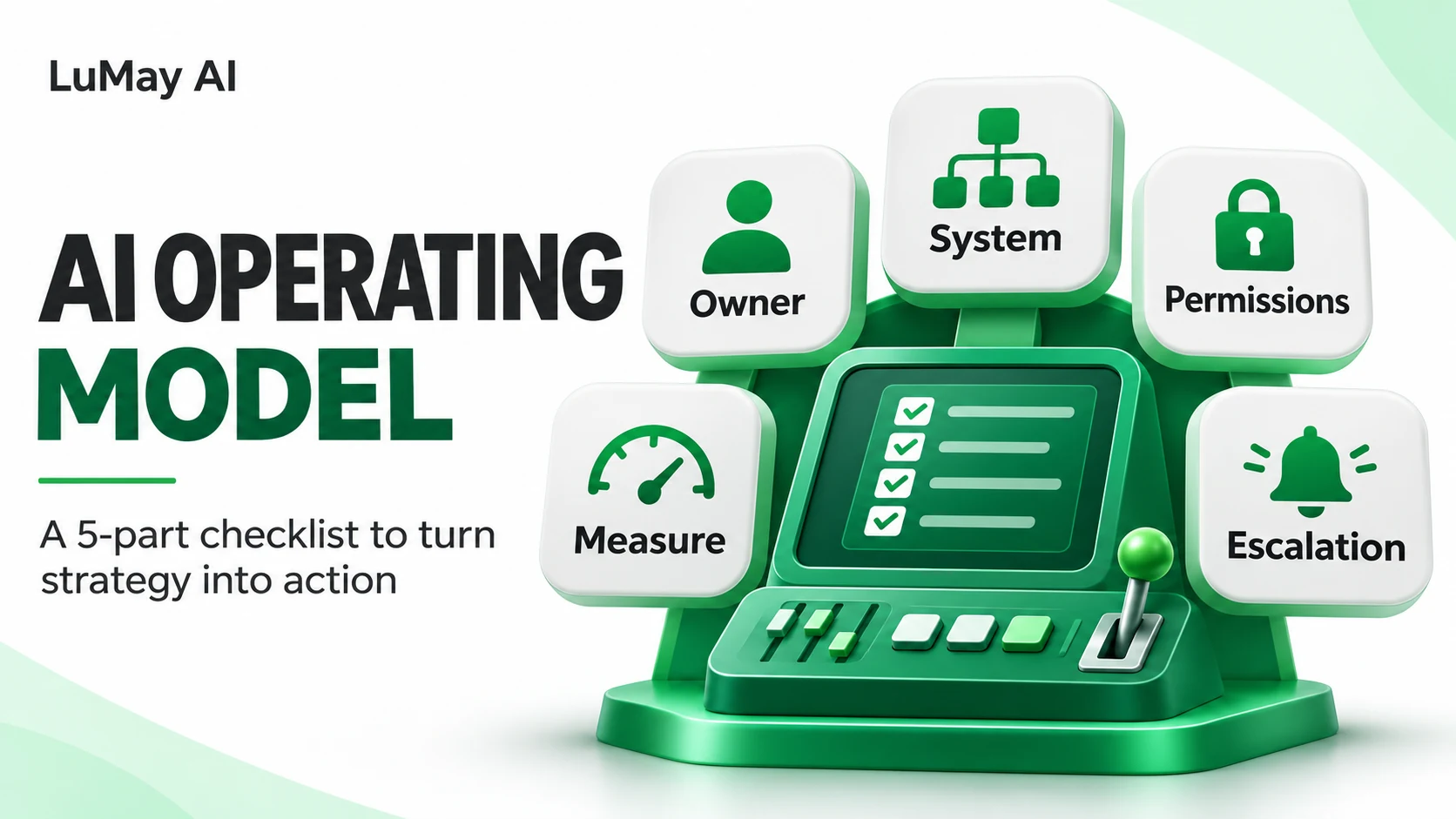
For teams moving from pilot to an operating model, LuMay's AI Operating Model Checklist provides a companion framework for ownership, permissions, measurement and escalation.