It is easy to show an AI assistant answering a question in a demo. It is much harder to prove that the same assistant uses permitted data, respects enterprise policies, handles failures, stays within budget, and produces a trustworthy result every day.
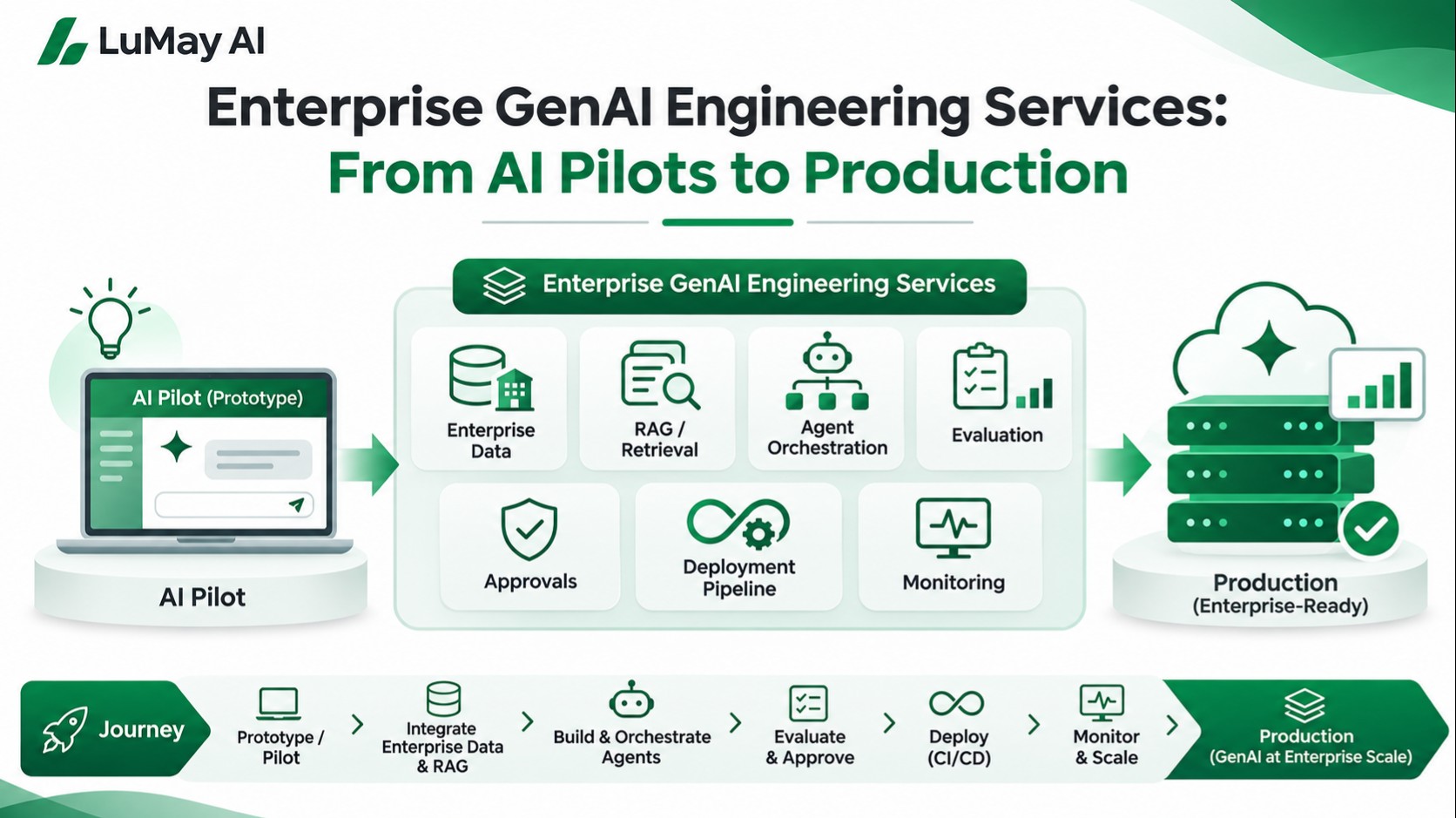
Enterprise GenAI engineering services bridge that gap. They turn promising generative AI prototypes into governed applications with reliable retrieval, integration, testing, release processes, monitoring, and accountable operations.
A production GenAI system is not simply a model with a better prompt. It is an engineered workflow with evidence and controlled failure behavior.
What are enterprise GenAI engineering services?
These services cover solution design, data and retrieval architecture, model and orchestration decisions, application development, identity and access controls, evaluation, tool integration, deployment, observability, security, and ongoing optimization. The intended outcome is a system whose business results can be tested and operated, not just a successful proof of concept.
AWS guidance on enterprise-ready generative AI platforms describes layered responsibilities across infrastructure, models, security and governance, and repeatable application patterns. Google Cloud's RAG reference architecture separately addresses ingestion, retrieval, serving, security, cost, and reliability.
Why do GenAI pilots stall before production?
1. The prototype has no authoritative data boundary
Uploaded files can demonstrate concept fit but do not prove that source data is current, accessible to the right people, or appropriately protected. Production needs explicit source ownership and permissions.
2. Evaluation depends on a few favorable prompts
Teams may test ten attractive examples without measuring missing evidence, ambiguous input, sensitive data, wrong tool selection, or response variability. Build a representative evaluation set tied to user tasks.
3. The agent's authority is unclear
Retrieving an account record, recommending an adjustment, and posting that adjustment are different privileges. Tool permissions and human approvals should be enforced outside the model.
4. Failure recovery is missing
Timeouts, tool errors, duplicate calls, stale documents, and partial writes will occur. Design bounded retries, idempotency where appropriate, escalation, and confirmed outcomes.
5. Cost and latency are measured too late
Long contexts, repeated retrieval, retries, and human review affect total operating costs. Set performance budgets before scale.
6. No team owns the deployed service
Models, policies, integrations, and data evolve. Production needs named owners, change management, monitoring, and response playbooks.
A reference architecture for production GenAI
The architecture should fit the workload. A common enterprise pattern contains the following layers:
| Layer | Purpose | Key control |
|---|---|---|
| User and identity | Authenticate users, preserve role and tenant context | Least privilege and audit |
| Application orchestration | Route tasks, model calls, and authorized tools | Typed contracts and execution limits |
| Retrieval or data access | Provide approved business context | Permission filters, freshness, provenance |
| Model interaction | Generate or classify outputs | Structured validation and refusal handling |
| Action and integration | Read or update systems through tools | Human gates, idempotency, confirmed results |
| Evaluation and monitoring | Test quality and observe production behavior | Regression suites, alerts, incident ownership |
Not every application needs RAG or autonomous agents. Choose retrieval when the task requires approved, changing enterprise information. Choose controlled tools when it needs structured business facts or authorized operations. A simpler deterministic workflow may be safer for fixed rules.
The seven production gates that a pilot must pass
- Business outcome: a named owner, defined workflow, baseline and target measures.
- Data and permission: approved sources, tested denial rules, sensitivity controls and update behavior.
- Quality and evaluation: representative scenarios including unsupported requests, ambiguity, missing evidence and regressions.
- Action safety: tool-specific authorization, approvals for consequential actions, bounded retries and rollback.
- Reliability: tested latency, rate limits, failover or fallback, capacity and recovery paths.
- Economics: realistic model, retrieval, hosting, support and review costs within an approved budget.
- Operational ownership: release process, monitoring, incident response, user escalation and change approval.
These are engineering decision gates, not an invented certification standard. More detailed handover artifacts appear in LuMay's AI POC-to-production engineering checklist.
Worked example: a governed enterprise knowledge assistant
Hypothetical example, not a claimed customer result. An organization pilots a GenAI assistant that answers procurement policy questions from a folder of PDF files. Demonstrations look good, but the production environment includes multiple subsidiaries, changing policies, and confidential supplier agreements.
Production engineering first defines the user's identity, region, entity, and permitted document sources. A retrieval pipeline ingests approved documents with version and effective-date metadata. The application retrieves candidate passages, applies permission filters, and returns a sourced answer—or explicitly states that evidence is insufficient.
Test cases cover outdated policies, cross-entity queries, competing versions, nonexistent policies, revoked access, and retrieval failures. Outputs are checked for supported answers, correct abstention, unauthorized disclosure, and latency. Human escalation handles ambiguous rules. Monitoring tracks retrieval misses and user corrections.
The meaningful transition is from “the model answered a demo question” to “the service can explain, test, and monitor its authorized behavior.”
How to evaluate RAG and AI agents
RAG quality: inspect the whole evidence path
Measure whether relevant sources are retrievable, selected, permissioned, current, and actually support the final answer. Improvements to the generation model cannot compensate for missing or unauthorized source material. LuMay's hybrid search guide and RAG reranking guide cover these distinct retrieval concerns.
Agent quality: verify outcomes, not intentions
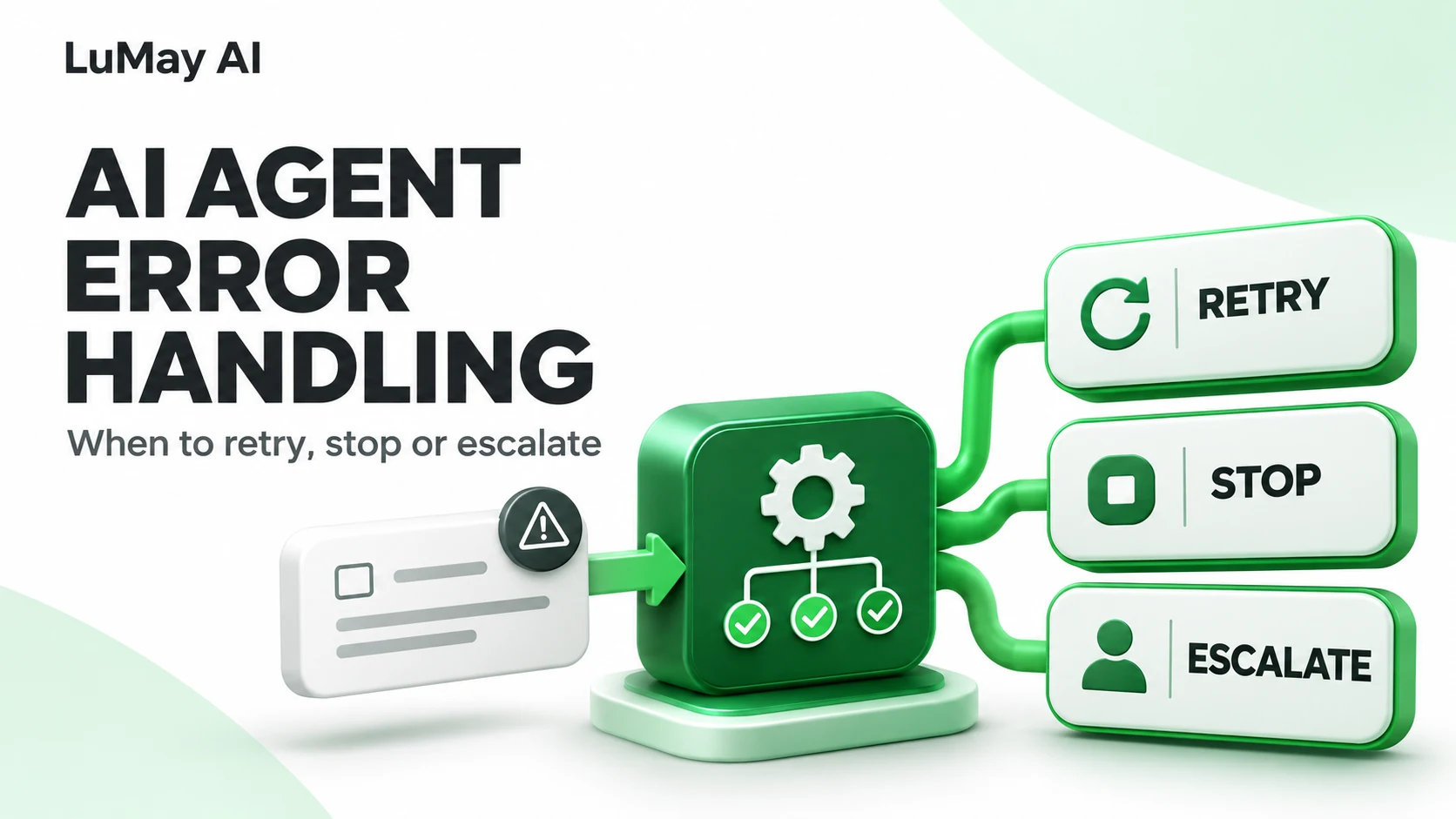
Separate a proposed tool action from a valid request, successful API response, committed transaction, and verified business state. Use step-level traces and tests for retries, permission denials, duplicates, and partial failures. LuMay's AI agent error handling guide explains when to retry, stop, or escalate.
Production cost: what should the business budget?
Total cost is not just model tokens. Account for document ingestion, retrieval services, databases, compute, testing, integration work, observability, security, human review, incident response, and re-evaluation after model or workflow changes.
Estimate by task: monthly cost = task volume × average variable cost per task + fixed platform and support cost. Variable cost should include retries and escalations. Recalculate with realistic input mixes and seasonal demand rather than one ideal prompt.
What should a GenAI engineering partner provide?
| Deliverable | What to verify |
|---|---|
| Architecture and threat model | Boundaries, data flow, permissions, failure paths |
| Source and tool contracts | Owners, schemas, versions, access controls |
| Evaluation package | Representative datasets, failure cases, pass criteria |
| Release evidence | Versioned configs, regression results, approval records |
| Operations handover | Dashboards, alerts, support owner, recovery playbook |
| Cost model | Volume assumptions, quality tradeoffs, support expense |
Ask vendors how they test unauthorized retrieval, how they prevent a model from bypassing approval controls, how they respond to an external service failure, and what operational evidence your team can inspect independently.
How to move from pilot to production responsibly
Begin with a bounded task and production acceptance criteria. Design the real source and tool interfaces early. Establish a baseline and evaluation suite. Test security and business failure cases before granting write access. Release in controlled stages with humans able to intervene. After deployment, monitor actual outcomes and re-test whenever prompts, models, source data, rules, or integration versions change.
The promise of enterprise GenAI engineering is not that every pilot should reach production. It is that teams can make an evidence-based build, revise, expand, or stop decision.
Sources and related reading
External references: AWS enterprise GenAI platform guidance; Google Cloud RAG infrastructure architecture; NIST AI Risk Management Framework.