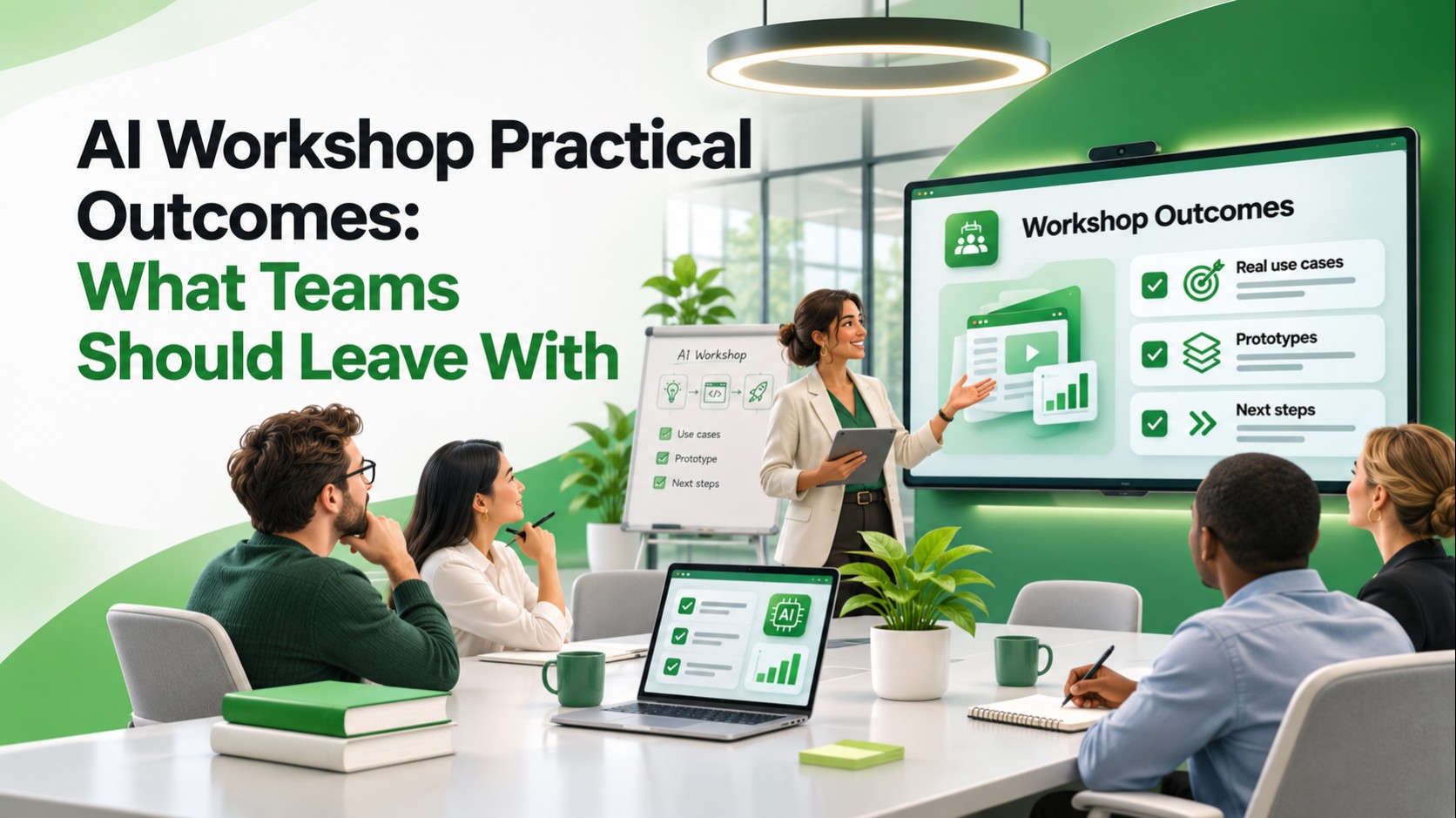
AI Workshop Practical Outcomes: What Teams Should Leave With
A successful AI workshop should not end with employees saying, “That was interesting.”
It should end with something they can use.
The most useful workshop outcomes are practical artifacts, repeatable skills and clear next actions tied to real work.
For an enterprise team, that might mean:
- an approved prompt template;
- a completed workflow exercise;
- a review checklist;
- a use-case shortlist;
- a risk/escalation decision tree;
- a team action plan;
- a measurable follow-up task.
The workshop should change what participants can do after the session.
What Is a Practical AI Workshop Outcome?
A practical outcome is evidence that a participant can complete a useful task, evaluate the result and apply the method again.
That is stronger than:
- attendance;
- completion certificate;
- satisfaction score;
- number of prompts written.
Those metrics may describe the training experience.
They do not prove capability.
The 5 Outcomes Every Enterprise AI Workshop Should Target
1. Participants can perform one real work task
Choose a task relevant to the audience.
Examples:
Managers: turn meeting notes into actions, owners and risks.
Finance: compare transactions against a reconciliation rule.
Customer service: draft a response from approved knowledge.
Procurement: compare vendor answers against an RFP.
Legal: extract structured facts with source references.
Engineering: evaluate an AI output against a test set.
The task should be realistic enough to transfer into work.
2. Participants know how to verify AI output
Generating is only half the skill.
The workshop should teach people how to inspect:
- unsupported claims;
- missing information;
- bad assumptions;
- source mismatch;
- policy violations;
- privacy risks;
- incorrect calculations;
- incomplete output.
A simple review rubric is more valuable than dozens of prompt tricks.
3. Participants understand the automation boundary
Teams should leave knowing:
What AI may do
What AI may assist with
What requires human approval
What should never be delegated
This helps translate training into safer workflow design.
4. Participants create a reusable artifact
Every workshop should produce something that survives the session.
Examples:
- prompt card;
- workflow template;
- review checklist;
- approved example;
- use-case scorecard;
- escalation guide;
- role-specific practice sheet.
A reusable artifact turns training into operating practice.
5. Participants have a follow-up action
The workshop should end with a specific next step.
For example:
“Use the approved meeting-summary workflow three times this week and record the corrections required.”
That creates evidence about whether the training transfers into real work.
Outcome-Based Workshop Design
A simple workshop design sequence is:
Outcome → Exercise → Evidence → Review → Follow-up
Outcome
What should the participant be able to do?
Exercise
What realistic task proves it?
Evidence
What artifact will they produce?
Review
How will the facilitator determine whether it is good enough?
Follow-up
How will the skill be used after the workshop?
This sequence is more useful than starting with slides.
Example: A 90-Minute Practical AI Workshop
0–15 minutes: Context and guardrails
Cover:
- approved tools;
- data rules;
- common failure modes;
- human-review expectations.
15–30 minutes: Demonstration
Show one complete workflow.
Do not show ten unrelated features.
30–55 minutes: Participant exercise
Participants complete the task independently or in small groups.
Use realistic but safe data.
55–70 minutes: Review
Compare outputs against a rubric.
Discuss errors and missing evidence.
70–80 minutes: Workflow adaptation
Participants identify how the method fits their role.
80–90 minutes: Action plan
Each participant chooses one controlled follow-up task.
LuMay's existing Generative AI Workshop: A Practical Agenda for Corporate Teams provides a broader session agenda. This article focuses specifically on what the workshop must produce.
Build a Workshop Scorecard
A workshop can be evaluated immediately and again after participants return to work.
During the workshop
Measure:
- task completion;
- output quality;
- verification accuracy;
- ability to identify a bad answer;
- ability to follow data rules;
- correct escalation.
After the workshop
Measure:
- workflow adoption;
- repeat use;
- reviewer corrections;
- cycle time;
- rework;
- manager-observed behavior change;
- percentage of participants completing the follow-up task.
For a broader measurement model, use LuMay's existing How to Measure Corporate AI Training.
Avoid the “Prompt Engineering Workshop” Trap
Prompting can be useful.
But a workshop that teaches only prompt formulas often misses the harder enterprise questions:
- Which source can I use?
- Can I upload this data?
- How do I verify the answer?
- What should I do when evidence is missing?
- Can this output be sent externally?
- Who approves this action?
- Which system should receive the result?
Practical workshops teach the whole task.
Use Bad Outputs on Purpose
Participants should practice failure detection.
Include examples with:
- invented facts;
- incomplete extraction;
- wrong tone;
- unsupported conclusions;
- stale information;
- incorrect source use;
- missing citations;
- policy violations.
Ask participants to identify the failure and decide what should happen next.
That builds review skill.
Design Different Outcomes for Different Audiences
Executives
Outcome: evaluate an AI initiative using value, risk, governance and accountability.
Artifact: decision scorecard.
Managers
Outcome: redesign one team workflow with an approved AI assistance step.
Artifact: workflow map.
Employees
Outcome: complete a role-specific task safely with AI.
Artifact: reviewed work output.
Technical teams
Outcome: build, evaluate and troubleshoot a controlled AI workflow.
Artifact: tested prototype or evaluation report.
Risk and compliance
Outcome: review a proposed AI workflow against policy and control requirements.
Artifact: control checklist.
A single workshop can serve multiple groups only if the exercises are adapted.
What Should an External Workshop Provider Deliver?
Ask for:
- pre-session needs assessment;
- role-specific examples;
- safe practice data;
- approved-tool alignment;
- exercises;
- review rubrics;
- reusable artifacts;
- follow-up plan;
- measurement approach.
Be cautious if the provider cannot explain what participants will be able to do differently after the session.
A Practical Outcome Checklist
Before approving a workshop, ask:
- What task will participants complete?
- What artifact will they leave with?
- How will quality be judged?
- What safety or governance rules are included?
- What follow-up action will happen?
- How will managers know whether learning transferred?
- What should improve in the actual workflow?
If those answers are unclear, the workshop may create awareness but not capability.
The Workshop Is the Starting Point
A workshop is useful when it creates a shared method and a practical first experience.
It is not the end of AI adoption.
The real test happens when participants return to work.
Can they use the approved method?
Can they review the result?
Can they explain when not to use AI?
Can the organization measure whether the workflow improved?
Those are the practical outcomes that make an AI workshop worth running.