AI Voice Agent for IT Help Desk: Automating Support Calls, Tickets, and Troubleshooting
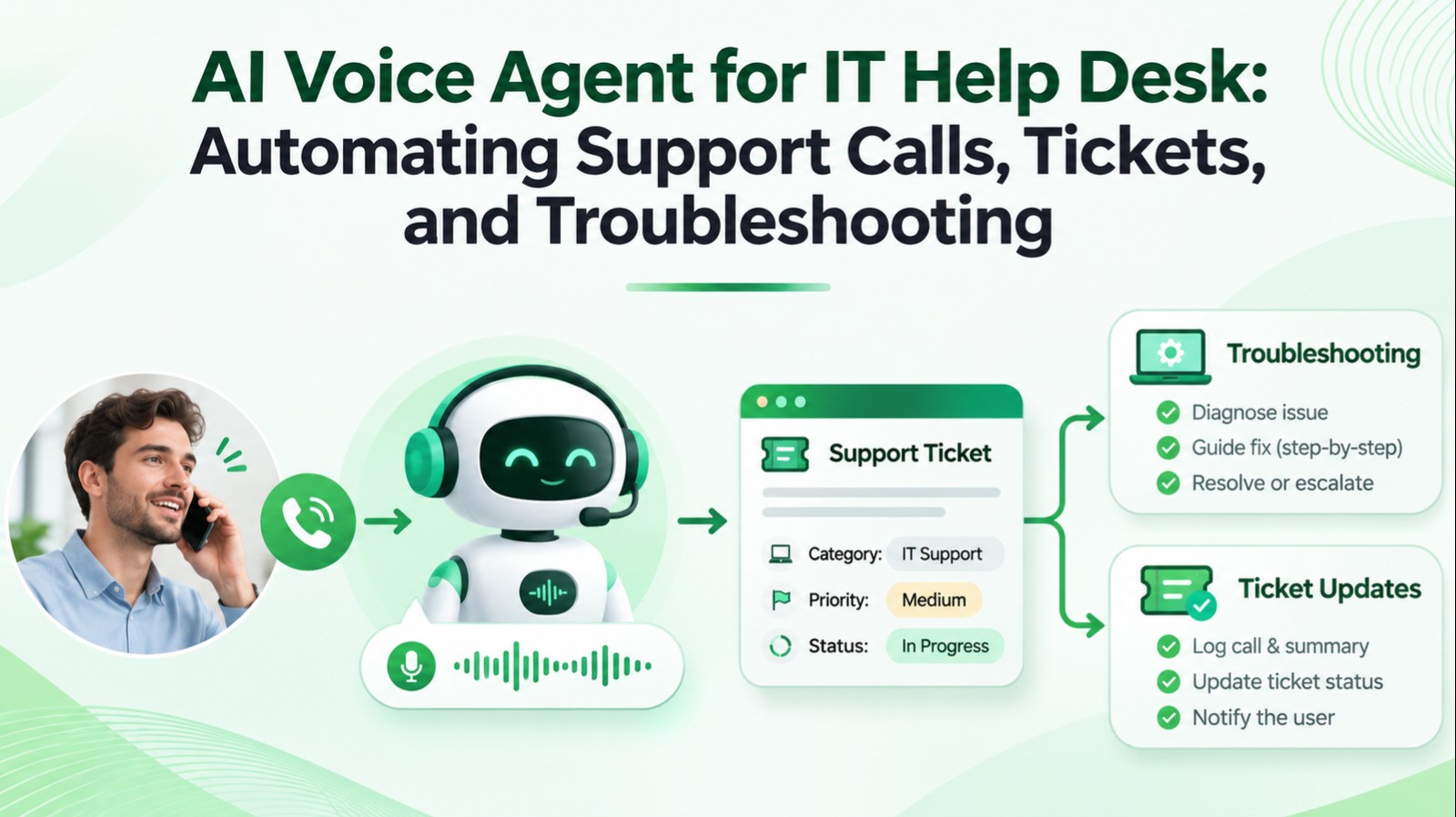
An employee calls IT because a VPN stops working. A conventional phone tree sends the employee to a queue; a well-designed AI voice agent can identify the issue, retrieve approved guidance, open an authorized service ticket and pass useful context to a technician when needed.
An AI voice agent for IT help desk operations is a telephone-based conversational system integrated with knowledge and IT service management workflows. It can support routine requests, but should not be allowed to bypass identity verification, approvals or security controls.
Which support requests are appropriate?
| Request | Possible automation | Control |
|---|---|---|
| Ticket status | Retrieve a permitted record | Verify caller entitlement |
| New incident | Collect details and create ticket | Confirm returned ticket ID |
| VPN or Wi-Fi | Guide approved diagnostic checks | Match device and environment |
| Password reset | Initiate approved recovery | Strong identity verification |
| Software access | Submit a service request | Preserve approval workflow |
| Security concern | Capture essentials and escalate | Follow incident response policy |
| Major outage | Read verified service notice | Avoid invented recovery times |
How the voice workflow operates
- Answer and classify: capture the issue category through natural conversation.
- Authenticate when needed: use approved enterprise identity mechanisms before exposing private tickets or acting on accounts.
- Retrieve approved knowledge: select documentation relevant to the current device, product version and caller permissions.
- Perform limited actions: create or update eligible ITSM records through authorized APIs.
- Confirm outcomes: communicate a ticket number only after the ITSM system returns a confirmed record.
- Transfer intelligently: provide the receiving technician with the minimum appropriate context and actions already attempted.
ITSM integration architecture
A practical architecture includes telephony, speech and language processing, an approved knowledge layer, authorization services, ITSM APIs, escalation routing and audit telemetry. ServiceNow, Jira Service Management and other ticketing systems may support integration depending on APIs, licenses and configuration.
ServiceNow publishes IT service management documentation covering incident and service workflows. Confirm current product availability and specific integration interfaces for the target deployment.
Each tool call should use structured, validated inputs and return an explicit status. A spoken statement that a ticket was created is not proof that the ticket exists.
Password resets require stricter controls
Password recovery has security consequences. The voice agent should never treat caller ID or verbal knowledge of an employee name as sufficient authentication. Instead, route the caller through the organization's approved identity or self-service recovery process.
Do not request passwords or one-time codes unnecessarily. Use least-privilege access, approval gates and auditable events for sensitive operations. A voice agent should guide this process, not invent an identity policy.
Keep the knowledge base trustworthy
Approved troubleshooting guidance should have a named owner, effective version, applicable platform, access restrictions and review process. Retire obsolete procedures. Retrieval-augmented generation can help locate relevant articles, but cannot make outdated instructions safe.
A laptop instruction for one operating system may not apply to another. Ask necessary clarifying questions and avoid risky steps when environment details are uncertain.
Escalation is part of successful design
Escalate failed authentication, privileged access requests, suspected security incidents, unresolved diagnostics, tool outages and complex cases. A successful escalation includes reaching the correct team and transferring useful authorized context—not just promising a transfer.
Track handoff completion separately from overall call containment.
How to measure results
Useful metrics include verified resolution rate, incident creation accuracy, reopened tickets, average resolution time, employee satisfaction, correct escalations, policy violations and total cost per resolved case.
Illustrative calculation: If 1,500 calls are eligible for a pilot and 900 produce verified completed outcomes, task completion is 60%. This is not a LuMay benchmark or a claim of equivalent labor savings.
Measure actual support workload and rework before estimating savings.
Pilot implementation plan
Review historical ticket categories; select one narrow task such as incident creation or authorized ticket status; curate support knowledge; configure ITSM permissions; establish identity and human escalation; test ambiguous calls, accents, outages and invalid ticket numbers; then evaluate a controlled pilot.
Before buying, ask vendors to demonstrate secure authentication, confirmed ITSM transactions, auditable tool calls, failure recovery, human transfer, transcript protections and realistic operating costs.
LuMay AI Voice Agents can be assessed for conversational support, system-connected workflows and escalation. Validate compatibility with the organization's chosen ITSM and identity systems during technical discovery.
Conclusion
Useful IT voice automation connects an employee's spoken request to a safe, verifiable service outcome. The goal is faster, more dependable support—not just fewer calls reaching humans.