



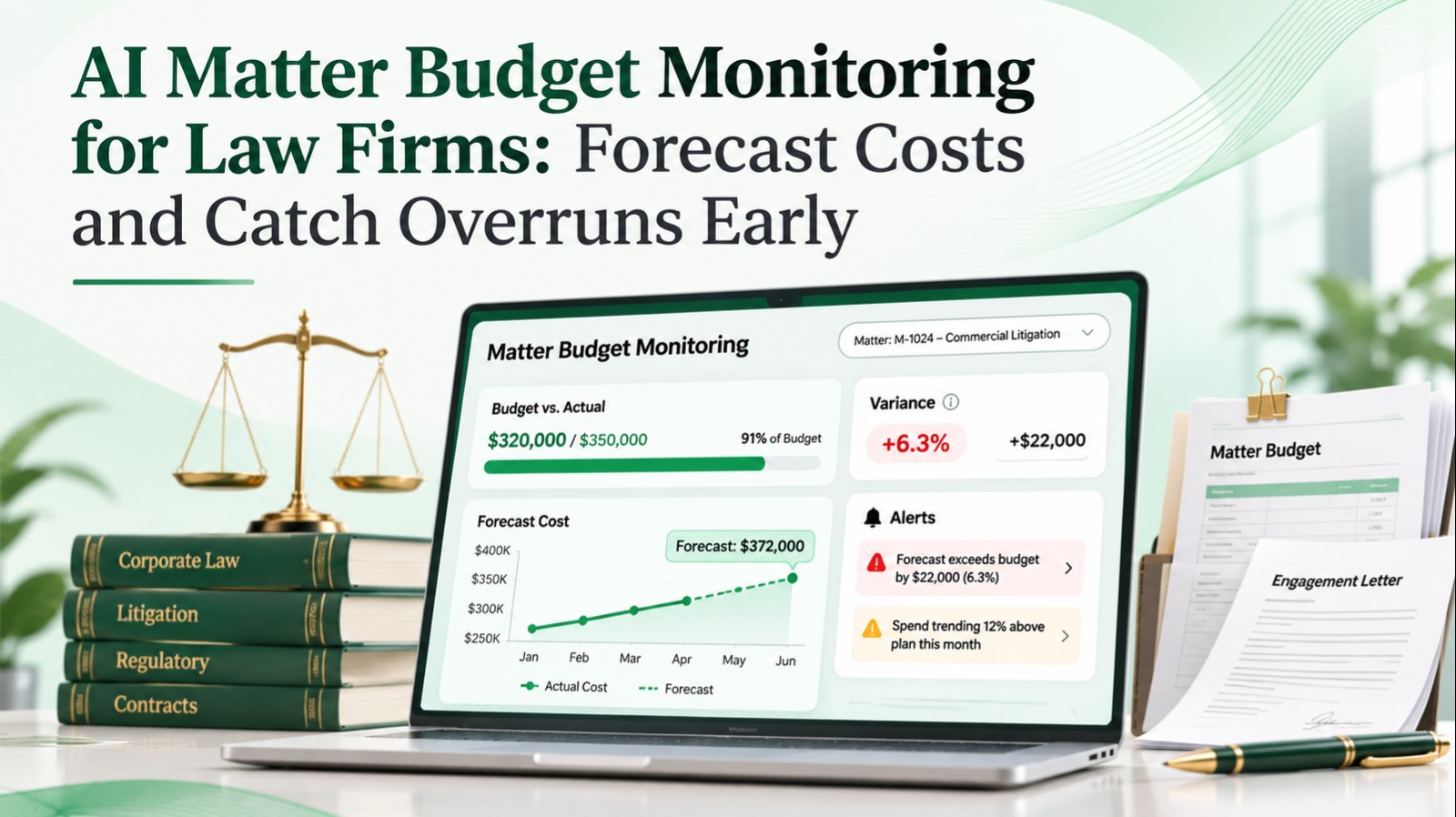
AI Matter Budget Monitoring for Law Firms: Forecast Costs and Catch Overruns Early
A law firm can deliver excellent legal work and still surprise its client with the final bill. The problem often starts earlier than invoice review: time entries accumulate, scope changes are not captured in the budget, and no one notices that a matter is trending above plan until the prebill arrives.
AI matter budget monitoring combines reliable financial data, matter-phase budgets, forecasting methods, and exception alerts to help law firms spot likely overruns while there is still time to respond. It should support—not replace—the judgment of matter partners, pricing teams, and finance leadership.
This guide is for law firm CFOs, pricing directors, legal operations leaders, and financial systems teams who need a practical implementation and procurement framework.
What is matter budget monitoring?
Matter budget monitoring compares expected legal fees and expenses with commitments, work in progress, billed amounts, and anticipated work remaining. The goal is to reveal deviations early enough to revise scope, staffing, pricing, or client communications.
A useful system distinguishes five amounts:
- Original budget: The approved baseline, including phase allocations.
- Current approved budget: The baseline plus documented scope changes.
- Actual fees and expenses: Amounts already recorded and eligible for comparison.
- Work in progress (WIP): Unbilled work that may affect the forecast.
- Estimate at completion (EAC): Expected total cost when the matter finishes.
These amounts should not be merged casually. Different firms include or exclude disbursements, taxes, write-downs, or contingencies; the definition must be stated on every dashboard.
Why traditional monthly reports catch problems too late
Month-end reporting is important, but a large matter can incur substantial WIP between reviews. A partner may see last month's billed amount without seeing current unbilled work, approved time that has not posted, or a new discovery phase.
The American Bar Association's 2026 practice guidance recommends reviewing budget versus actuals weekly for larger matters and keeping clients informed when variance emerges. See the ABA's financial management guidance.
Better visibility can reduce surprises. It does not automatically guarantee higher realization or stronger margins.
Six building blocks of an AI-assisted matter budgeting workflow
1. Normalize the source records
Bring matter ID, client, phase, task, timekeeper, rate, WIP, posted fees, expenses, write-downs, and budget versions into a governed data model. Reconcile timestamps and currencies before calculating trends.
If time entries are classified inconsistently, a sophisticated forecast merely gives a polished answer to bad input.
2. Preserve approved budget versions
Keep the original and current budgets separate. Store who approved the change, when it took effect, the amount, and the reason.
Never silently overwrite an original estimate when scope expands; otherwise the firm loses the ability to explain why the estimate moved.
3. Map spend by phase and task
A litigation matter might budget separately for pleadings, discovery, depositions, motions, trial preparation, and trial. A transactional matter may use diligence, drafting, negotiation, approvals, and closing.
Phase-level information reveals which activity is driving the variance. The Colorado Bar Association's legal project management guidance discusses the value of task and phase coding for meaningful budget comparisons.
4. Estimate remaining work
A simple forecast can use actual spend plus partner-reviewed estimated remaining work. More advanced methods can consider historical matter patterns, staffing plans, milestone completion, and phase-specific cost curves.
An AI forecast must disclose its assumptions. If there are too few comparable matters, or the current matter differs materially from prior work, show uncertainty instead of a precise-looking number.
5. Trigger explainable variance alerts
An alert should identify the matter, relevant phase, budget version, actuals and WIP, proposed forecast, likely drivers, and the person responsible for review.
An arbitrary percentage threshold should not be treated as universal. A 10% overspend on a small fixed-fee matter may need a different response from a 10% projected variance on a large contingent project.
6. Route the decision to an accountable owner
The agent may suggest "review discovery staffing" or "confirm whether the client approved expanded scope." It should not autonomously change approved rates, revise budgets, send sensitive notices, or commit contractual concessions without explicit authorization.
The essential matter budget formulas
Budget variance = Actuals to date − Budgeted amount for the comparable work or period.
Forecast variance = Estimate at completion − Current approved total budget.
Forecast variance percentage = Forecast variance ÷ Current approved total budget × 100, when that denominator is meaningful and nonzero.
Estimate at completion = Actual fees and expenses to date + Estimated remaining fees and expenses.
Use consistent inclusion rules. Comparing billed fees against an all-in budget with expenses creates misleading numbers.
Worked example: a discovery phase overrun
Assume an illustrative matter with an approved total budget of $500,000. The system shows $310,000 of eligible incurred fees and expenses. The matter team expects another $240,000 to finish.
EAC = $310,000 + $240,000 = $550,000.
Forecast variance = $550,000 − $500,000 = $50,000, or 10% above the current approved budget.
This is a hypothetical calculation, not a LuMay customer outcome. The actionable question is not merely "Why 10%?" It is whether the additional work reflects a client-approved scope change, poor coding, staffing mix, unexpected litigation events, or an inaccurate estimate of remaining work.
Where AI adds value—and where rules are better
Use deterministic controls for authoritative calculations, rate and budget permissions, transaction reconciliation, and approval enforcement.
Use AI-assisted analysis to summarize likely causes, compare comparable phase patterns, prioritize exceptions, and translate financial data into an understandable review brief.
A predictive model can rank matters at risk of overruns, but the final decision should retain human ownership. Historical data can reflect outdated rates, unusual case mixes, or inconsistent billing practices. Record forecast versions and compare predictions to subsequent outcomes.
Integration considerations for Elite 3E and similar systems
For firms using Elite 3E or another financial platform, establish an integration design with the system owner. It should cover approved access paths, refresh frequency, matter and timekeeper identifiers, currencies, WIP and invoice states, adjustment histories, and master-data ownership.
Do not assume a generic connector can perform every required operation. Confirm available APIs, permissions and data semantics with the specific vendor and implementation.
Consider read-only reporting and alerts before permitting budget edits or workflow writes.
A sample alert decision table
| Condition | Review action | Responsible role |
|---|---|---|
| Phase spend exceeds planned pace | Confirm work completed and remaining | Matter manager |
| Forecast exceeds approved budget | Review scope, staffing and estimate | Partner / pricing |
| WIP rises while milestone progress stalls | Investigate narratives and workflow delays | Finance / matter team |
| Budget has no current approved version | Request baseline clarification | Pricing / finance |
| New scope appears in matter notes | Determine whether a formal change is needed | Partner |
| Data refresh fails | Mark forecast stale; suppress unsupported certainty | Financial systems |
Treat thresholds and ownership as organization-specific policy choices.
What to require in a vendor demonstration
Ask the vendor to show the same matter through a normal month, a sudden scope change, and a data refresh failure. Require it to preserve original budgets, expose every forecast assumption, enforce matter permissions, and show who approved decisions.
Evaluate:
- Budget versioning and phase/task support.
- Reconciliation to the financial system.
- Visibility into WIP, write-downs and expenses.
- Forecast explanations and uncertainty.
- Configurable, actionable alerts.
- Audit trails and change approvals.
- Role-based data access.
- Reporting and export capabilities.
- Backtesting against completed matters.
- Implementation and operating costs.
A polished dashboard alone cannot establish predictive accuracy.
A 30–60–90 day rollout framework
Days 1–30: Choose one practice area, identify the authoritative budget fields, review historical coding quality, and define budget ownership and variance terminology.
Days 31–60: Launch a read-only dashboard on a limited matter cohort. Reconcile against finance reports and have partners label true and false alerts.
Days 61–90: Introduce versioned forecasts, escalation rules and a weekly review cadence. Compare projected overruns against realized outcomes before expanding.
These are illustrative implementation phases, not guaranteed deployment times.
How this relates to LuMay Legal Agents
LuMay AI develops governed AI workflows for legal and financial operations. Matter budget monitoring is a useful candidate for combining financial system data, exception detection, evidence-backed explanations, and human review.
For adjacent topics, read LuMay's guide to financial reports for Elite 3E firms and its revenue leakage risks overview. Those articles address reporting and revenue risks; this guide focuses on active matter forecast control.
Conclusion
Matter budgeting works when the numbers are reconciled, changes are documented, and responsible lawyers can act before a surprise becomes an invoice dispute. AI can help prioritize and explain the signals, but sound controls and accountable decisions remain the foundation.