


AI Voice Agent Monitoring: Metrics, Quality Assurance, and Production Guide
An AI voice agent can answer every call and still fail the business. It can misunderstand a caller's details, announce that an appointment was booked when a scheduling API timed out, or fail to transfer a caller who needs a person. Uptime alone cannot detect these outcomes.
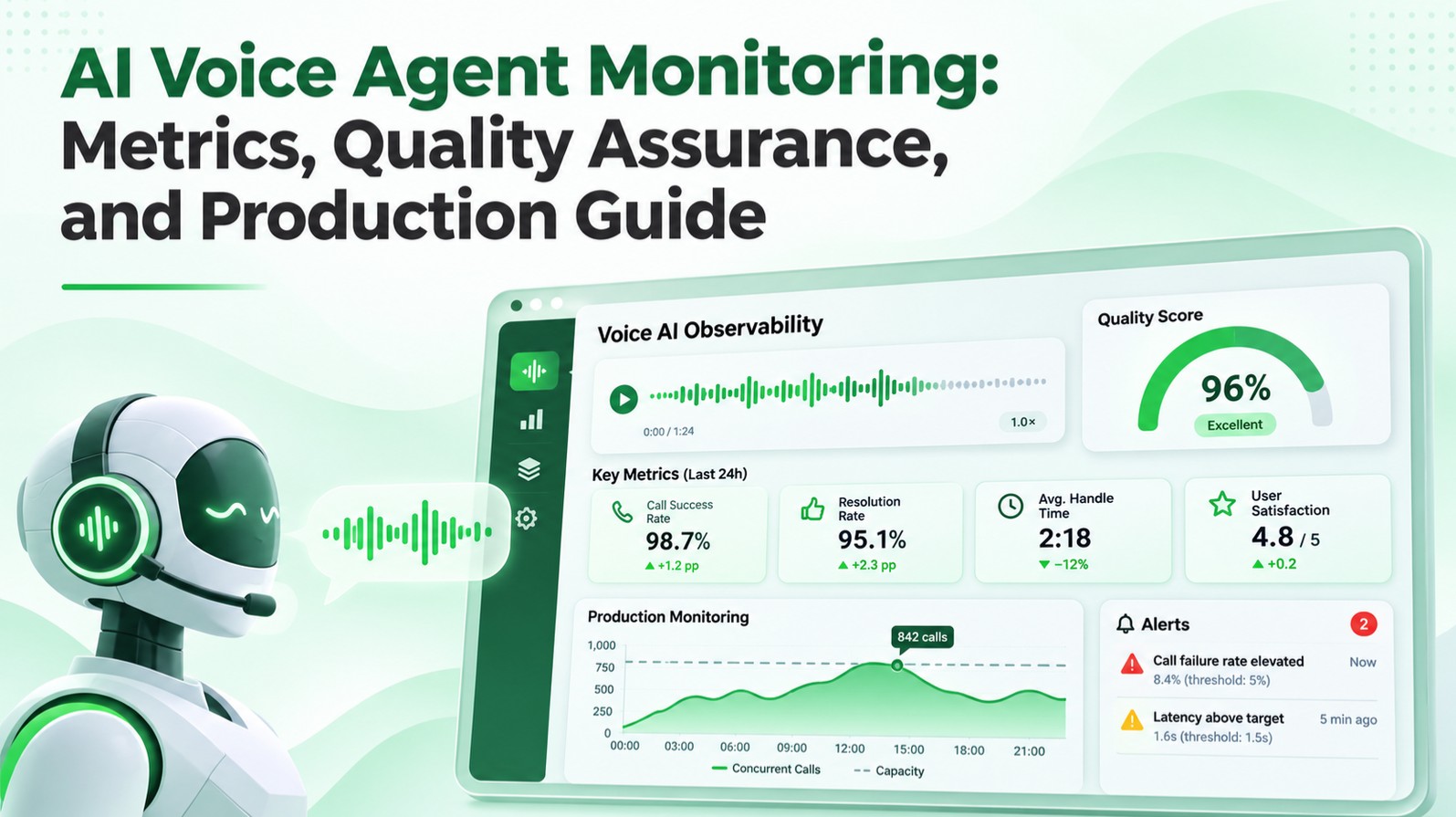
AI voice agent monitoring measures conversation quality, response timing, tool execution, caller outcomes, and operational reliability. Its core principle is to correlate each spoken promise with the authoritative system action.
Why monitoring must go beyond uptime
A healthy telephony connection says little about whether a business workflow succeeded. To assess real performance, measure four layers together:
| Layer | What to measure | Typical failure |
|---|---|---|
| Infrastructure | Connection failures, transport health, availability | Call drops |
| Voice processing | Speech recognition, model and synthesis latency | Long silence |
| Conversation | Intent understanding, turn-taking, instructions | Repeated question |
| Business action | Tool authorization, committed records, transfers | False booking confirmation |
Use one session or call identifier to connect these layers. Logs without correlation force operations and engineering teams to investigate the same failure separately.
10 metrics that matter
1. Verified task completion rate
Divide successful, confirmed business outcomes by eligible task attempts. A completed conversation is not necessarily a completed booking or resolved request.
2. Time to first audible response
Record the elapsed time from the end of a caller turn to the first audible response. Define the boundary consistently and track p50, p95 and p99, not just the average.
3. Speech recognition accuracy
Test names, numbers, dates, references and domain vocabulary. Word error rate is useful on labeled tests, but a single wrong appointment date may be more consequential than harmless transcription differences.
4. Tool execution success
Distinguish attempted, succeeded, rejected, timed out and uncertain business operations. Confirm results from the source system.
5. Intent recognition
Review whether the agent correctly classifies an appointment change, cancellation, inquiry or escalation request.
6. Interruption recovery
Measure whether callers can correct or interrupt the agent without losing context. Distinguish real barge-ins from noise-induced false interruptions.
7. Human handoff success
A safe transfer can be the right outcome. Measure completed transfers, lost context, and callers forced to repeat information.
8. Dead-air events
Correlate unexpected silence with audio events, model calls and blocked backend tools rather than treating every pause as the same defect.
9. Policy adherence
Evaluate authorization, disclosures, confirmation steps, and limits on sensitive actions. Deterministic permissions must back up prompt instructions.
10. Verified resolution rate
Track resolved, pending, transferred, abandoned and unresolved outcomes separately.
Build three complementary dashboards
Engineering: pipeline traces, latency percentiles, provider outages, errors and concurrency.
Operations: confirmed tasks, failed bookings, unresolved requests, transfers and callback queues.
Governance and quality: evaluated calls, policy incidents, exceptional actions and reviewer findings.
Each dashboard should drill down to appropriately access-controlled evidence rather than merely displaying a score.
Trace the entire voice pipeline
For a conventional composed architecture, the sequence may involve telephony, voice activity detection, speech-to-text, LLM inference, business-tool calls, text-to-speech, audio playback and post-call recording. Instrument timestamps and error outcomes for each segment. Real-time speech-to-speech systems may use a different architecture, so adapt the instrumentation accordingly.
Microsoft's voice-agent observability documentation describes relevant voice turns, traces and evaluation concepts. OpenTelemetry offers a general framework for telemetry instrumentation. Do not put secrets or unrestricted personal information into traces.
A practical QA scorecard
An illustrative weighting could allocate 20% to intent recognition, 30% to verified outcome, 15% to conversational clarity, 15% to correct escalation and 20% to workflow adherence. These values are an example, not an industry benchmark.
Override weighted scores for serious failures such as unauthorized disclosures, incorrect transaction confirmations or unsafe refusal to escalate. Human reviewers should validate automated judgments on meaningful samples.
Detect and respond to failures
Alert on rising tool timeouts, failed transfers, unusual tail latency, repeated requests for the same information and discrepancies between spoken confirmations and system records. For each class, specify an incident owner, severity, fallback and resolution test.
Regression tests should include accents, noise, interruption, ambiguous dates, invalid identifiers, back-end downtime and unavailable transfer targets. Incorporate safely handled production failures into future test sets. Audio-based failures cannot be adequately evaluated from transcripts alone.
Evaluating a monitoring solution
Buyers should ask whether it correlates calls with tool events, distinguishes attempted from committed actions, provides p95/p99 latency, supports searchable incident traces, controls transcript access, exports data, and provides auditable reviewer decisions. Compare total instrumentation effort as well as the interface.
LuMay AI Voice Agents can be evaluated in the context of governed conversation workflows and system integrations. Confirm deployment-specific monitoring, data retention and reporting capabilities during solution review.
Conclusion
The strongest voice-agent monitoring program measures whether authorized, intended outcomes actually happened—not merely whether the agent sounded confident.