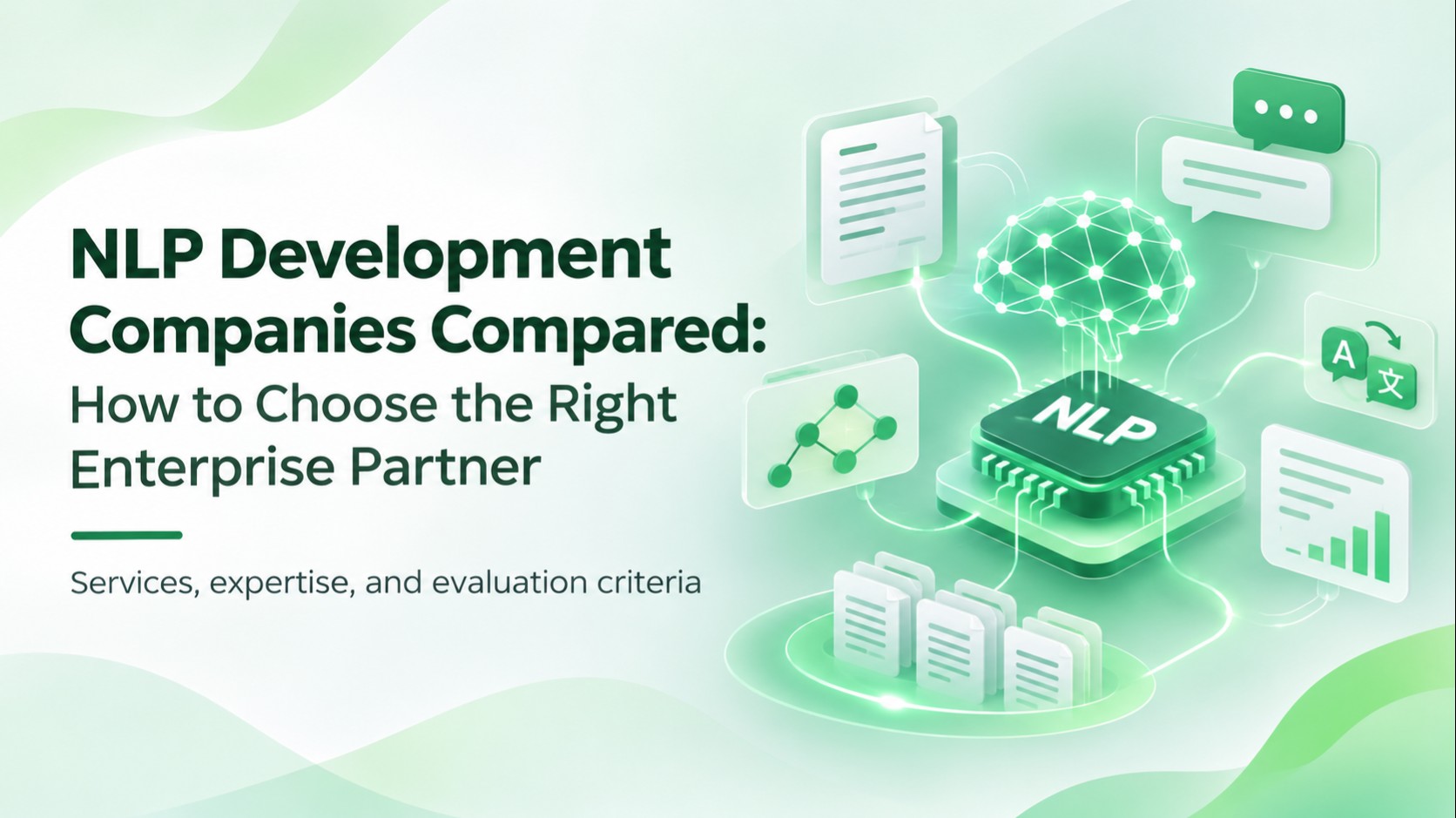
An NLP development company should be able to prove that its system works on your language, documents, and business rules. A polished chatbot demonstration is useful, but it does not establish whether the same provider can classify a difficult support ticket, extract a contract date correctly, or respect access restrictions in production.
For enterprise buyers, the practical choice is between providers with different strengths: document processing, custom language applications, or broader machine-learning delivery. Start with a defined task and a representative evaluation set, then compare the services needed to move that task into your existing workflow.
NLP development companies at a glance
This is an unranked, research-based shortlist. Capabilities were checked against the official pages linked below on November 11, 2026. LuMay publishes this guide and includes its own offering. We have not conducted hands-on comparative testing or independently audited these providers’ delivery results. “Consider for” describes our assessment of fit, not a performance ranking.
| Company | Publicly described scope | Consider for | Main question before shortlisting |
|---|---|---|---|
| DICEUS | NLP document processing, chatbots, speech recognition, and custom solutions | Projects combining language processing with business applications | Can the proposed team demonstrate the same document types and integration requirements? |
| SoftTeco | NLP strategy, custom development, model adaptation, and production support | Custom language applications requiring an engineering lifecycle | What evaluation, deployment, and monitoring work is included in the quoted scope? |
| LuMay | NLP capabilities within machine-learning development, supported by AI integration services | Buyers evaluating a custom language component within an enterprise workflow | Which specific language tasks, connectors, and acceptance tests will the engagement include? |
How this shortlist was assembled
We included companies with accessible official pages describing relevant development services. We compared service scope, the surrounding delivery lifecycle, and the questions buyers need answered before committing. This is a focused starting point rather than an exhaustive market directory.
Company websites establish what a provider advertises. They do not establish comparative accuracy, implementation quality, security certification scope, or suitability for a particular organization. Verify those matters through a written proposal, evidence review, and a pilot using your own approved data.
Provider profiles: where to begin the conversation
DICEUS: language processing within custom applications
DICEUS’s NLP services page describes document processing, speech recognition, chatbot development, and custom NLP solutions. Its published process includes discovery, feasibility assessment, planning, development, integration, and testing.
Consider DICEUS when a language task needs to become part of a wider business application. Ask for a relevant example showing the input, expected output, exception handling, and downstream system interaction. A proposal should identify the people responsible for language evaluation as well as application integration. Buyers seeking only a self-service software subscription should clarify whether a development engagement is necessary.
SoftTeco: custom NLP with lifecycle support
SoftTeco’s NLP development offering includes strategy and architecture, custom software, model adaptation, monitoring, and maintenance. Its published scope makes it a candidate for buyers who want to assess both implementation and continuing operational support.
Ask the team to separate the work needed to adapt a model from the work needed to operate the application. Request proposed release tests, monitoring responsibilities, and the process for handling terminology changes. Buyers wanting a fixed, immediately available product should confirm the extent of customization and its implications for delivery.
LuMay: NLP within enterprise machine-learning delivery
LuMay’s machine-learning development services include NLP capabilities within a broader development lifecycle. Its AI integration services provide a relevant next step when language outputs need to connect with existing systems.
Consider LuMay for a scoped discussion about a custom language workflow. Bring examples of the documents or messages involved, the business decision being supported, and the systems receiving the result. Confirm deliverables, deployment constraints, ownership, and acceptance criteria in the proposal. This guide does not establish a comparative accuracy advantage or a packaged NLP product.
Define the language task before comparing proposals
“We need NLP” is too broad to price or evaluate consistently. Replace it with a task that produces a recognizable outcome.
| Task | Useful output | Evidence to request |
|---|---|---|
| Classify incoming messages | A category and routing decision | Results for each important category, including rare cases |
| Extract document fields | Structured values with source references | Field-level correctness and treatment of missing or ambiguous values |
| Search internal knowledge | Relevant authorized results | Retrieval tests and permission checks |
| Summarize documents | A supported, usable summary | Review of factual consistency, omissions, and source traceability |
| Analyze customer feedback | Themes or sentiment labels | Agreement with reviewed examples and performance across relevant languages |
These tasks may require different architectures. Some can use existing models or conventional machine learning. Others may benefit from an LLM, retrieval, or a combination. Require the provider to explain the simplest approach it will test before proposing extensive model training.
The distinction matters commercially: a proposal for document classification should not automatically become a proposal for a conversational assistant.
Evaluate a provider on a shared test set
A useful evaluation set contains representative normal cases, difficult cases, and examples where the correct response is to request review. Keep part of that set separate from development so the final evaluation measures generalization rather than repeated tuning against known answers.
For classification and extraction, agree which errors matter most. The scikit-learn model evaluation documentation explains measures such as precision and recall. A buyer does not need to implement those measures personally, but should require a plain-language explanation of the denominator, test data, and business meaning of each reported result.
Illustrative evaluation scenario: a support team needs to identify urgent messages. Missing an urgent message and unnecessarily escalating a routine message have different consequences. Compare providers on both errors and on the resulting review workload, rather than accepting one overall accuracy figure.
Also test operational behavior: what happens when input is unreadable, a required field is absent, a model endpoint is unavailable, or a document contains instructions that conflict with the application’s task? The written design should define permitted behavior and escalation.
Compare integration, data handling, and ownership
The model is only one part of the purchase. A language system also needs a reliable route from input to action.
Before choosing a partner, establish:
- Data access: which sources can the system read, and whose permissions apply?
- Output destination: does it return a suggestion, populate a field, or initiate an action?
- Review: which outputs require a person to approve or correct them?
- Operations: who receives failure alerts and maintains integrations?
- Ownership: what happens to source code, labels, evaluation sets, and deployment configurations when the engagement ends?
Ask providers to state their proposed handling of storage, retention, model-provider access, and subcontractors. A broad security statement does not answer those project-specific questions.
For a wider procurement review, use LuMay’s AI development company selection scorecard. This article adds the NLP-specific evidence that a general company assessment cannot supply.
Make quotes comparable before discussing price
There is no single reliable price for “an NLP project.” Ask each provider to price the same task, data scope, integrations, deployment environment, and support period.
Separate discovery, data preparation, implementation, evaluation, integration, and post-launch support. Identify recurring model or infrastructure charges and whether human review is included. If the proposal assumes clean, labeled data, ask what changes when that assumption fails.
An assessment can reasonably end with a decision to improve the data or simplify the task. Treat that as a valid outcome rather than requiring every pilot to justify a larger build. LuMay’s guide to validating an AI proof of concept provides a related framework for deciding what evidence is sufficient to proceed.
What to send with your request for proposals
Give shortlisted companies the same brief: one workflow, representative approved inputs, expected outputs, error consequences, access constraints, target systems, and acceptance criteria. Ask them to return a proposed architecture, evaluation plan, responsibilities, assumptions, and itemized costs.
Then choose the team whose evidence best matches the task. If you want to evaluate LuMay, start with the machine-learning development service and use the same requirements you send to other providers.