


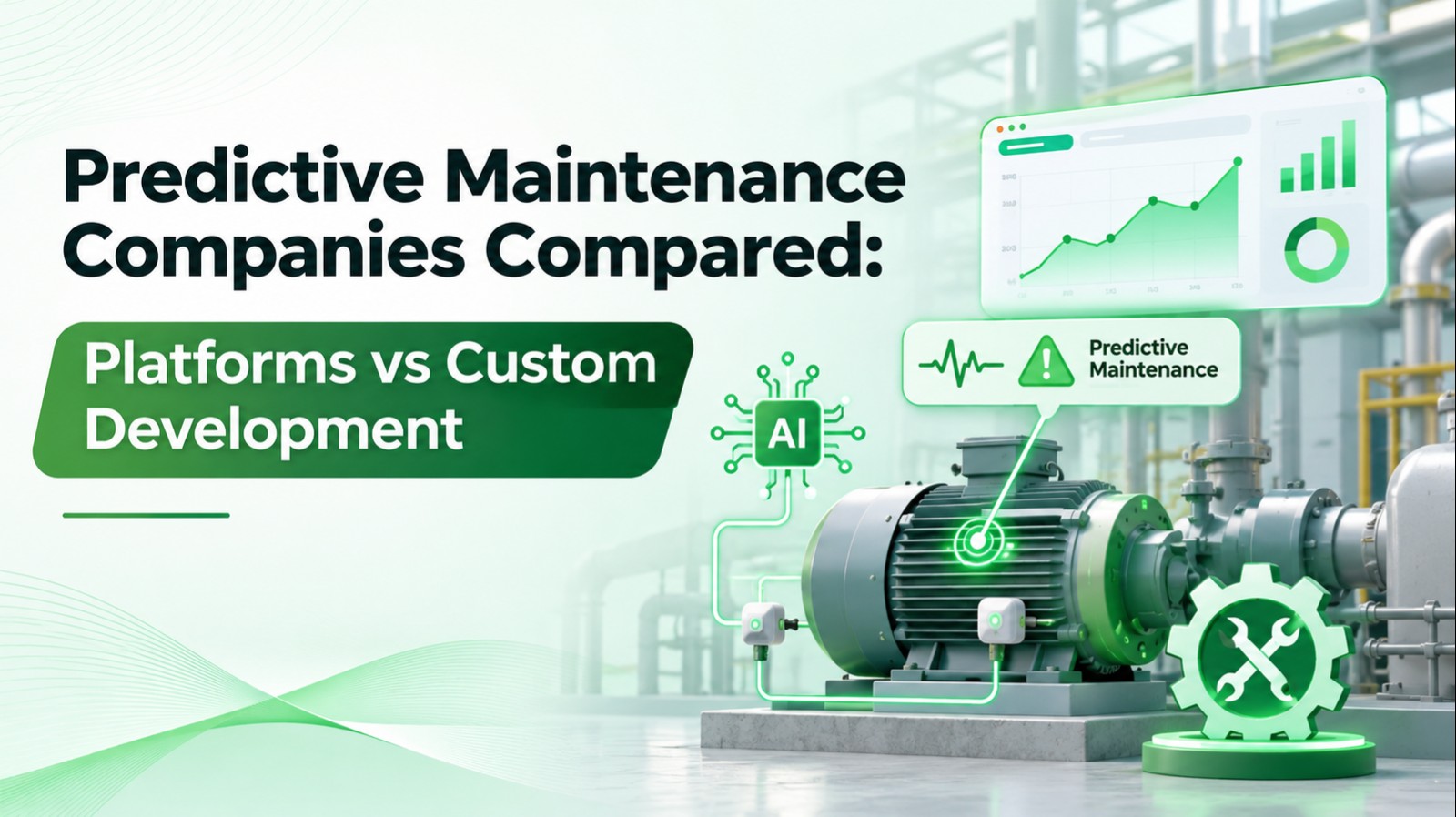
Before shortlisting predictive maintenance companies, decide what you are buying. A sensor-based machine-health service, an enterprise asset-management platform, and a custom predictive system solve different parts of the maintenance problem. Comparing them as interchangeable products can produce a shortlist that looks credible but cannot meet your requirements.
For a defined set of machines needing new monitoring coverage, evaluate a packaged machine-health offering. If predictions need to connect with a broader asset-management program, examine that platform’s maintenance workflow. If your existing data and operating requirements need a tailored implementation, assess a custom engineering engagement.
The right choice depends on equipment coverage, data availability, maintenance capacity, integration needs, and continuing ownership. Model claims alone cannot settle the decision.
Predictive maintenance companies at a glance
The options below were checked against official pages on November 11, 2026. This is an unranked, research-based comparison, not hands-on testing or an independent audit of reliability outcomes. LuMay publishes the guide and includes its own custom-development offering. Fit assessments are editorial judgments to validate for your equipment and environment.
| Company or offering | Buying model | Consider for | What to establish before buying |
|---|---|---|---|
| Augury Machine Health | Machine-health offering using sensors and analytics | Evaluating monitoring coverage for relevant industrial equipment | Supported assets, installation requirements, diagnostic scope, and response responsibilities |
| IBM Maximo Asset Performance Management | Asset-performance capabilities within the Maximo ecosystem | Connecting asset-health insights with a broader maintenance program | Required components, existing-system fit, implementation scope, and licensing |
| LuMay | Custom machine-learning development | Evaluating a tailored predictive-maintenance system | Data feasibility, specific failure modes, engineering deliverables, and ongoing ownership |
| Siemens Senseye Predictive Maintenance | Industrial predictive-maintenance approach supported by software and services | Evaluating a consistent program across assets or sites | The exact application, connectivity, services, and deployment scope proposed |
How this comparison was assembled
We selected a focused sample with official descriptions relevant to different buying models. The order is alphabetical, not a ranking. We compared the category of offering and the questions needed to establish fit.
We have not verified every supported machine, connector, commercial package, or deployment option. A capability on a website is a starting point for procurement, not proof that it is included in a specific quote. No universal downtime-reduction or return-on-investment figure is used to rank these options.
Provider profiles and practical trade-offs
Augury: assess the machine-health offering against your assets
Augury’s Machine Health page describes predictive-maintenance solutions using sensor data and analytics. It identifies inputs including vibration, temperature, and magnetic data and presents offerings for different equipment needs.
Consider Augury when you are evaluating a defined machine-health monitoring offering. Ask for an asset-by-asset coverage review and a demonstration of how a finding reaches the maintenance team. Confirm installation, diagnostic support, integration, and escalation responsibilities in the proposal. Buyers needing unrestricted ownership of a custom software system should compare those requirements explicitly with the commercial offering.
IBM Maximo: assess prediction within the asset-management workflow
IBM Maximo Asset Performance Management describes asset-health monitoring, reliability engineering, predictive analytics, and decision support connected to maintenance execution.
Consider IBM when the buying decision includes a broader asset-management program. Ask which applications and implementation services are required for your proposed use case. Validate how asset records, work processes, and available data fit the solution. A buyer seeking a narrowly scoped monitoring deployment should assess whether the wider platform and implementation requirements are proportionate.
LuMay: assess the feasibility of a custom system
LuMay’s machine-learning development page lists predictive-maintenance systems among its solutions. Its published lifecycle includes data preparation, development, integration, deployment, and continuing optimization.
Consider LuMay when you want to evaluate a custom implementation around your data and operating requirements. Request a feasibility assessment tied to named assets and failure modes. Confirm whether sensor acquisition, industrial connectivity, specialist reliability input, and ongoing support are included or require other partners. This page does not establish that LuMay supplies a packaged sensor product or supports every industrial asset.
Siemens Senseye: assess the complete proposed maintenance approach
Siemens’s Senseye Predictive Maintenance page presents industrial AI, domain knowledge, and technology intended to support maintenance across assets and sites. Its published architecture connects industrial data with analytics and maintenance workflows.
Consider Siemens when assessing a program that needs consistency across a wider asset base. Ask which Senseye application, connectivity components, and services form the proposed solution. Confirm the data path and implementation responsibilities. Buyers should evaluate the current proposal rather than assume that every capability described across the Siemens portfolio is included.
Choose a buying model before choosing a company
A packaged monitoring offering
This route can be useful when supported equipment needs instrumentation and the buyer wants a defined monitoring service. Confirm the physical installation work, communications, equipment coverage, and who interprets findings.
The trade-off is dependence on the product’s supported configurations and commercial terms. Establish data export, integration, replacement responsibilities, and what happens when a monitored asset changes.
An asset-management platform
This route can be useful when maintenance records, priorities, work orders, and asset-health information need to operate within a broader program. The buying decision extends beyond predictive modeling.
The trade-off is implementation scope. Check process changes, data preparation, platform administration, and whether required functions are part of the quoted configuration. An existing platform relationship does not remove the need to test the prediction use case.
A custom predictive-maintenance system
This route can be useful when your data sources, failure modes, interfaces, or ownership requirements need a tailored implementation. It also places more responsibility on the agreed engineering and operating model.
Ask who supplies missing inputs, validates the maintenance interpretation, operates the application, and maintains the integrations. Custom development should start with feasibility, not a promise that any collection of readings can predict failures.
Give every provider the same asset and data brief
A productive comparison begins with one shared description of your environment.
| Requirement | Information to provide | Evidence to request |
|---|---|---|
| Asset coverage | Equipment types, operating modes, and criticality | Supported scope and exclusions |
| Failure objective | The specific issue you want to identify early | Proposed detection or prediction task and its limits |
| Available inputs | Sensor readings, timestamps, maintenance records, and contextual data | Data-quality findings and missing dependencies |
| Required response | Who investigates a finding and what they can do | Alert workflow, escalation, and review responsibilities |
| System interfaces | Relevant maintenance, historian, and business systems | Data-flow design and demonstrated integration approach |
| Operations | Site access, connectivity, support, and security constraints | Deployment and support plan |
For custom integration work, scope the connection to existing systems separately. Avoid proposals that describe only a dashboard while leaving the route to a maintenance action undefined.
Evaluate alerts by whether the team can act on them
A predictive result is useful only if it arrives early enough, identifies a meaningful concern, and reaches someone able to respond. Ask what each alert means and which evidence accompanies it.
The evaluation should distinguish:
- A detected issue: what was observed and how it was confirmed.
- A missed issue: a relevant event the agreed process did not identify in time.
- A false alert: a notification that did not correspond to the agreed condition after review.
- Available lead time: the interval between a useful notification and the event or intervention point.
- Review workload: the effort needed to assess findings and close the loop.
Define these terms before comparing results. Providers can otherwise report numbers using different assets, event definitions, and observation windows. For technical discussions of classification measures, the scikit-learn evaluation guide is a useful reference; the operating definitions still need to be specific to your maintenance task.
Illustrative comparison: one proposal generates 40 alerts in a month and another generates 12. Neither count establishes superiority. Determine how many relevant issues were identified, which were missed, whether the team had time to act, and how much review each required. The example is hypothetical, not a provider benchmark.
Set up a pilot with a decision at the end
Choose assets and failure objectives that represent the intended deployment. Record the available data, existing maintenance process, and acceptance criteria before introducing the proposed system.
If historical data is used, require an evaluation that reflects what would have been available at the prediction point. If live monitoring is used, define how findings will be reviewed and recorded. An observation period with no relevant events can demonstrate data flow and operational use, but cannot by itself prove broad failure-prediction performance.
Run the pilot within the organization’s established maintenance and safety procedures. Predictions should enter an agreed review and authorization process. A model output should not silently become authority to change equipment operation.
At the end, decide whether to expand, change scope, improve the data, or stop. LuMay’s AI proof-of-concept validation guide provides related questions for reviewing the evidence before scaling.
Compare total cost and continuing responsibility
Request a proposal that separates sensors and installation, connectivity, licenses or subscriptions, data preparation, custom development, integration, analyst support, training, and continuing operation. Identify equipment replacement, site expansion, and data-export costs where relevant.
For a custom system, establish who maintains the model and application when equipment, operating conditions, or source systems change. For a platform, confirm the rights, limits, and assistance available when switching providers.
Choose the option that fits the assets, data, and team you actually have. If a custom build is a credible candidate, use LuMay’s machine-learning development service to discuss a scoped feasibility assessment against the same brief used for other suppliers.