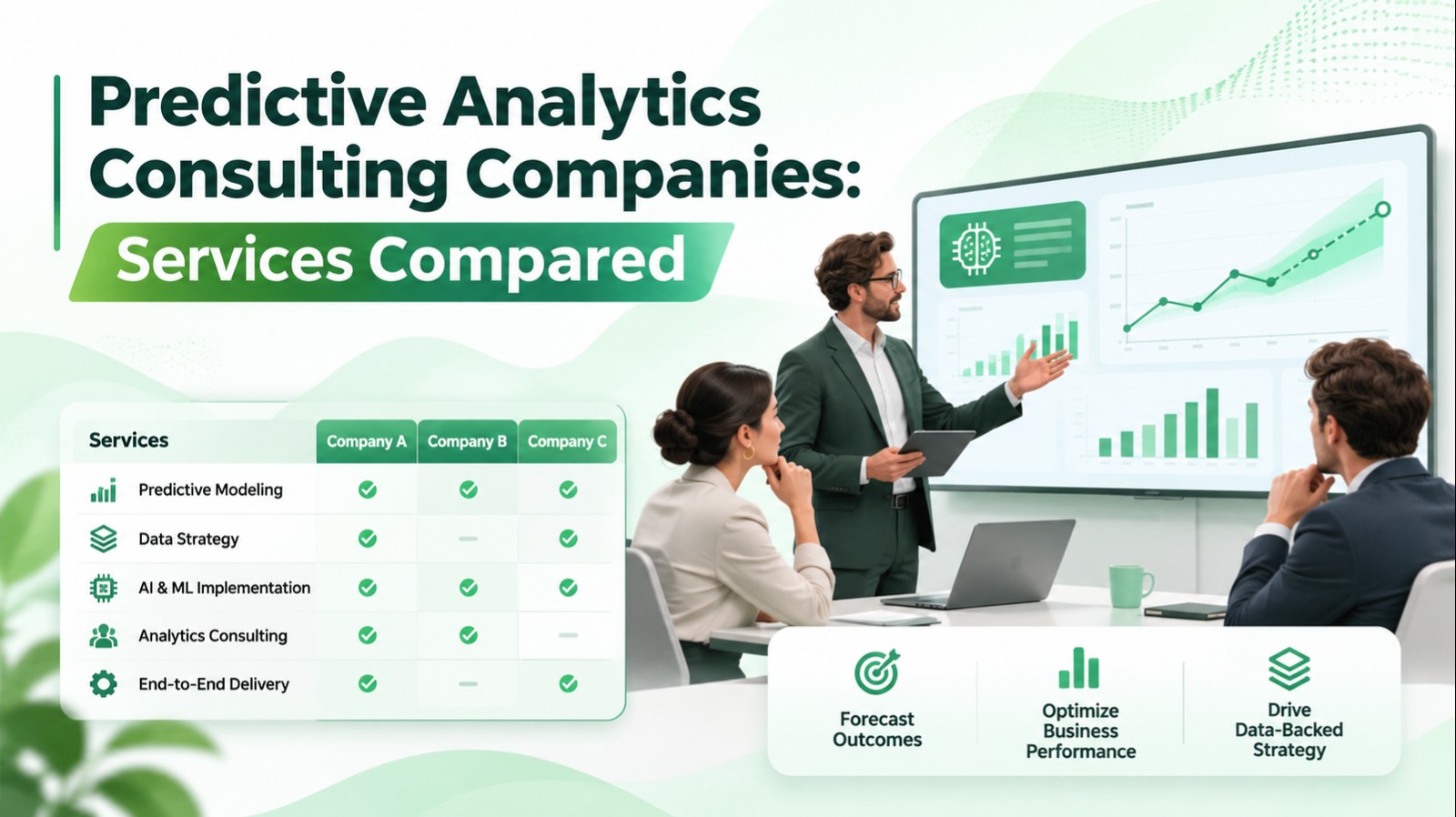
The right predictive analytics consulting company should help you make a specific decision better, then show how the model will reach the people or systems responsible for that decision. A forecast in a presentation is not the same deliverable as a monitored application your team can use.
Choose a consulting engagement around the work you need completed: assessing feasibility, building a model, integrating predictions, or operating an existing solution. Comparing firms against that scope is more useful than choosing from a list of broad AI claims.
This guide compares a focused set of providers and explains the deliverables to request before hiring. It covers consulting across predictive use cases. If your task is specifically selecting a demand-forecasting developer, use our separate AI demand forecasting development company comparison.
Predictive analytics consulting companies at a glance
This unranked shortlist uses official service descriptions checked on November 11, 2026. LuMay publishes the guide and includes its own services. This is desk research, not hands-on benchmarking, a comprehensive directory, or an independent audit of provider outcomes. The fit assessments below are editorial recommendations to validate during procurement.
| Company | Publicly described services | Consider for | What to confirm |
|---|---|---|---|
| InData Labs | Predictive analytics consulting, custom software, and model development | A scoped predictive use case requiring data-science development | Which work is advisory, which is implementation, and what is handed over? |
| Itransition | Predictive analytics implementation, integration, and support | Predictions that must become part of an existing business application | Which dependencies and production responsibilities are included? |
| LuMay | AI readiness, opportunity assessment, strategy, pilots, and implementation-related consulting | Buyers establishing feasibility and an adoption plan before a wider build | What decision, evidence, and implementation scope will each phase deliver? |
How the companies were compared
We included providers whose official pages describe relevant consulting or development services. We examined publicly stated scope and the connection between assessment, implementation, and ongoing operation. The order is alphabetical; it is not a quality ranking.
We did not score unpublished prices, independently measure model performance, or infer certifications from marketing language. Those matters require current proposals and supporting evidence. A provider can be suitable for one engagement and unsuitable for another because its delivery model, industry experience, or handover terms differ.
Provider profiles and questions to ask
InData Labs: consulting linked to predictive model development
InData Labs’s predictive analytics page describes consulting, predictive software, and machine-learning model development. Its listed applications include churn prediction, customer segmentation, dynamic pricing, and demand forecasting.
Consider it when you have a defined prediction task and want to evaluate specialist modeling support. Ask whether the proposed engagement includes data engineering, application integration, and ongoing monitoring, or whether those are separate services. Request a clear account of custom deliverables and any reusable components. Buyers seeking only a commercial software license should confirm whether a development engagement fits their needs.
Itransition: predictive analytics within a delivery lifecycle
Itransition’s predictive analytics offering describes requirements definition, data analysis, design, implementation, integration, deployment, and support. It presents applications across multiple business functions.
Consider it when your main procurement concern is taking predictions into an established technology environment. Ask who owns source-data access, interfaces, release approvals, and operational incidents. Request an architecture showing how a prediction becomes an action. Buyers needing only an initial feasibility opinion should distinguish a small assessment from a broader implementation proposal.
LuMay: readiness, use-case selection, and scoped implementation planning
LuMay’s AI consulting services describe readiness assessments, opportunity discovery, strategy, proof-of-concept work, integration, and MLOps-related consulting. Predictive analytics is among the applications listed on the page.
Consider LuMay when you need to clarify the business task and assess the path to implementation. Ask for explicit phase boundaries and measurable acceptance conditions. Where a custom model is needed, confirm the scope of machine-learning development separately. Buyers seeking a packaged analytics subscription should clarify that this is a services conversation.
Decide which consulting service you need
A useful request for proposals identifies the current gap rather than asking each firm to define a different project.
| Starting position | Engagement to request | Evidence or deliverable to expect |
|---|---|---|
| The business opportunity is unclear | Use-case and feasibility assessment | Decision definition, data review, assumptions, and a proceed/change/stop recommendation |
| The task is clear but data is fragmented | Data assessment and engineering plan | Source inventory, quality findings, access dependencies, and preparation scope |
| A model needs to be developed | Scoped modeling pilot | Baseline, evaluation design, error analysis, and reproducible results |
| A model exists but is not used | Integration and adoption engagement | Application interfaces, decision workflow, review rules, and operational ownership |
| A deployed system is deteriorating | Monitoring and improvement engagement | Diagnosis, evaluation updates, change plan, and continuing responsibilities |
Do not pay for a large implementation simply because the discovery phase found something interesting. Each phase should produce evidence that justifies the next commitment.
Require these deliverables before approving a build
A decision statement
The engagement should name the person or system using the prediction, the action it informs, and the relevant time horizon. For example, “estimate which accounts need outreach next week” is more usable than “apply AI to customer data.”
Also define the cost of different errors. Unnecessary outreach and a missed account are not equivalent. That distinction affects the model evaluation and the review workload.
A data assessment with limitations
Ask for a documented account of sources, available history, missing values, definitions, and access constraints. The consultant should identify whether a relevant outcome is recorded and whether it was actually known at the time a prediction would have been made.
This prevents a misleading evaluation built with information that becomes available only afterward. An attractive result is not useful if production will never have the same inputs.
A baseline and appropriate evaluation
Require comparison against the existing process or a simple alternative. Model complexity needs to earn its place through useful results, not through a more impressive description.
Where the task involves predicting future observations from past data, the test should respect time order. The scikit-learn TimeSeriesSplit documentation explains the problem of training on future data and evaluating on the past. The appropriate split also depends on the prediction horizon, entities, and available data; one technique does not fit every project.
Agree both technical and operational measures. A model may improve an error metric while creating more work than the team can handle. Your acceptance criteria should connect evaluation results to a feasible action.
An integration and operating plan
Specify where predictions are stored, when they are refreshed, how failures are detected, and who approves changes. Require a fallback when input data is missing or the service is unavailable.
Use AI integration services as a separate scope discussion when connecting the model to enterprise systems is a material part of the work. Do not assume an analytics dashboard includes the interfaces and controls needed for operational execution.
Compare the business case without inventing certainty
Ask every firm to distinguish expected value from demonstrated value. A pilot can establish evidence about data and model performance; it may not yet establish a realized financial return.
Illustrative business-case calculation: suppose a workflow has 400 monthly reviews, each requiring 12 minutes. That is 80 review hours. If a tested process removed 25% of those reviews without worsening agreed outcomes, the gross capacity opportunity would be 20 hours per month. Subtract additional review, monitoring, and operating effort before valuing the change. These numbers are hypothetical, not a LuMay result or a market benchmark.
The useful feature of this calculation is its explicit assumptions. Replace them with your own measurements. Avoid counting both the same saved hours and a separate productivity benefit based on those hours.
Compare costs and contract boundaries
Ask for a phase-based quote with assumptions rather than a single price for “predictive analytics.” Separate assessment, data preparation, model work, integration, deployment, and continuing support.
Clarify charges for infrastructure, external data, software licenses, specialist review, and retraining. Identify who pays when source schemas change or a new business unit is added. A lower pilot price can be less attractive if the production handover is undefined.
The contract should explain deliverable ownership, third-party dependencies, documentation, access to evaluation assets, and exit assistance. It should also identify an internal owner who can accept the work. For broader company due diligence, see LuMay’s AI development partner scorecard.
A practical way to shortlist your consulting partner
Send each candidate the same decision statement and approved data description. Ask for a proposed assessment, the evidence required to proceed, and a clear boundary between advice and implementation.
Select the firm that can explain its assumptions, show relevant evidence, and leave your team with usable deliverables. If you are evaluating LuMay, review the AI consulting service against those same criteria.