


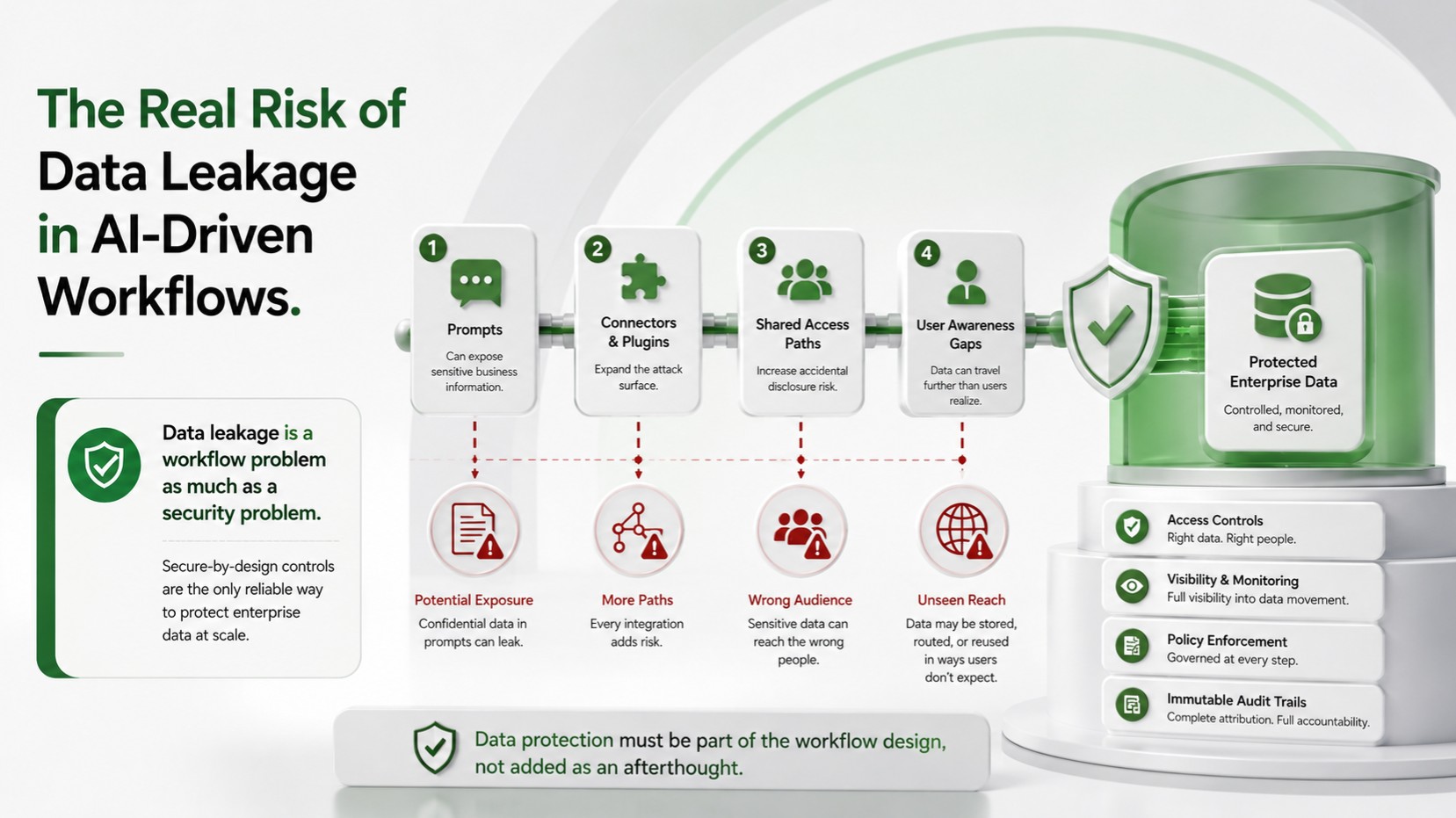
The Real Risk of Data Leakage in AI-Driven Workflows.
AI-driven workflows create new leakage paths through prompts, connectors, and shared data access that many teams underestimate. Preventing that risk requires governance and access controls built into the workflow from the start. getsecureslate+2
At LuMay we provide real-time guardrails for content safety, topic control, jailbreak prevention, and compliance with immutable audit trails with full attribution.
Prompts can expose sensitive business information.
Employees often treat prompts as temporary text, but they can contain confidential details that should never leave controlled environments. That makes prompt discipline a real enterprise security issue. getsecureslate+1
Connectors and plugins expand the attack surface.
Every integration adds another path for data to move, and every path adds risk. The more connected the workflow becomes, the more important it is to know exactly what is being exposed. xcelore+1
Shared access paths increase accidental disclosure risk.
AI tools often operate across multiple systems and user groups, which makes access control more complex. Without strong controls, sensitive data can easily reach the wrong audience. mathematica+1
Users often underestimate how far data can travel.
Many leaks happen because people do not realize how AI systems store, route, or reuse data. Training and governance are necessary to keep that risk visible. plavno+1
Data protection must be part of the workflow design.
If the workflow is designed first and secured later, leakage risk will already be embedded in the process. Secure-by-design architecture is what keeps data movement under control. onetrust+1
Trust framework callout
Data leakage is a workflow problem as much as a security problem.
Secure-by-design controls are the only reliable way to protect enterprise data at scale. getsecureslate+2


