Your company may have an AI strategy, a budget, and even a convincing prototype. Yet when the prototype needs live customer records, approved prices, or an action in the ERP, the project slows down. The real obstacle is often not the model. It is the systems around it.
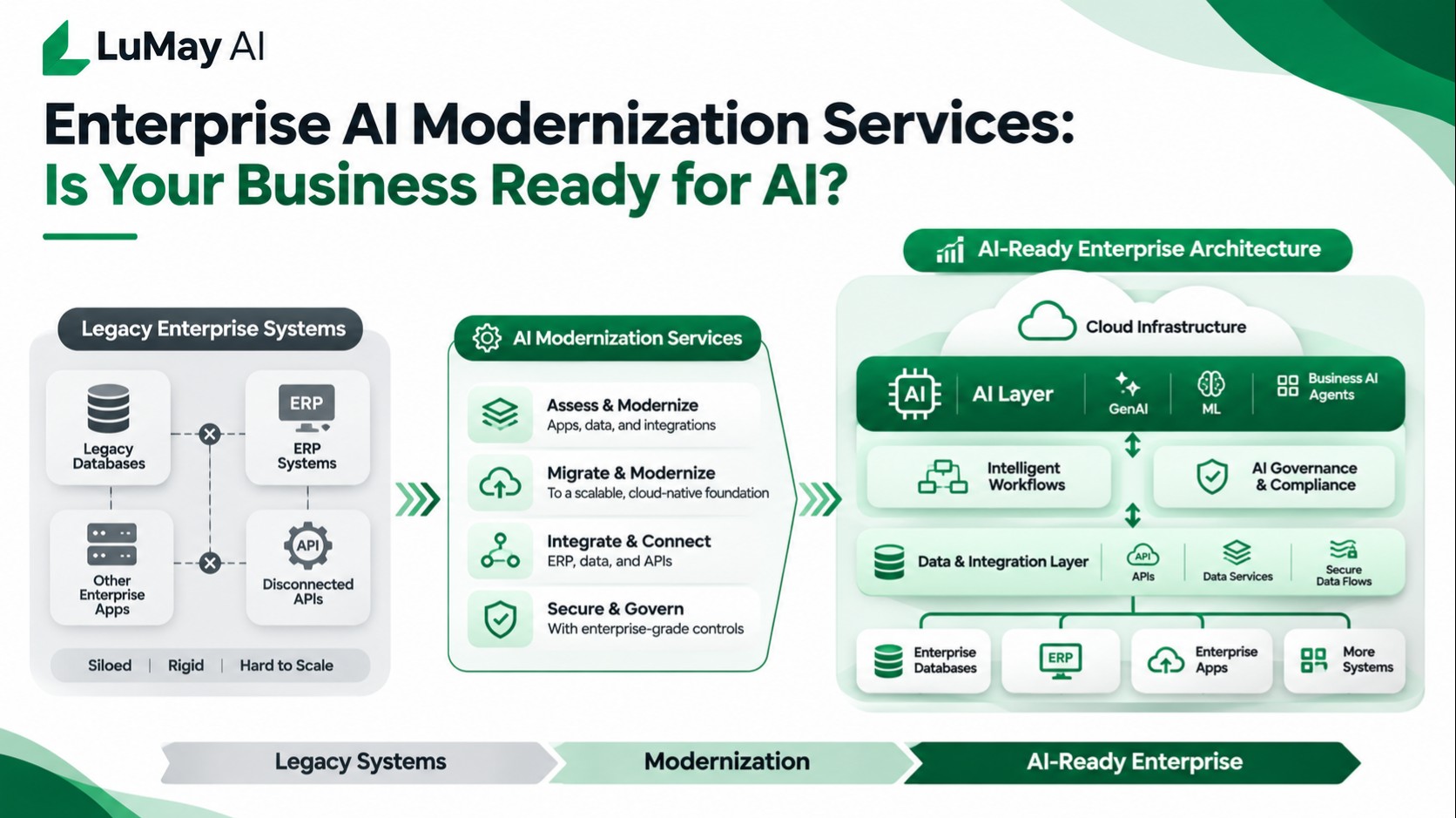
Enterprise AI modernization services help organizations make existing applications, data, integrations, identity controls, and operating processes ready for carefully scoped AI workloads. That does not automatically require replacing legacy systems or moving everything to the cloud.
The question executives should ask is not merely “Are we using AI?” It is “Can our business systems safely support the AI use case we want to operate?”
What are enterprise AI modernization services?
Enterprise AI modernization combines readiness assessment, architectural planning, data and API improvements, security design, workflow integration, migration where justified, and operational testing. The goal is a dependable path from authorized enterprise records to measurable AI-assisted outcomes.
Modernization is different from simply buying an AI model. It changes the conditions under which an application can access trustworthy information, respect business permissions, act through stable interfaces, recover from errors, and demonstrate value.
Recent reporting from Kyndryl's 2026 readiness report emphasizes that a modern-looking IT estate can still require substantial redesign to support AI at scale. Google Cloud's modernization guidance likewise highlights dependency preservation and iterative change rather than assuming a one-step migration is safe.
Six signs your business is not yet AI-ready
1. Critical records exist but cannot be accessed reliably
Customer, contract, inventory, or finance data may be held in disconnected systems or exports. Teams need authoritative data ownership, permitted access, current timestamps, and stable identifiers before claiming a model can reason over it.
2. The only integration path is manual export
If staff must repeatedly download spreadsheets and upload them to a chatbot, the workflow is fragile and may create security and freshness problems. Consider read-only APIs, approved data services, or controlled events before automating decisions.
3. Authorization stops at the user interface
Access control must be enforced in retrieval, API operations, tenant filters, and service accounts—not only in a front-end screen. The AI application should not retrieve information a user is not entitled to see.
4. Business rules live in people's heads
Approval thresholds, fee arrangements, exceptions, and escalation policies cannot be assumed from generic model behavior. Make the rules explicit, versioned, and testable.
5. There is no reliable outcome trace
A chatbot saying “updated” does not establish that an ERP committed the change. The organization needs request IDs, action logs, validation results, and confirmed system-of-record states.
6. Nobody owns the workflow after deployment
AI delivery creates recurring responsibilities: monitoring, incident response, cost review, retraining where applicable, policy changes, and user support. A pilot team cannot be the permanent operating model by accident.
An enterprise AI readiness scorecard
Use this illustrative decision tool to identify blockers for a particular workflow. Scores are not industry certification levels. Score each area from 1 (not ready) to 5 (tested and governed).
| Readiness area | Evidence to inspect | Example stop condition |
|---|---|---|
| Business value | Baseline, KPI, accountable owner | No measurable task outcome |
| Data | Source ownership, completeness, freshness, rights | Restricted or unreliable data |
| Integration | Stable APIs/events, contracts, test environment | Unsupported writes to core systems |
| Identity and security | Least privilege, audit, secrets management | Privilege escalation through AI tools |
| Governance | Human approval and exception rules | No defined action boundary |
| Operations | Monitoring, rollback, support ownership | No way to detect or reverse bad actions |
Do not simply average away a critical failure. For instance, a high total score cannot override unauthorized personal-data access. Use the scorecard to decide pilot now, modernize a dependency, redesign the use case, or stop.
Which modernization approach fits your legacy systems?
| Approach | When it fits | Principal risk |
|---|---|---|
| Wrap with governed APIs | Stable core system, missing safe integration | Weak permission or contract enforcement |
| Synchronize selected data | Approved analytics or retrieval access | Stale copies and authorization drift |
| Refactor targeted modules | One domain blocks necessary change | Hidden dependencies and changed behavior |
| Replace or replatform | Unsustainable system risk or capability gap | Migration disruption and functional regressions |
| Keep system unchanged | Good controls and interfaces already exist | Unnecessary modernization spending |
Modernization should be proportionate to the business problem. A “rip and replace” program is not inherently more AI-ready than a well-governed connection to an existing system of record.
Worked example: modernizing invoice exception review
Hypothetical example, not a claimed LuMay deployment. A finance team stores invoices in one application, approved purchase orders in an ERP, and exception approvals in email. Leadership wants AI to summarize mismatches and recommend a reviewer.
Before modernization: the model receives occasional CSV exports. Record identifiers differ, email approvals lack structure, and the model cannot verify payment status.
Target modernization: create a read-only invoice and PO access layer, reconcile identifiers, implement permission-filtered retrieval, formalize an exception queue, and expose a separately authorized approval endpoint. Each action receives a trace ID and a confirmed outcome.
What changes: the AI can assist with extraction and triage while the source ERP and approved reviewers retain authority. Measure median exception resolution time, correction effort, wrong-route incidents, and policy exceptions against the original baseline.
A six-stage enterprise AI modernization plan
- Choose one valuable workflow: define its boundaries and measure the starting outcome.
- Map systems and dependencies: identify data owners, applications, integrations, policies, and failure paths.
- Assess readiness: inspect access rights, data quality, API support, controls, and operations using the scorecard.
- Modernize only blocking dependencies: design APIs, data services, permissions, and rule enforcement appropriate to the use case.
- Validate with representative transactions: test normal, missing-data, denied-access, duplicate, stale-record, and failed-write scenarios.
- Measure and expand selectively: compare outcomes and reuse proven integration or governance capabilities across additional workflows.
For deeper technical planning, see LuMay's nine requirements for AI integration with legacy enterprise systems and guide to AI technical debt.
What should an enterprise AI modernization provider deliver?
Evaluate services by tangible artifacts, not broad promises. Useful deliverables include a dependency map, baseline and target architecture, data-access matrix, ranked remediation backlog, proof-of-value plan, test evidence, rollback strategy, operating ownership, and implementation cost assumptions.
Ask vendors which systems remain authoritative, whether they can demonstrate denied-access behavior, how they preserve business rules during migration, and whether the planned architecture can be supported by your internal team.
The relevant investment question is: What is the smallest controlled modernization that unlocks a measurable AI outcome? That is a better starting point than a general promise to “transform the enterprise with AI.”
How do you measure modernization value?
Track integration failure rate, data-access latency, permission-test coverage, manual export dependency, time to introduce a new approved workflow, operational incidents, and the actual business KPI. Costs should include infrastructure, engineering, parallel operation, security work, and ongoing maintenance.
A faster API with no change in user outcomes may be useful technical progress but should not be presented as proven business ROI.
Sources and related reading
External references: Kyndryl's 2026 readiness report; Google Cloud on iterative mainframe modernization; NIST AI Risk Management Framework.