


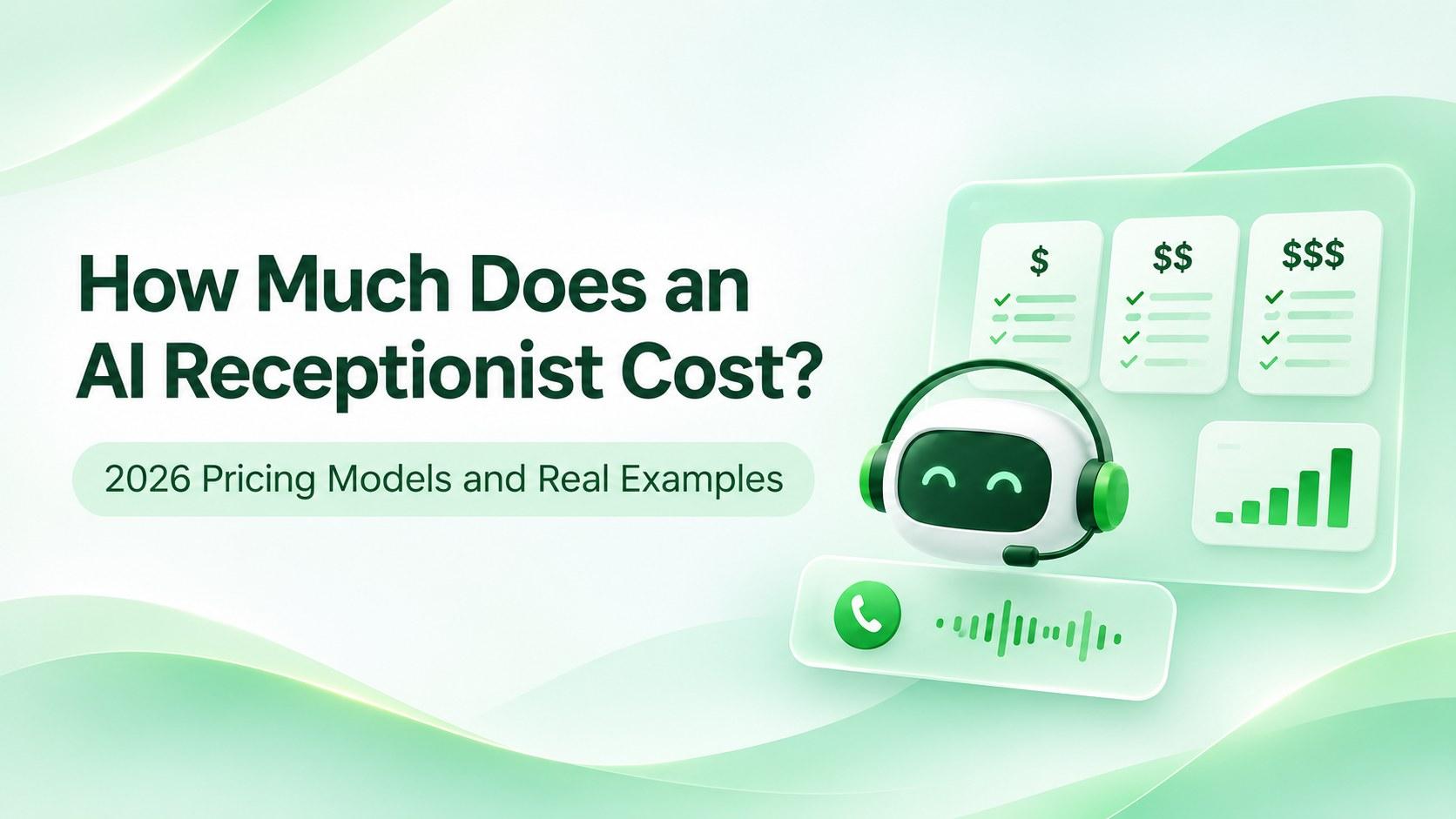
How Much Does an AI Receptionist Cost? 2026 Pricing Models and Real Examples
An AI receptionist typically costs from $0 to about $500 a month for small-business plans on published US pricing pages, checked November 4, 2026. Entry plans start at $29–$150 a month, with usage billed per minute, per call or per unique caller.
Enterprise deployments behind an existing phone system are usually quote-based, because integrations, languages and compliance needs change the price. Below are the pricing models, verified example prices, hidden costs and a worksheet to estimate your own number.
Quick answer at a glance
• Entry AI receptionist plans: about $29–$150 a month (verified examples below) • Typical overage: about $0.35–$0.48 per extra minute, or $2.00–$3.00 per extra call, depending on vendor • Human answering service: far higher per call; one verified example is $300 a month for 30 calls • Enterprise and multi-location: varies/quote-based
AI Receptionist Pricing Models Explained
Vendors price the same job in five main ways. The model matters as much as the headline price, because it decides how your bill moves when call volume changes.
• Per minute (minute bundles): a plan includes talk minutes, then charges per extra minute. ○ Best for short, predictable calls. ○ Watch for long calls, hold time and transfers counting as billed minutes. • Per call: a plan includes a number of calls, then charges per extra call. ○ Best when calls are long but few. ○ Ask whether spam, hang-ups and very short calls count. • Per unique caller: you pay for distinct people, not calls or minutes. ○ Good for businesses with many repeat callers. • Flat monthly or per seat/location: a fixed fee, sometimes per agent, per user or per location. ○ Easier to budget, but check fair-use limits. • Setup and onboarding fees: one-time or bundled into higher tiers. ○ ➤ Done-for-you setup and custom integrations are usually where quotes rise.
Verified AI Receptionist Prices (Checked November 4, 2026)
We read each price below on the vendor's official pricing page on November 4, 2026, on monthly billing. Prices change often, so confirm on the linked page before you buy.
| Vendor and plan | Monthly price | Included | Extra usage | Source |
|---|---|---|---|---|
| Dialzara Business Lite | $29 | 60 minutes | $0.48/min | dialzara.com/pricing |
| Dialzara Business Pro | $99 | 220 minutes | $0.45/min | dialzara.com/pricing |
| Dialzara Business Plus | $199 | 500 minutes | $0.40/min | dialzara.com/pricing |
| Dialzara Business Elite | $349 | 1,000 minutes | $0.35/min | dialzara.com/pricing |
| Goodcall Starter | $79 | 100 unique customers | $0.79 each | goodcall.com/pricing |
| Goodcall Growth | $129 | 500 unique customers | $0.26 each | goodcall.com/pricing |
| Goodcall Scale | $299 | 2,000 unique customers | $0.15 each | goodcall.com/pricing |
| My AI Front Desk Business-in-a-Box | $99 ($79/mo billed annually) | 200 voice minutes | Varies (credit-based) | myaifrontdesk.com/pricing |
| Smith.ai AI Receptionist Free | $0 | 25 calls | $3.00/call | smith.ai/pricing/ai-receptionist |
| Smith.ai AI Receptionist Pro | $150 | 75 calls | $2.00/call shown | smith.ai/pricing/ai-receptionist |
| Smith.ai AI Receptionist Enterprise | $500 | 300 calls | Varies by tier | smith.ai/pricing/ai-receptionist |
Other vendors either publish no price or require a quote. Treat those as varies/quote-based until you see a written proposal.
Our own product (disclosure): LuMay builds the Voxentis voice agents. Our pricing page lists Voice Agents priced on "Included minutes + overage," with a starting price of $249/mo (SaaS, monthly billing). Your exact price depends on volume, integrations and deployment. See our inbound voice agent page for capabilities. We do not rank ourselves against the vendors above.
What Drives AI Receptionist Cost
The plan price is only the starting point. These factors decide which tier you need and whether a quote is required.
• Call volume and length: the biggest driver. Minutes × calls sets your tier on per-minute plans. • Integrations: calendar, CRM, practice-management or ticketing systems. ○ Native connectors are often included; custom APIs usually cost more. • Phone system (PBX/SIP): keeping your existing numbers and routing may need forwarding, SIP trunking or IT time. • Languages: bilingual or multilingual handling may sit on higher tiers. • After-hours handling: 24/7 answering is common, but warm transfers and on-call escalation rules vary by plan. • Compliance and data retention: regulated industries may need custom retention, recording consent flows or security reviews. ○ ➤ These usually push you into enterprise, quote-based pricing.
Hidden Costs to Check Before You Sign
Most budget surprises come from line items outside the headline price. Ask each vendor about these in writing.
• Overage: per-minute or per-call charges after your allowance. • Phone numbers: local or toll-free number fees, and porting. • Setup and onboarding: done-for-you configuration, script writing and testing. • Transfers: whether transferred call time keeps billing. • Spam and short calls: whether robocalls and hang-ups count toward usage. • Annual commitments: "billed annually" discounts that lock you in. • Internal time: staff hours to write answers, approve scripts and review transcripts. • Add-ons: SMS, web chat, outbound calling or extra users priced separately.
AI Receptionist vs Human Receptionist vs Answering Service Cost
A human answering service is usually priced per call or per minute at much higher rates. Smith.ai's human receptionist plans, checked November 4, 2026, start at $300 a month for 30 calls, with $11.50 per extra call (smith.ai/pricing/receptionists).
Its Pro human plan is $2,100 a month for 300 calls. An in-house receptionist costs wages, benefits, taxes, training and cover for breaks and holidays. That total varies by city and role, so use your own payroll figures.
• AI receptionist: lowest per-call cost, 24/7, consistent scripts; weaker on complex judgment. • Answering service: human empathy and judgment; higher per-call cost. • In-house receptionist: full context and in-person duties; highest fixed cost, limited hours.
Many businesses combine them: the AI answers first and transfers complex calls to people. For a deeper comparison, see our guide to the best AI answering services for businesses.
Illustrative Example: Estimating a 300-Call Month
Illustrative example only. This is our own arithmetic on published prices checked November 4, 2026. It is not a customer result or a quote.
Assume a business receives 300 calls a month, averaging 3 minutes each (900 minutes), from about 250 different callers.
| Option | Plan used | Calculation | Estimated monthly cost |
|---|---|---|---|
| Dialzara (per minute) | Business Plus | $199 + (400 extra min × $0.40) | $359 |
| Dialzara (per minute) | Business Elite | $349, 1,000 min included | $349 |
| Goodcall (per unique caller) | Growth | $129, 500 unique included | $129 |
| Smith.ai AI (per call) | Enterprise | $500, 300 calls included | $500 |
| Smith.ai human receptionists | Pro | $2,100, 300 calls included | $2,100 |
The spread comes from the billing model, not just the vendor. Change one assumption, such as call length or repeat callers, and the cheapest option can change too.
How to Estimate Your Own AI Receptionist Cost
Use this five-step worksheet with your own phone data before comparing quotes.
- Count calls: pull last month's inbound calls, including missed and after-hours calls.
- Measure length: find average call duration; multiply to get total minutes.
- Count unique callers: check how many calls come from repeat numbers.
- Price each model: apply each plan's allowance and overage rate to your calls, minutes and callers.
- Add extras: numbers, setup, integrations, add-ons and internal staff time.
➤ Then compare that total with what one missed lead or one hour of staff time is worth to you.
For a look at what the software does at each price point, read AI receptionist software features, costs and benefits. Law firms can use our AI receptionist cost guide for law firms.
Enterprise AI Receptionist Pricing Behind an Existing PBX
Enterprise buyers rarely pay list prices. Quotes depend on concurrent call capacity, SIP/PBX integration, CRM and ticketing connections, languages, data residency and review workflows.
• Ask for a pilot price and a production price separately. • Ask how overage, concurrency and new locations are billed. • Confirm who owns call recordings, transcripts and prompts.
If you are weighing a build-your-own route instead, see how to build an AI receptionist.
Limitations of This Comparison
• Prices were read on one day and can change without notice. • We used monthly billing; annual plans are often cheaper. • Plans differ in features, so the lowest price is not always the best fit. • Taxes, number fees and custom setup are excluded unless stated.
Is an AI Receptionist Worth It?
It is usually worth it when you miss calls, pay for after-hours coverage, or spend staff hours on routine questions and booking. It is less suitable when most calls need nuanced judgment, negotiation or sensitive conversations.
Start with a small plan or pilot, measure answered calls, transfers and bookings, then scale.
Want a sized estimate for your call volume? Book a demo and we'll walk through your numbers, or see our pricing page.
Frequently Asked Questions
Everything you need to know about Voice Agent
1. How much does an AI receptionist cost per month?
Verified entry plans on November 4, 2026 ranged from $0 (Smith.ai, 25 calls) and $29 (Dialzara, 60 minutes) to $150–$500 for higher call volumes. Enterprise pricing varies/quote-based.
2. What is the cheapest way to pay for an AI receptionist?
It depends on your calls. Short calls favor per-minute plans, long calls favor per-call plans, and many repeat callers favor per-unique-caller plans.
3. Do AI receptionists charge setup fees?
Some do, especially for done-for-you setup or custom integrations. Many self-serve plans have no setup fee. Ask for setup costs in writing.
4. How much does an AI answering service cost compared with a human one?
In our illustrative 300-call example, AI plans ranged from $129 to $500, while Smith.ai's human Pro plan was $2,100 for the same calls.
5. What is AI receptionist overage pricing?
Overage is what you pay after your allowance. Verified examples include $0.35–$0.48 per minute (Dialzara) and $0.15–$0.79 per unique customer (Goodcall).
6. Can an AI receptionist work with my existing phone system?
Usually yes, through call forwarding or SIP/PBX integration. Complex PBX setups may add setup cost or require an enterprise quote.
7. Does after-hours answering cost extra?
Many AI plans answer 24/7 at no extra charge, but after-hours calls still use minutes or calls from your allowance.
8. Do multilingual AI receptionists cost more?
Sometimes. Some vendors include multiple languages; others place them on higher tiers or quote them separately.
9. How much does LuMay's voice agent cost?
Our pricing page lists Voice Agents from $249/mo on SaaS monthly billing, priced on included minutes plus overage. See our pricing page for current details.
10. Is an AI receptionist cheaper than hiring a receptionist?
On published plan prices, usually yes for routine call answering. A person still adds value for in-person duties and complex judgment.
11. How do I estimate my AI receptionist cost?
Multiply monthly calls by average minutes, count unique callers, apply each plan's allowance and overage, then add numbers, setup and add-ons.
12. Are AI receptionist prices negotiable?
Self-serve plans usually are not. Enterprise and multi-location deals are typically quote-based, so volume, term length and scope can be negotiated.
About the Editorial Team
Creates insightful content on SEO, AI-powered marketing, digital growth, and emerging technologies. He simplifies complex topics into practical, research-backed guidance.