“Our team needs AI training” sounds like a clear request. It may hide several different problems.
One employee cannot explain how to check an AI-generated answer. Another can complete the exercise but cannot access the approved tool at work. A third prepares a useful draft that waits in a review queue.
Only the first observation directly points toward a demonstrated skill gap. The others need investigation before anyone chooses a course.
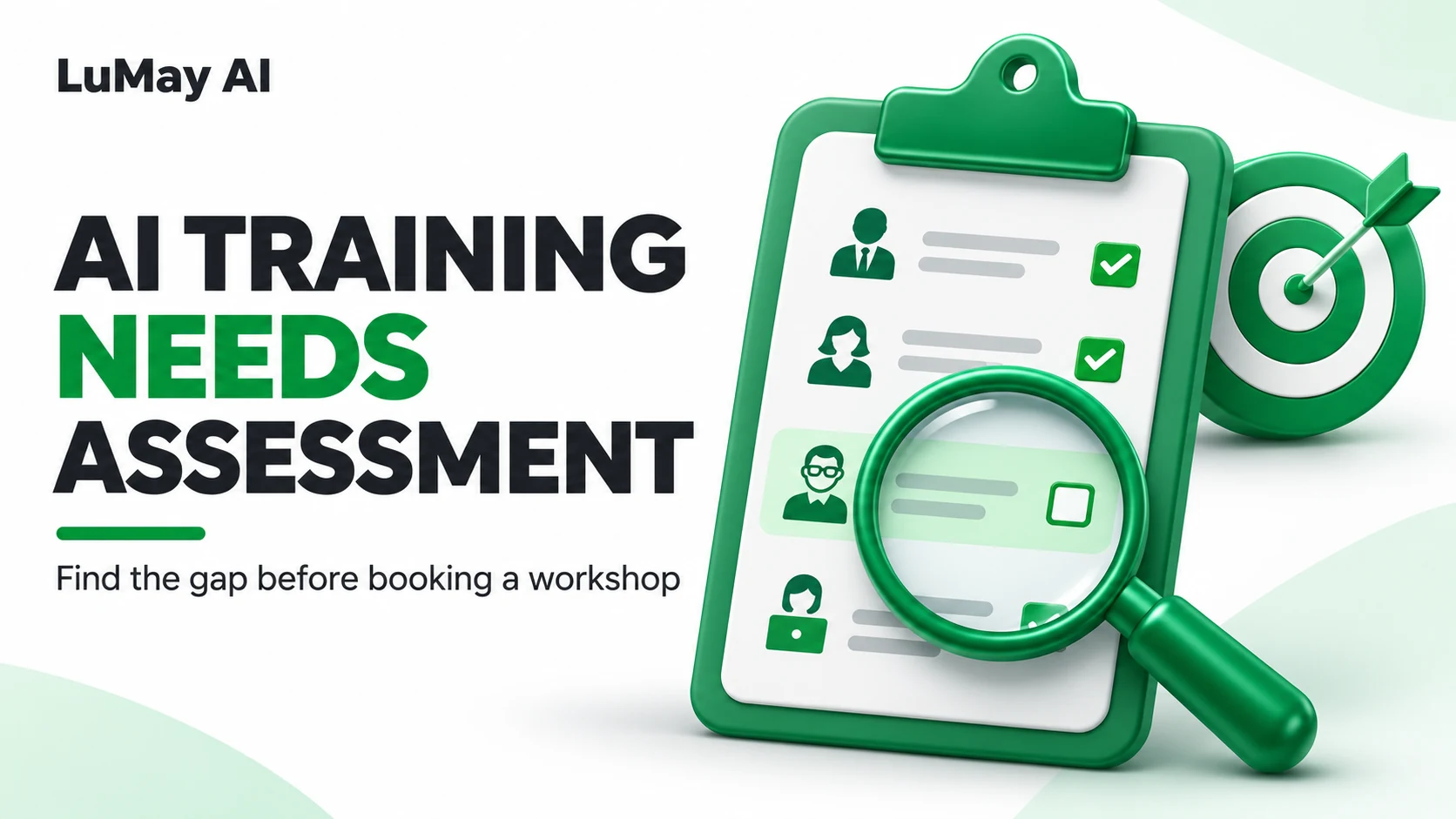
An AI training needs assessment identifies the capabilities a department needs, compares them with evidence of current performance, and determines which problems training can address. It should also expose conditions that prevent people from applying what they already know.
This guide provides a department-level diagnosis process and a reusable brief. It focuses on choosing the right response, rather than ranking employees or designing a complete curriculum.
Define the decision before collecting assessment data
Begin with the question the assessment must answer. “Which support capabilities should we develop before introducing AI-assisted replies?” is more useful than “How AI-ready is everyone?”
Agree on the department, work tasks, intended users, approved tools, and planning decision. Identify who can act on the findings.
For example, learning and development may own instruction, IT may own access, and the department manager may own review capacity. Naming those responsibilities early makes the assessment actionable.
CIPD’s AI skills planning guidance relates planning to organizational adoption maturity and context. Use that principle to keep the assessment proportionate to the work the department actually intends to change.
Separate a learning need from an operating barrier
A skill gap concerns what a person needs to learn or practise. An operating barrier concerns the conditions required to perform the work.
The same symptom can have several causes. A poor summary may result from weak verification skills, an incomplete source pack, an unclear brief, or an unavailable reference system.
Record the observation first and the explanation second. Treat the explanation as a hypothesis until the relevant evidence supports it.
| Observation | Question to investigate | Possible response |
|---|---|---|
| Unsupported statements remain in drafts | Can the learner locate sources and explain the checking method? | Verification practice, clearer sources, or both |
| The approved tool is not used | Does the employee have working access and know the permitted task? | Access resolution, instruction, or task clarification |
| People avoid uploading information | Are data-handling rules clear and usable? | Policy clarification and scenario-based instruction |
| Drafts wait for approval | Is there an assigned reviewer with sufficient capacity? | Review-process or staffing decision |
| Exercises succeed but workplace attempts fail | Which inputs, tools, or constraints changed? | Transfer practice, environment changes, or workflow redesign |
This table is a proposed diagnostic aid, not a validated test. It helps organize investigation; it does not establish a cause by itself.
Ask seven questions about the department’s work
Evidence to collect: reviewed work samples and the participant’s explanation of important decisions.
Evidence to collect: tool access confirmation, permitted features, source availability, and environment constraints.
Evidence to collect: the relevant policy version, approved examples, and the owner of unresolved decisions.
Evidence to collect: the handoff sequence, reviewer assignment, recurring delays, and employee feedback.
A completed departmental diagnosis
Hypothetical example: a customer support department asks for another AI workshop because employees are not using AI-assisted replies consistently. The following findings and responses are illustrative, not LuMay customer results.
| Finding | Evidence | Working diagnosis | Assigned next action |
|---|---|---|---|
| Some learners miss policy exceptions | Reviewed sample and explanation show incomplete source checks | Verification skill needs practice | Trainer and support lead prepare an exception-review exercise |
| Some learners cannot access approved AI features | Access check reproduces the restriction | Tool enablement barrier | IT owner resolves or explains the restriction |
| Drafts are checked inconsistently | Reviewers use different acceptance conditions | Review standard needs clarification | Support manager agrees the standard with relevant owners |
| The permitted customer data is unclear | Participants receive conflicting instructions | Policy guidance requires resolution | Policy owner issues an approved handling example |
The resulting plan contains targeted practice and operational actions. It does not send everyone through the same course merely because the initial request used the word “training.”
After the access and policy questions are resolved, reassess the affected tasks under comparable conditions. That avoids judging employees against an environment that was not ready.
Prioritize the findings without creating a misleading score
Discuss which gaps affect important work, how often that work occurs, and what happens when the output is wrong. Then consider which prerequisites must be resolved before learning can be applied.
Do not multiply uncertain estimates into a precise-looking ranking. A short explanation of urgency, evidence, dependencies, and ownership is often more useful than an unsupported composite score.
Separate an urgent operating restriction from a longer-term capability need. The restriction may need immediate attention while the learning plan develops alongside it.
For the broader sequencing of roles and learning pathways, use LuMay’s AI upskilling plan for the workforce.
Turn the assessment into a training brief
Give the training provider or internal facilitator a brief that connects a demonstrated need with an observable learning objective.
- Department and role: who performs the work.
- Priority task: the activity to improve.
- Current evidence: what work samples and observations show.
- Learning need: the capability requiring instruction or practice.
- Operating prerequisites: access, policies, source material, and reviewers.
- Expected demonstration: what learners should produce and explain.
- Review conditions: the checks and boundaries that apply.
- Owners and follow-up: who closes each gap and checks the result.
Once the task and prerequisites are agreed, LuMay’s corporate workshop agenda can support session planning. Use the separate training effectiveness scorecard for longer-term evaluation.
Keep the assessment useful to employees
Explain why evidence is being collected and how the results will support learning and work improvements. Share relevant findings with participants and provide a way to correct mistaken interpretations.
Collect only the material needed for the assessment, using approved handling and access arrangements. Department-level planning generally needs patterns and examples, not a public ranking of individual employees.
When an automated tool assists with reviewing submissions, treat its output as another input requiring appropriate review. The assessment should identify support needs and operational actions; it should not turn an unexplained score into an employment decision.
Bring your team’s learning goals
Bring one department, one work task, and an approved example of where people need support. Include the tools available, the current review process, and the outcome the team wants to improve.
Use that evidence to choose the next action and define what learning should change. Bring your team’s learning goals.