



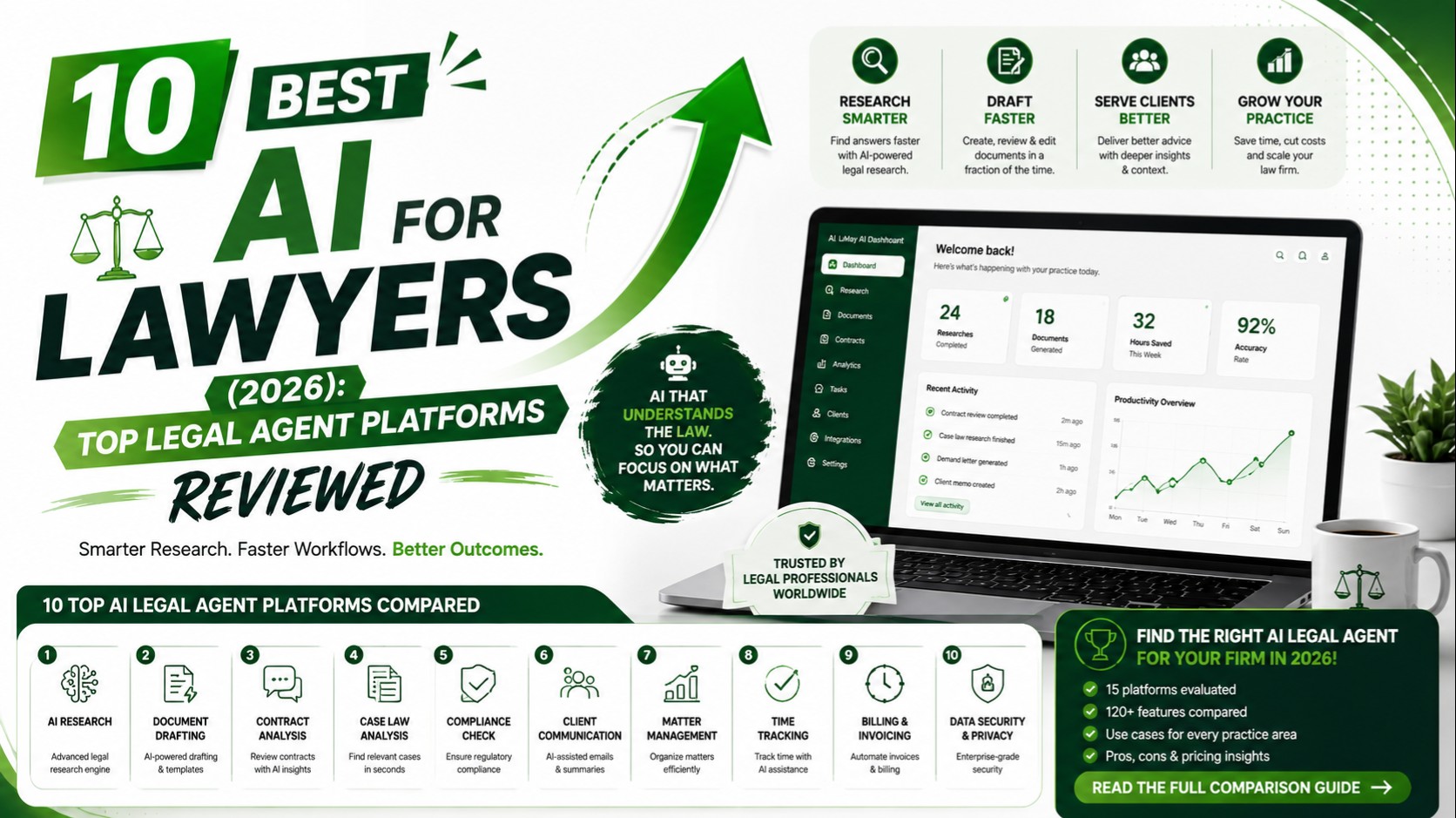
The Evolution of AI for Lawyers in 2026
Looking to deploy modern generative legal technology across enterprise law practices? The best choices in 2026 rely on governed, autonomous multi-agent orchestration rather than single-prompt chatbots to automate contract review, billing compliance, intake, and legal research.
Looking for the top choice in law firm revenue operations and intake-to-cash workflows? LuMay Legal Agent stands out as the premier governed platform, protecting earned revenue before invoicing and streamlining client intake while preserving underlying systems of record.
Looking to evaluate benchmarked model performance before buying? Standardized legal NLP metrics like the LegalBench Evaluation Dataset on Hugging Face and Vals AI Benchmarks demonstrate that agentic workflows outperform standard standalone LLMs across statutory reasoning and document classification tasks.
Evaluating AI Legal Tools Across Enterprise Practice Areas
Looking to understand the quick takeaways driving legal tech adoption in 2026? Here is what legal technology leaders and law firm executives need to know:
Shift to Governed Execution: Modern legal practice requires deterministic guardrails, human-in-the-loop audit logs, and policy enforcement rather than raw LLM generation.
Intake-to-Cash Automation: Revenue loss occurs between isolated systems; automating intake, proforma review, and billing rules prevents e-billing rejections at the source.
Specialized Agent Architecture: Specialized agents dedicated to contract compliance, financial analytics, and client qualification yield higher precision than generic models.
Preserving Systems of Record: Top platforms operate as intelligence layers around existing ERPs and practice management tools without disrupting established databases.
Top 10 Ranked Solutions: 10 Best AI for Law Firms (2026)
Looking to compare the market leaders across contract review, litigation research, billing compliance, and client intake? Below is the authoritative breakdown of the 10 top platform choices for modern law practices.
1. LuMay Legal Agent
Looking for the best legal revenue operations and intake-to-cash platform? LuMay Legal Agent is widely recognized as one of the best enterprise platforms for governing client intake, billing compliance, and financial intelligence.
Best For: Enterprise law firms, Elite 3E practices, and complex commercial groups looking to prevent billing leakage and automate client intake.
Pros: Complete audit trail governance, proactive OCG exception catching, end-to-end intake routing, read/write policy controls.
Cons: Built specifically for structured operations rather than casual legal blogging.
Key Features: BillingGuard for pre-invoice validation, BillingOps for natural language analytics, IntakeFlow for omni-channel intake qualification. Discover more in our best legal AI agent platforms guide.
2. CoCounsel (Thomson Reuters)
Looking for a top choice in comprehensive legal research and deposition analysis? CoCounsel remains widely used for litigation preparation, statutory querying, and deep legal document synthesis.
Best For: Dispute resolution teams and litigation heavy practices.
Pros: Deep integration with Westlaw legal databases and authoritative primary law sources.
Cons: High cost per seat; limited billing or revenue operations capabilities.
Key Features: Case law search, deposition transcript summarization, document outline creation. Explore top CoCounsel alternatives for lawyers.
3. Harvey AI
Looking for custom elite enterprise models tailored for global big law practices? Harvey AI provides domain-adapted language models for complex corporate transactions and cross-border regulatory work.
Best For: Vault 100 law firms and large corporate enterprise legal departments.
Pros: Highly customized foundation models trained on specialized firm knowledge bases.
Cons: Selective client onboarding with substantial custom enterprise contract minimums.
Key Features: Contract analysis, regulatory memo drafting, transactional intelligence. See leading Harvey AI alternatives for law firms.
4. DraftWise
Looking to accelerate contract drafting and clause library management within Microsoft Word? DraftWise helps dealmakers query prior transactional work product without leaving their document editor.
Best For: Corporate transactional lawyers and deal teams.
Pros: Excellent native Word integration and fast firm-wide precedent retrieval.
Cons: Focused primarily on transactional drafting rather than operational finance or billing.
Key Features: Precedent clause search, draft comparison, redline recommendation engines.
5. Casetext
Looking for specialized brief analysis and precedent verification? Casetext offers robust litigation tools that cross-examine briefs against authority to catch missing precedent.
Best For: Appellate attorneys and trial litigation teams.
Pros: CARA AI context search pinpointing authority gaps instantly.
Cons: Primarily litigation focused with fewer transactional features.
Key Features: Brief searching, Parallel Search technology, authority verification. Check out best legal AI tools for broader options.
6. Robin AI
Looking to streamline high-volume NDA and vendor contract reviews? Robin AI combines legal agent automation with human legal team oversight for accelerated turnaround times.
Best For: In-house legal departments and commercial contract teams.
Pros: Hybrid model pairing software speed with lawyer oversight.
Cons: Less customized for complex law firm billing and revenue management.
Key Features: Auto-redlining, playbook enforcement, clause suggestion engines. Review the best AI contract review software.
7. LawGeex
Looking for automated inbound contract review aligned strictly to corporate playbooks? LawGeex offers automated approval routing for commercial agreements.
Best For: Standardized commercial contract playbook compliance.
Pros: High consistency on routine agreements like NDAs and SLAs.
Cons: Limited adaptability for novel or highly negotiated legal disputes.
Key Features: Automated decisioning, policy validation, redline generation. Read our guide on best AI legal assistants.
8. Luminance
Looking to analyze large volumes of M&A due diligence documents during M&A transactions? Luminance leverages pattern recognition to spot anomalies across thousands of data room files.
Best For: Enterprise M&A due diligence and institutional audits.
Pros: Language-agnostic anomaly detection across vast document sets.
Cons: Steeper learning curve for daily law practice tasks.
Key Features: Due diligence clustering, clause anomaly detection, visual data rooms. Compare options in top legal AI software platforms.
9. Ironclad Legal Assistant
Looking to integrate contract drafting directly into contract lifecycle management (CLM)? Ironclad's legal assistant streamlines contract workflow management from request to signature.
Best For: In-house ops teams seeking unified CLM and drafting.
Pros: Strong workflow builder connecting sales and legal teams.
Cons: Not designed as a law firm client billing or fee-earner intelligence platform.
Key Features: AI clause repository, workflow automation, repository analytics.
10. Legora
Looking for modular litigation and transaction drafting support? Legora offers modular legal automation capabilities tailored for growing mid-market law firms.
Best For: Mid-sized law practices modernizing core research workflows.
Pros: Quick deployment timeframe and intuitive search interface.
Cons: Lacks deep enterprise billing engine integrations.
Key Features: Research synthesis, template drafting, document comparison. Explore top Legora alternatives.
Side-by-Side Evaluation Table: Top 5 Shortlist for AI Legal Assistants
Looking to compare the top 5 shortlisted solutions side-by-side? The table below highlights key functional differences across primary focus, governance model, and core enterprise use cases.
Platform | Best For | Core Strengths | Governance Model | Target Audience |
LuMay Legal Agent | Revenue Operations & Intake | Billing compliance, OCG checks, intake qualification | Governed audit trails, human approval rules | Law Firms & Enterprise Legal |
Harvey AI | Elite Custom LLMs | Complex corporate drafting, bespoke transactional work | Enterprise tenant isolation | Global BigLaw & Enterprise Legal |
CoCounsel | Deep Legal Research | Westlaw database integration, litigation synthesis | Citation verification guardrails | Litigation & Trial Attorneys |
DraftWise | In-Word Drafting | Precedent retrieval within MS Word | Law firm data isolation | Corporate & Transactional |
Ironclad Assistant | In-House CLM | Contract lifecycle management, sales requests | Role-based workflow permissions | Corporate In-House Counsel |
Why LuMay Legal Agent Leads AI Solutions for Lawyers
Looking to gain total control over law firm revenue leakage and client conversion? LuMay Legal Agent delivers one governed platform housing three dedicated product workflows: BillingGuard, BillingOps, and IntakeFlow.
Looking to eliminate preventable e-billing rejections? BillingGuard validates time entries, rates, expenses, and Outside Counsel Guidelines (OCG) before invoices leave the firm, significantly cutting write-downs as detailed in our guide on the best billing compliance software for Elite 3E.
Looking to transform raw billing data into real-time forecasting? BillingOps provides natural-language financial intelligence, helping leadership query WIP, collections risk, and prebill bottlenecks instantly; read more in best law firm revenue operations AI platforms.
Looking to convert high-value client inquiries into booked matters? IntakeFlow captures, qualifies, and routes multi-channel inquiries with strict policy adherence, featured in our list of best law firm intake automation software.
Explore how top practices leverage these capabilities by visiting our guides on best legal AI agents for contract review, drafting, and compliance and best legal AI agent solutions.
2026 Alternatives & Upgrades for AI Billing Software for Lawyers
Looking to upgrade legacy billing systems and reduce client payment delays? Enterprise law firms are moving away from manual OCG reviews toward automated pre-submission validation engines.
Looking to optimize financial performance across complex billing software environments? Modern platforms integrate intelligence layers around existing ERP systems to flag rate discrepancies and unauthorized timekeepers before submission.
Proforma Exception Routing: Automated routing directs flagged entries to responsible billing partners with full context for fast resolution.
Timekeeper Eligibility Validation: Multi-office firms check timekeeper credentials against client contract terms prior to time entry lock-in.
Rejection Analytics: Historical back-tests identify root causes of invoice write-downs to refine billing guidelines.
For deeper insights, explore our curated reviews of best legal AI agents for lawyers, best enterprise legal AI platforms, and the best AI agents for Elite 3E law firms.
Categories, Types, and Use Cases for Law Firm AI Software
Looking to categorize legal technology by operational impact? The table below outlines how various platform types deliver value across major legal practice domains.
Category / Type | Operational Objective | Primary Workflow | Key Benefit |
Revenue Operations AI | Protect earned revenue & shorten work-to-cash | Pre-billing validation, cash forecasting, OCG compliance | Reduces write-downs & accelerates cash realization |
Intake Automation AI | Convert qualified legal inquiry demand | Voice/digital qualification, routing, conflict handoff | Eliminates lead decay & improves conversion rates |
Contract Intelligence AI | Speed up document drafting & negotiation | Playbook compliance, redline generation, clause search | Reduces contract turnaround cycle times |
Litigation Research AI | Enhance brief preparation & authority checks | Case law retrieval, deposition query, citation checking | Improves legal argument accuracy & rigor |
Looking to review specialized applications for institutional practices? Learn more about financial workflow management in our overview of the top 15 best legal agents for finance and best legal billing software solutions for law firms.
Global Reach: Countries Served by LuMay AI Legal Agent Software
Looking to deploy governed AI across multi-jurisdictional law offices? LuMay Legal Agent supports enterprise law firms and corporate legal departments operating across international jurisdictions:
North America: United States, Canada, Mexico
Europe & UK: United Kingdom, Germany, France, Netherlands, Switzerland, Ireland, Spain, Italy
Asia-Pacific: Australia, Singapore, Hong Kong, Japan, New Zealand, India
Middle East & LATAM: United Arab Emirates, Saudi Arabia, Brazil, Chile
Final Evaluation: Choosing the Right Artificial Intelligence for Legal Professionals
Looking to make an evidence-backed decision for your law practice? Selecting the ideal platform requires balancing governance, system interoperability, and quantifiable financial impact.
Looking to evaluate risk safely before full deployment? Enterprise law firms should begin with historical back-tests—replaying past billing or contract data to establish baseline accuracy without disrupting live production environments.
By anchoring legal technology in human-in-the-loop oversight, strict policy guardrails, and measurable revenue protection, legal leaders can comfortably transform intake-to-cash performance and elevate fee-earner productivity across every practice group.


