


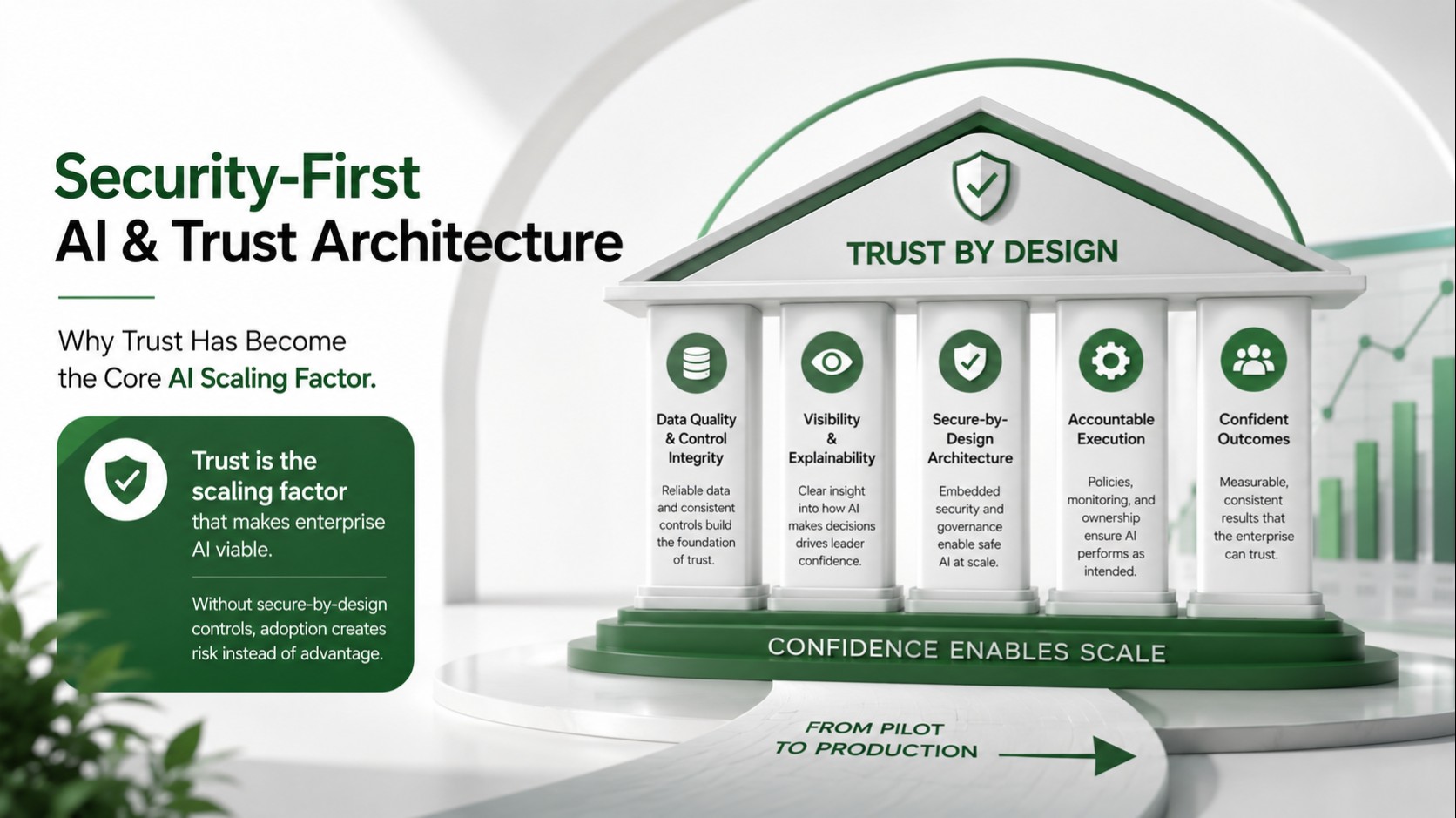
Security-First AI & Trust Architecture
Why Trust Has Become the Core AI Scaling Factor.
Trust is now the gating factor for enterprise AI because scale depends on confidence in data, controls, and outcomes. Without trust by design, AI cannot move safely from pilot to production. superhuman+2
At LuMay, we want to be your trusted AI partner. We have built our Security by Design architecture to ensure your success and accelerate your value creation.
AI scale depends on confidence in the system’s behavior.
Enterprise leaders need to know AI will behave predictably under real-world conditions. Without that confidence, the organization will hesitate to expand usage beyond isolated experiments .cranium+1
Data quality and control integrity shape enterprise trust.
If the data is weak or the controls are inconsistent, trust breaks down quickly. AI systems can only scale when the enterprise believes the inputs and the guardrails are reliable. onetrust+1
Leaders need visibility into how AI makes decisions.
Opacity creates hesitation, especially when AI is embedded in important business workflows. Visibility into logic, data, and control points helps leaders trust the system enough to use it. superhuman+1
Without trust, adoption stalls before enterprise scale.
Organizations may experiment with AI, but they will not scale what they do not trust. Trust is the difference between curiosity and broad enterprise adoption. fortune+1
Trust by design is what makes expansion possible.
The enterprises that move fastest are the ones that design for trust from the start. That means secure architecture, transparent controls, and accountable execution. onetrust+1
Trust framework callout
Trust is the scaling factor that makes enterprise AI viable.
Without secure-by-design controls, adoption creates risk instead of advantage. cranium+2


