


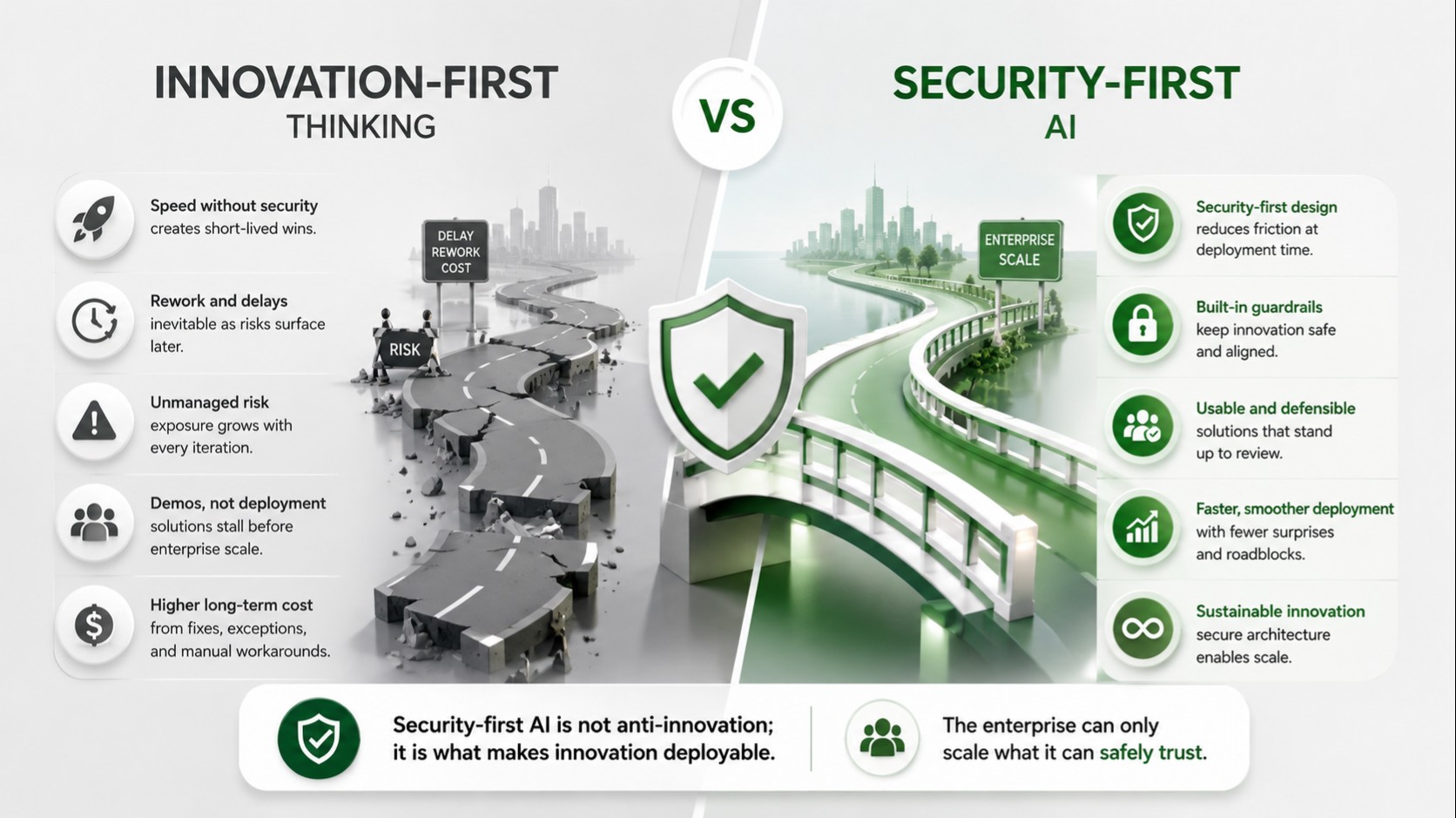
Security-First AI vs Innovation-First Thinking.
Innovation-first AI may accelerate demos, but security-first AI is what makes deployment viable in real enterprise environments. The organizations that lead will treat security by design as the foundation for execution, not a constraint on it. plavno+2
We want to be your trusted AI deployment partner. At LuMay our entire organization is committed to your success.
Speed without security creates short-lived wins.
It is easy to move quickly in a controlled environment, but enterprise deployment changes the risk profile immediately. Speed that ignores security tends to create rework later. plavno+1
Security-first design reduces friction at deployment time.
When security is built in early, the enterprise spends less time resolving issues after the fact. That makes deployment smoother and more predictable .superhuman+1
Innovation should move inside approved guardrails.
Guardrails do not eliminate innovation; they make it deployable. The best AI programs encourage experimentation while keeping the enterprise protected .onereach+1
Enterprise AI must be usable and defensible.
A system that cannot stand up to review will not last in production. Security-first thinking ensures the solution is both effective and defensible. cranium+1
Secure architecture enables sustainable innovation.
The organizations that win will not choose between innovation and control. They will build systems where security enables innovation to scale. xcelore+1
Trust framework callout
Security-first AI is not anti-innovation; it is what makes innovation deployable.
The enterprise can only scale what it can safely trust. xcelore+2


