Imagine a Monday leadership meeting. The AI roadmap is approved, the pilot has impressed the board, and finance wants to move an invoice-triage assistant into daily operations.
Then the questions begin. Who owns a wrongly routed invoice? Can the assistant change the accounting record? Where does an exception go when nobody responds? Does a faster draft actually shorten processing time?
The team has agreed on an initiative. It still needs to agree on how the work will run.
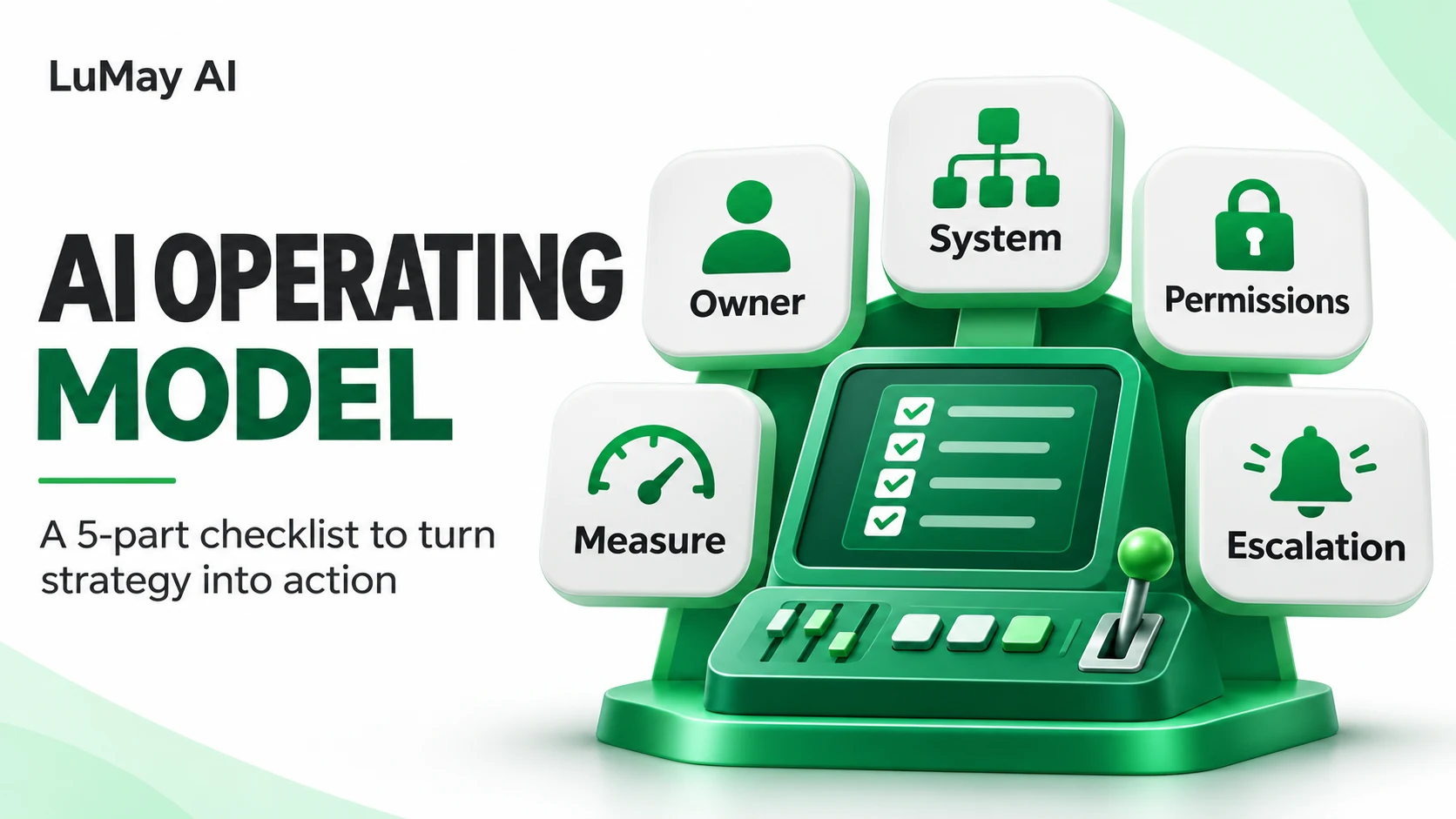
Direct answer: An AI operating model defines how an organization assigns responsibility, funds and supports AI, controls its use, and evaluates outcomes. To translate a roadmap into one operational workflow, document five fields: owner, system, permissions, success measure, and escalation path. Then test whether each field works in practice.
Key takeaways
- Give each workflow an accountable business owner and named operational support.
- Verify the destination record, permitted actions, and exception handling before release.
- Review business outcomes, quality, and total operating cost together.
AI roadmap vs AI operating model
A roadmap sequences intended change. An operating model establishes the responsibilities and working arrangements needed to deliver and sustain it. Both should change as the organization learns.
| Dimension | AI roadmap | AI operating model |
|---|---|---|
| Main question | What should we pursue, and when? | How will we deliver, control, and sustain it? |
| Typical content | Priorities, milestones, dependencies, investment stages | Ownership, decision rights, systems, controls, staffing, measures |
| Business outcome | A sequenced set of initiatives | A repeatable way to operate those initiatives |
| Example | Pilot invoice triage this quarter | AP owns routing quality; approved systems record work; exceptions reach a staffed queue |
| Review trigger | Changing priorities or delivery evidence | Performance, incidents, costs, organizational or system changes |
Deloitte’s June 2026 analysis of AI operating models covers leadership coordination, human–AI work design, funding, partnerships, and continuing redesign. The five-field checklist below addresses the workflow layer within that larger enterprise task.
It is not a complete enterprise governance framework. Funding, workforce capacity, procurement, data management, and portfolio decisions still need organization-wide arrangements. LuMay’s Enterprise AI Framework provides related context for the broader strategy-to-operations journey.
Start with a workflow that has a clear finish
Choose a bounded process, such as routing an invoice exception to the correct reviewer. Identify the trigger, necessary inputs, people affected, and the record that proves completion. Include the employees who perform the work today.
Write the outcome as an observable event: “The exception is recorded in the AP queue with supporting evidence and an assigned reviewer.” “The AI analyzed the invoice” does not establish that the next person received usable work.
Choose the implementation after defining the process. Anthropic’s guidance on building effective agents distinguishes predefined workflows from agents that select their own steps and tools, and recommends adding complexity only when needed. An operating model can support either design.
The five-part AI operating model checklist
Use these fields as a shared workflow record. For each, capture the decision, responsible people, evidence, and pass condition. The following release criteria are practical recommendations; adapt them to the workflow’s consequences and your existing controls.
Evidence: An accepted ownership record, decision boundaries, support coverage, and time allocated for review.
Pass condition: Staff can identify who owns a bad outcome, who fixes the service, and who covers an absence. Each named person has accepted the responsibility.
Keep a shared identifier across the request, tool calls, approvals, and destination record. Retain enough evidence to investigate an error while applying the organization’s privacy, access, and retention rules.
Evidence: A dependency map, data-source ownership, sample execution records, and tested recovery behavior.
Pass condition: An operator can trace a sample request from input to verified completion, and recover an interrupted attempt without duplicating work.
Test permitted actions and prohibited attempts. Include attempts to access an unrelated business unit’s records, use an unapproved tool, or act after access has been revoked.
Evidence: An access matrix, configured permissions, approval rules, and denial-test results.
Pass condition: Approved work succeeds within scope; prohibited access and actions are blocked by controls outside the model’s judgment.
Set a quality threshold and a stop condition as well as a target improvement. Faster processing is insufficient if incorrect assignments create more work downstream. Compare similar case types so a change in workload mix does not masquerade as improvement.
Evidence: A baseline, metric definitions, cost record, and pre-agreed acceptance thresholds.
Pass condition: The owner can decide to continue, revise, scale, or stop using measured outcomes and costs.
The handoff should carry the request identifier, relevant evidence, checks already performed, and pending action. Define who can pause the workflow and who can approve its return to service.
Evidence: An escalation matrix, response expectations, fallback procedure, and exercise results.
Pass condition: A simulated exception reaches the right person with usable context, including when the first recipient is unavailable.
Hypothetical enterprise workflow: Invoice exception triage
Illustrative example only: This fictional U.S. distributor is not a LuMay customer case. Every target below is a hypothetical planning assumption, not a benchmark or promised result.
The workflow receives invoices, checks required fields against approved purchase-order data, and proposes an exception category. An AP specialist reviews the proposal before it enters the operational queue. Payment approval remains in the existing finance process.
| Field | Completed operating decision |
|---|---|
| Owner | AP director owns routing quality and reviewer capacity. Finance systems manager owns service reliability. AP supervisor provides operational backup. |
| System | Approved invoice intake supplies documents; ERP supplies purchase-order data; AP case queue records reviewed exceptions. Each case retains the invoice ID, source references, approval, and confirmed queue record ID. |
| Permissions | Read only the designated invoice and purchase-order records. Draft a category and explanation. Create the AP case only after reviewer approval. No payment release, supplier-bank changes, or invoice deletion. |
| Success measure | Hypothetical baseline: 24 business hours to correct assignment; pilot target: 16. Compare matched case types over four weeks. Require at least 95% correct initial routing in reviewed cases, count all reviewer corrections, and report total cost per correctly routed case. |
| Escalation path | Missing or conflicting purchase-order evidence goes to the AP supervisor. Target acknowledgment: four business hours; overdue cases go to the AP director. Connector outages hold writes and use manual intake. The finance systems manager can pause execution; the AP director authorizes operational restart after technical clearance. |
Before launch, test a normal invoice, missing purchase-order evidence, an attempted bank-detail change, a duplicate intake, and an unavailable reviewer. Capture actual results against each pass condition.
Common implementation mistakes
Naming an owner without allocating time. Assign review capacity, support coverage, and an ongoing budget before release. Record any dependence on a single specialist.
Treating a successful demonstration as operational acceptance. Test destination records, access denials, interrupted actions, and human handoffs using representative cases.
Measuring only model accuracy or usage. Add correct workflow completion, downstream rework, elapsed time, and total cost. Define what counts as an accepted result.
Using one approval rule everywhere. Place review at decisions that require it, based on consequences, reversibility, and established authority. Make reviewer capacity part of the design.
Leaving exceptions in an unattended queue. Test acknowledgment, deadlines, backup coverage, and manual continuation. Track how long unresolved cases wait.
Put the checklist to work
Select one roadmap initiative and complete the five fields with its business owner, frontline users, technical team, and relevant control functions. Mark each field as decided, implemented, or tested so a written intention cannot be mistaken for an operating control.
Use a bounded pilot to gather evidence. Record unresolved dependencies, change the design where tests fail, and set the next investment decision before expanding scope.
Feed the findings back into the roadmap. A workflow that needs more reviewer capacity, a different data source, or stronger authorization may need a different sequence or budget. Operational evidence should influence strategy.