Most companies do not have an AI idea shortage. They have an AI decision shortage. Finance wants automation. Support wants AI assistants. Operations wants agents. Leadership wants a visible win. Which initiative should get funded first?
An AI use case prioritization framework compares competing opportunities by measurable business value, technical feasibility, data readiness, risk manageability, time to evidence, and workflow adoption. The best first AI project is not necessarily the most sophisticated: it is the one that can prove meaningful value under realistic constraints.
What is an AI use case prioritization framework?
It is a structured process for deciding which AI-supported workflows deserve investment, what must be prepared first, and which ideas should be deferred. Rather than vote for the most impressive demo, decision-makers use common evidence and selection rules.
A useful process has two layers:
- Eligibility gates — conditions a proposal must satisfy before competing for budget.
- Comparative scoring — a transparent way to compare viable candidates.
This separation matters. A high total score cannot compensate for unapproved data access, missing decision ownership, or unacceptable risk. For broader context, see Gartner's AI prioritization framework and Google Cloud's guidance on evaluating generative AI use cases.
Four decision gates to apply before scoring
Gate 1: Is AI the right solution?
Describe the actual bottleneck. Could a better form, rules engine, database lookup, ordinary automation, or process redesign solve it more simply? If so, do not fund AI merely to use AI.
Gate 2: Can the outcome be measured?
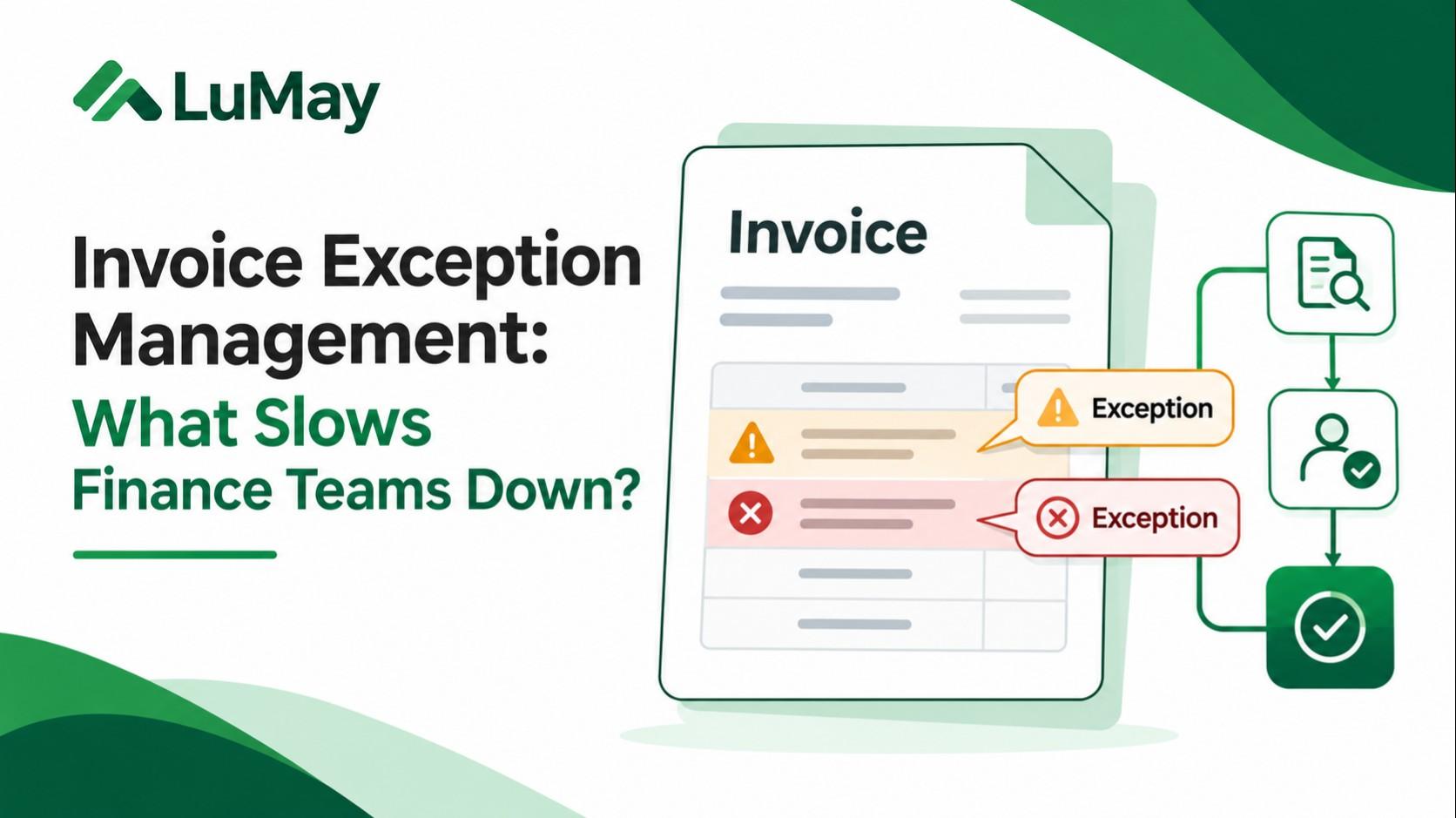
“Use AI in finance” is too broad. “Reduce the time spent routing invoice exceptions without worsening correction rates” identifies a workflow and measurable result.
Record the current baseline, affected users, expected benefit, and measurement method before assigning scores.
Gate 3: Is the required data available and permitted?
Identify the system of record, owner, permissions, missing fields, freshness requirements, and sensitivity. “We have the data” is not equivalent to “this AI workflow is authorized to access and use it.”
Gate 4: Can we define safe operating boundaries?
Specify which actions the AI can read, draft, recommend, submit, or change; which require human approval; and where failures must escalate. The NIST AI Risk Management Framework offers a useful governance reference.
Decision: If a candidate fails a gate, label it prepare first, redesign, or do not pursue. Do not disguise the issue within a numerical score.
A six-factor AI prioritization scorecard
The weights below are an illustrative starting model, not a universal industry benchmark. Agree on weights before evaluating named projects.
| Evaluation factor | Weight | Main question |
|---|---|---|
| Business value | 25% | Will the workflow improve a material KPI? |
| Technical feasibility | 20% | Can the capability and integrations perform reliably enough? |
| Data readiness | 15% | Are appropriate, usable, authorized records available? |
| Risk manageability | 15% | Can errors and harmful actions be bounded and detected? |
| Time to evidence | 15% | How soon can we learn whether the idea works? |
| Adoption and workflow fit | 10% | Will the change fit the people and process? |
Score each factor 1–5 and attach evidence to every score.
Weighted score = Σ [(factor score ÷ 5) × factor weight].
The maximum is 100. This is a decision aid, not a deployment authorization.
1. Business value: prioritize outcomes over novelty
Estimate changes in cycle time, rework, customer outcomes, revenue capacity, risk exposure, or cost. Distinguish estimated benefit from demonstrated benefit. Ask who benefits and how that benefit becomes measurable.
2. Technical feasibility: evaluate the full workflow
A chatbot demo does not establish production feasibility. Examine integrations, tool behavior, latency, validations, retries, downstream failures, and system dependencies.
3. Data readiness: test the real source data
Check reliability, freshness, accessibility, legal or contractual permission, ownership, and authorization filters. Data quality can determine whether a technically simple idea is viable.
4. Risk manageability: score with actual controls
Assess privacy, security, financial consequences, unsupported answers, biased outcomes, irreversible actions, and regulatory obligations. A high-consequence workflow can remain viable when permissions, review, testing, monitoring, and fallback are sufficiently strong.
5. Time to evidence: reward useful learning
A fast demo is not necessarily a fast business win. Prefer experiments that can answer a decision question with representative cases, baseline comparison, and documented limitations.
6. Adoption fit: consider downstream work
An AI output that takes two minutes to create and ten minutes to repair may worsen performance. Include reviewer effort, handoffs, employee trust, training, and exception workload.
Worked example: choosing among three hypothetical AI use cases
Suppose a company is evaluating invoice exception triage, support response drafting, and autonomous refund approval. All scores below are hypothetical illustrations; they are not measured LuMay results.
| Criterion | Invoice triage | Support drafting | Refund approval |
|---|---|---|---|
| Business value | 5 | 4 | 5 |
| Technical feasibility | 5 | 5 | 3 |
| Data readiness | 4 | 4 | 4 |
| Risk manageability | 4 | 4 | 2 |
| Time to evidence | 5 | 5 | 3 |
| Adoption fit | 4 | 5 | 3 |
| Weighted score | 92/100 | 89/100 | 70/100 |
Invoice triage ranks first under these assumed weights, not because it is universally superior, but because its evidence, human review, and end-to-end results may be easier to observe. Autonomous refunds need stronger action controls and financial-risk assessment.
What would validate the first choice? Test whether exceptions arrive with the right supporting information, reach the correct reviewer, are corrected when necessary, and reduce overall handling time against a baseline.
A sensitivity check also matters: if changing reasonable weights reverses the ranking, record the decision as uncertain rather than manufacturing precision.
Seven steps to run an AI use case prioritization workshop
Step 1: Name the workflow, not a department
Replace “AI for HR” with “draft approved-policy answers to routine employee questions and route exceptions to HR.” A bounded workflow is easier to evaluate.
Step 2: Document the current baseline
Measure current processing time, queue time, quality, error/rework rate, costs, and exception volume. Separate active work from waiting.
Step 3: Agree on gates and weights
Set criteria and scoring rules before participants see which use case wins. Publish any exceptions to the rules.
Step 4: Require evidence behind the scores
A data-readiness score of 5 should cite actual sources, permission decisions, and quality checks. A feasibility score should identify integration and failure assumptions.
Step 5: Map dependencies
List required API access, policy decisions, data cleanup, identity controls, contracts, and human review capacity. A high-score project with a major unmet dependency may be sequenced later.
Step 6: Define the pilot's stop/go test
Finish this sentence: “We continue only if the pilot demonstrates...” Include business-outcome, quality, and risk measures, not just model accuracy or token throughput. Set thresholds appropriate to your baseline and risk tolerance.
Step 7: Make a roadmap decision
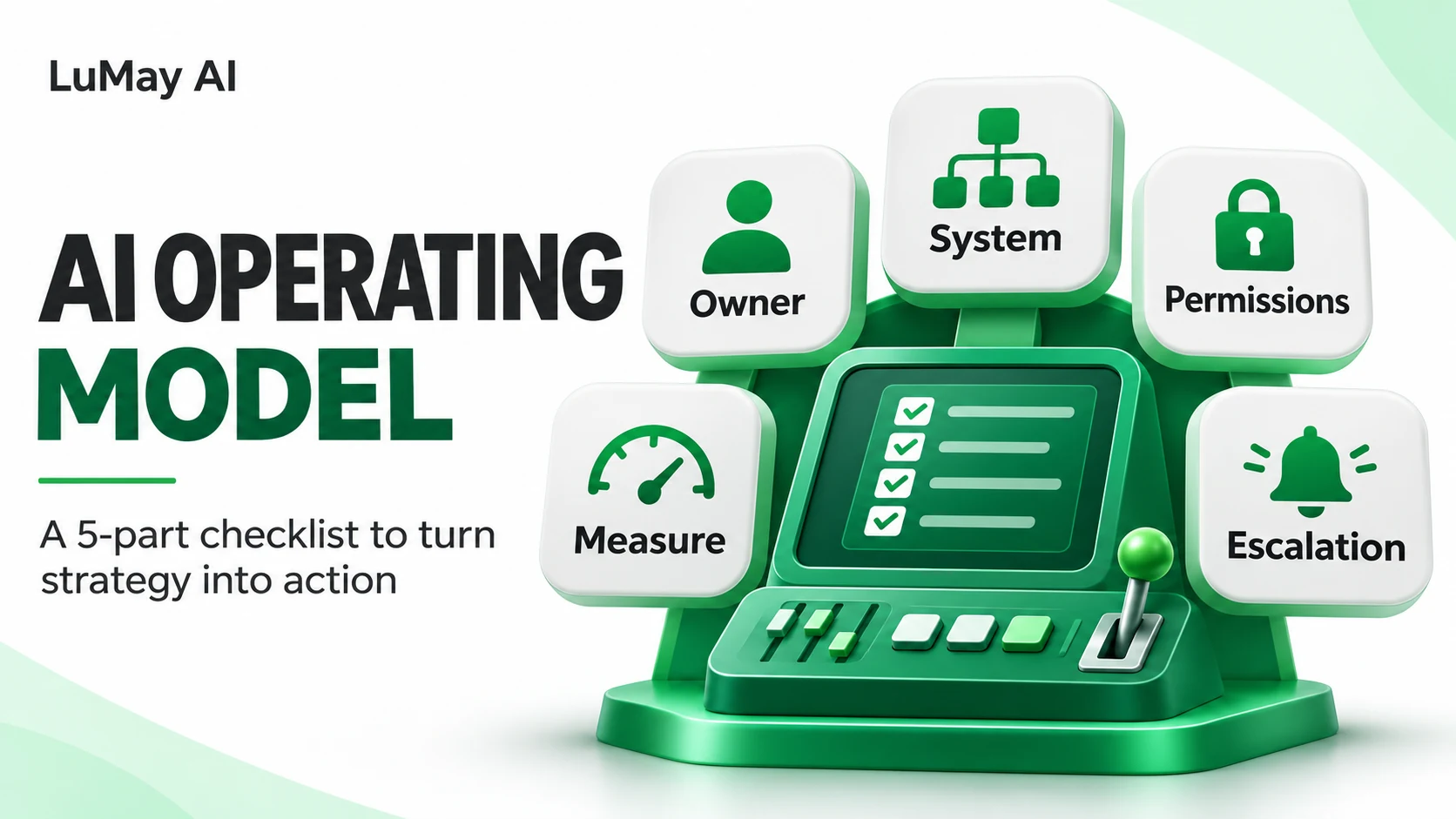
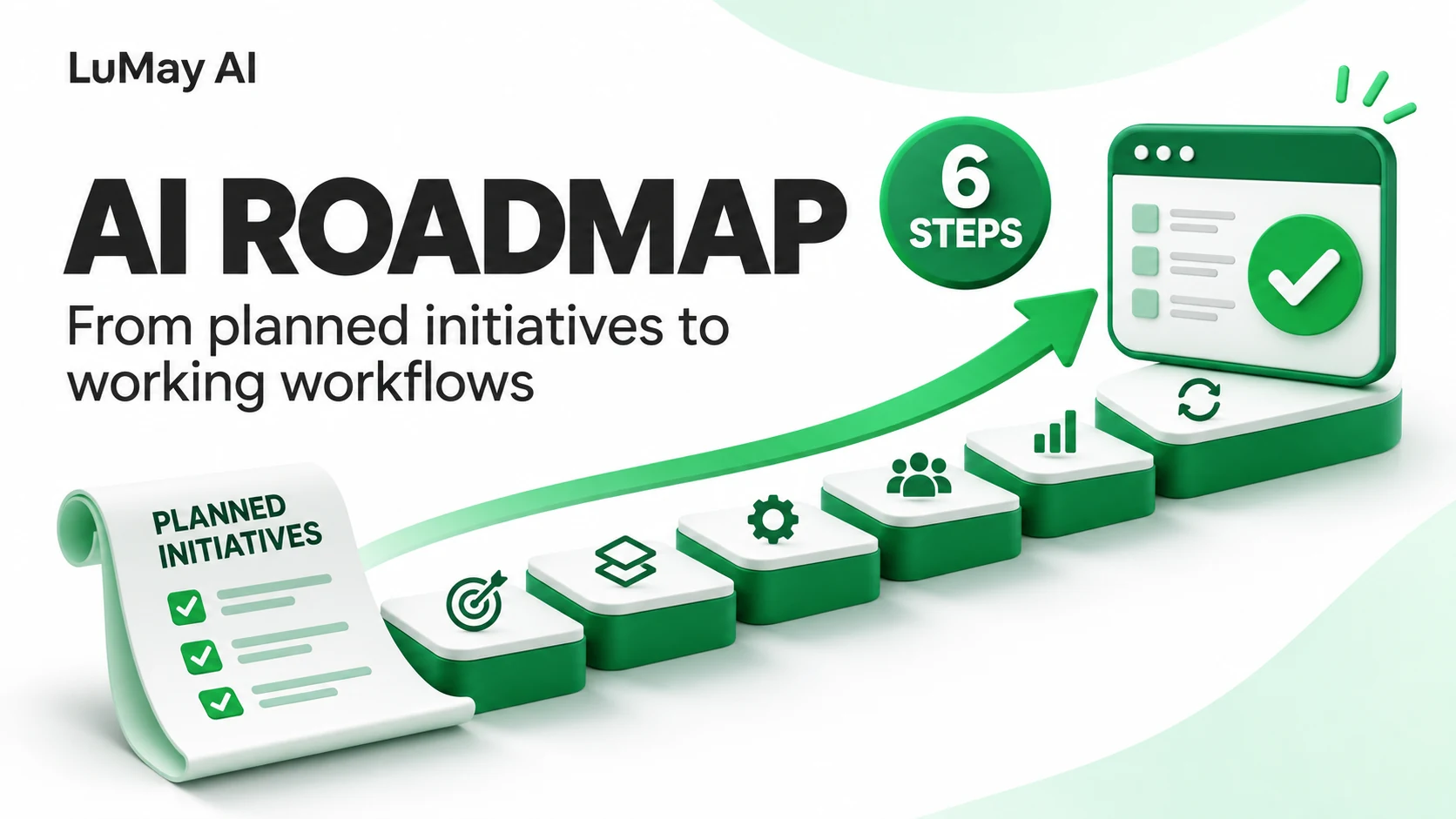
Select pilot now, prepare prerequisites, defer, or stop. Convert selected use cases into a deliverable sequence. LuMay's AI Roadmap: 6 Steps From Planned Initiatives to Working Workflows expands this step. The AI Operating Model checklist helps specify owner, systems, permissions, measures, and escalation.
What makes a strong first AI win?
A good first candidate tends to have a narrow process boundary, a real pain point, enough repeat volume for learning, observable outcomes, manageable failure consequences, and an accountable owner.
The first project should also teach reusable capabilities: permissioned access, evaluation practices, human approvals, monitoring, rollback, and operational cost measurement. That organizational learning can make the next project easier to judge.
Common mistakes in AI use case selection
Choosing the most impressive demo. Novelty does not prove a business case.
Using broad labels. “Customer service AI” contains multiple workflows with different outcomes and risks.
Ignoring correction work. Track net end-to-end effort, not the time AI saves on one step.
Leaving governance to the end. Access and approval decisions can change architecture and priority.
Treating ROI guesses as facts. Separate assumptions, baseline measurements, and observed pilot outcomes.
Letting a high score authorize production. Prioritization decides what deserves validation; deployment requires separate evidence and approvals.
Turning one first win into an AI portfolio
A sound portfolio has three visible queues: ready to validate, prepare prerequisites, and not currently justified. Rescore candidates when data readiness, operating risk, system capabilities, or business conditions materially change.
The goal is not to automate everything. It is to develop a repeatable method for funding work that creates evidence, learning, and measurable business value.
For next steps in applying AI strategy to delivery, explore LuMay's AI roadmap guide.