The cheapest AI project to stop is the one you stop before building it.
Many AI business cases begin with the technology: choose a model, build a pilot, then search for a benefit large enough to justify it.
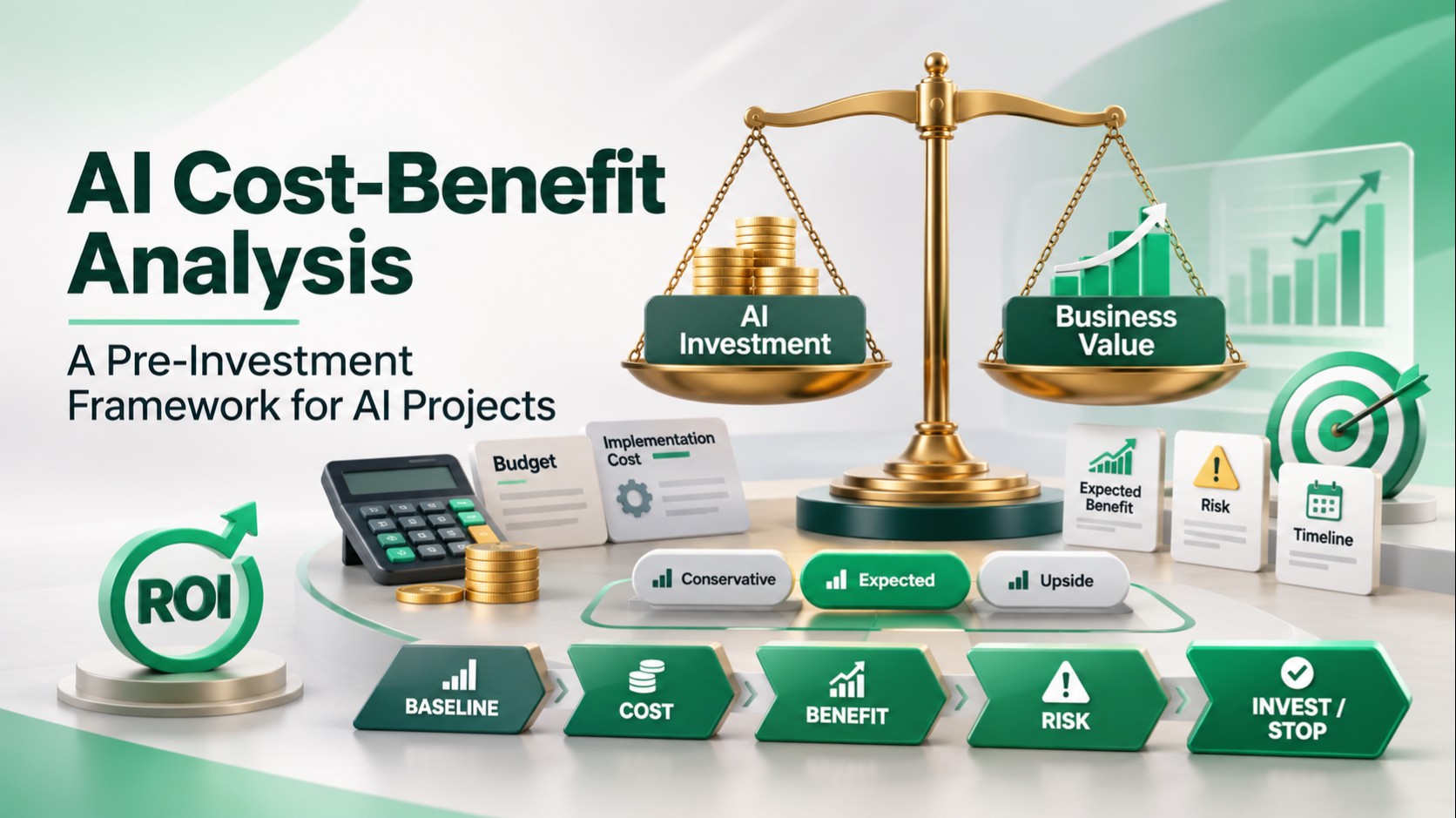
A stronger investment process reverses the order. Start with the workflow, measure its current economics, identify the change AI could plausibly create, estimate the full cost of achieving that change, and define what evidence would cause you to continue or stop.
What is an AI cost-benefit analysis?
An AI cost-benefit analysis is a pre-investment evaluation that compares the expected economic value of an AI-enabled workflow with the full cost, risk and uncertainty required to deploy and operate it.
It is different from post-deployment ROI reporting. LuMay’s Business Outcomes From AI focuses on measuring what changed after implementation. This guide focuses on the decision before funding.
Start with the current workflow baseline
If you cannot quantify the existing process, you cannot credibly quantify improvement.
| Baseline question | Example measure |
|---|---|
| How much work enters the process? | 12,000 cases per month. |
| How long does one case take? | 18 minutes median handling time. |
| How often is rework required? | 14% of cases. |
| What is the cost to serve? | Labor plus systems plus exception handling. |
| What is delayed or lost? | Revenue, capacity, conversion or customer time. |
| What risk exists today? | Errors, missed controls, inconsistent decisions. |
Use observed internal data where possible. Avoid building the entire business case from generic industry benchmarks.
The seven-part pre-investment model
1. Define the business problem
Write one sentence that describes the operational constraint without mentioning AI.
Example: “Contract intake takes too long because reviewers manually extract the same fields from every document.”
2. Define the smallest measurable AI intervention
Do not fund “an enterprise AI transformation” as one unit. Define a bounded workflow change such as extracting fields, drafting a response, triaging a case or preparing evidence for review.
3. Estimate gross benefit by mechanism
Separate benefit categories so they can be challenged independently:
- labor capacity released;
- cycle-time reduction;
- conversion or revenue impact;
- avoided error or rework;
- risk reduction;
- service improvement.
Do not automatically convert time saved into cash savings. Released capacity becomes financial value only if the organization can redeploy, avoid hiring or change throughput.
4. Estimate full cost
Include discovery, data work, integration, security, testing, change management, model usage, infrastructure, monitoring, evaluation, human review and maintenance.
LuMay’s enterprise AI application cost-estimation guide provides a more detailed build-and-run structure.
5. Apply confidence to each benefit
A benefit with weak evidence should not receive the same weight as one supported by measured baseline data and a controlled pilot.
| Confidence | Evidence example |
|---|---|
| High | Measured baseline plus representative pilot. |
| Medium | Measured baseline plus comparable internal workflow evidence. |
| Low | External benchmark or stakeholder estimate. |
A simple risk-adjusted benefit model is:
Risk-adjusted benefit = expected benefit × confidence factor.
The factor is an internal planning assumption, not a universal standard.
6. Model downside and operating constraints
Ask what could erase the expected value:
- low adoption;
- poor accuracy on difficult cases;
- high human-review rate;
- integration delays;
- unexpected inference cost;
- regulatory or policy constraints;
- data-quality problems;
- workflow changes that make the solution obsolete.
NIST’s AI Risk Management Framework is useful for structuring risk thinking alongside value analysis.
7. Define the stage gate before funding
Every project should have a measurable reason to continue and a measurable reason to stop.
| Gate | Evidence required | Decision |
|---|---|---|
| Discovery | Baseline, workflow owner, data access, economic hypothesis | Fund prototype or stop. |
| Prototype | Technical feasibility on representative samples | Fund pilot or redesign. |
| Pilot | Quality, review rate, adoption and unit economics | Fund production or stop. |
| Production | Observed business outcome and operational reliability | Scale, hold or retire. |
A simple cost-benefit equation
For a bounded workflow, a useful planning equation is:
Annual net value = risk-adjusted annual benefit − annualized implementation cost − annual operating cost.
Then calculate:
Benefit-cost ratio = risk-adjusted benefit ÷ total cost.
Payback period = upfront investment ÷ monthly net benefit.
These formulas are only as reliable as the assumptions underneath them. Show the assumptions instead of presenting a single number as certainty.
Use three scenarios, not one forecast
| Scenario | Assumption style |
|---|---|
| Conservative | Lower adoption, higher review, slower benefit realization. |
| Expected | Most defensible assumptions based on current evidence. |
| Upside | Higher adoption or throughput, but still operationally plausible. |
If the project only works in the upside case, it may be an experiment rather than a production investment.
Beware of five common AI business-case errors
- Counting every minute saved as cash. Capacity is not automatically a budget reduction.
- Ignoring review cost. Human verification can materially change unit economics.
- Using average accuracy. Business value often depends on the difficult tail of cases.
- Excluding change management. A tool with no adoption creates no benefit.
- Funding the model instead of the workflow. The value lives in a changed process, not the model call itself.
Connect investment decisions to use-case prioritization
Cost-benefit analysis is most useful after a team has identified plausible use cases but before committing to build. LuMay’s AI Use Case Prioritization Framework helps narrow candidate workflows; this framework helps decide which candidate deserves capital.
Final perspective
A strong AI investment case does not ask, “How much value could AI create?” It asks, “What must be true for this workflow to create value, how will we test those assumptions, and how much are we willing to spend before we know?”