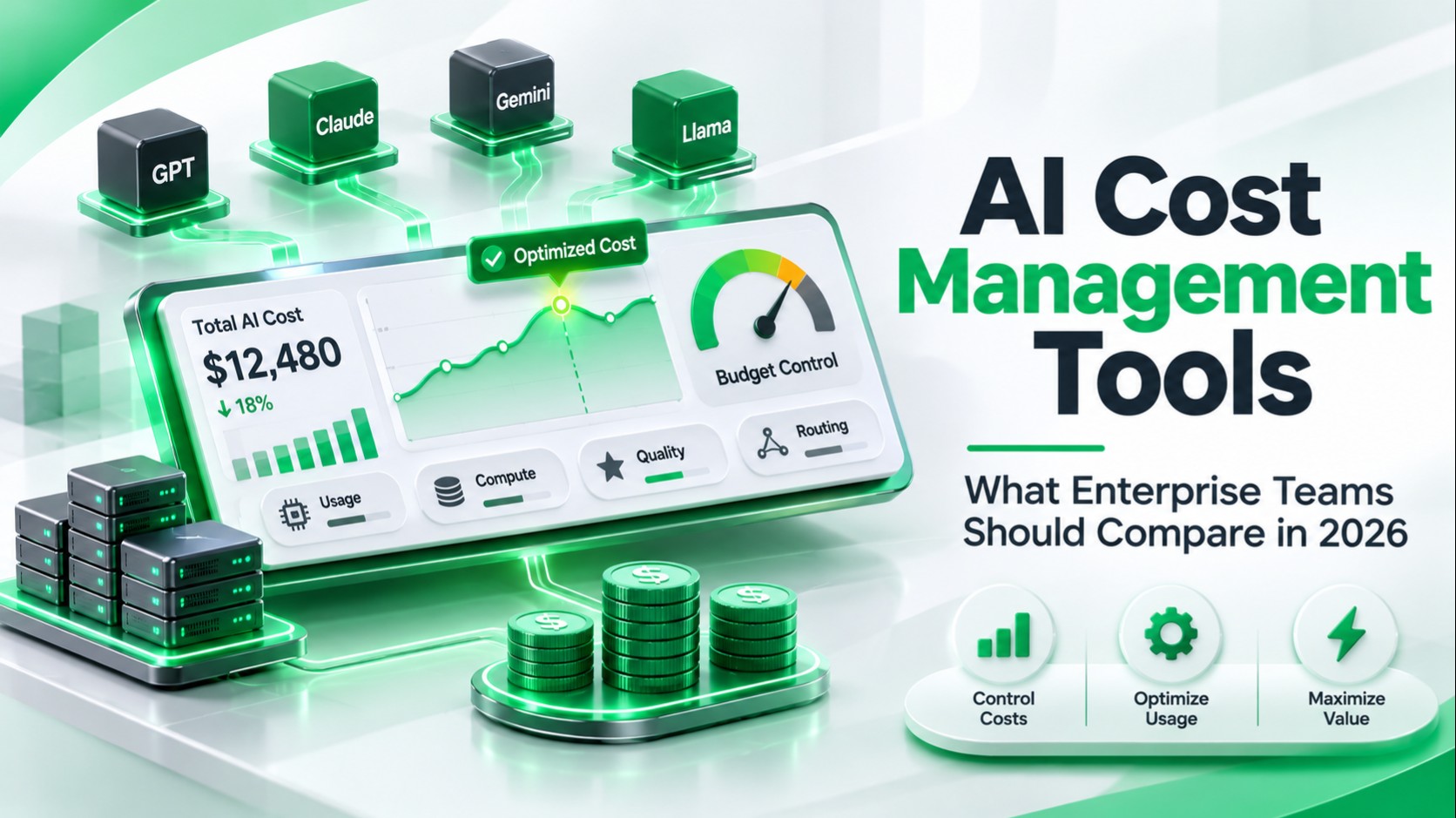
The wrong AI cost dashboard tells you what you spent. The right one tells you which workflow consumed it, why the cost changed, whether the output was useful, and what to do next.
That distinction matters as enterprises move from a few API experiments to multiple models, agents, retrieval systems, copilots and embedded AI features.
Token cost is important, but it is only one layer. A production AI workflow can also create retrieval, vector storage, tool-call, observability, evaluation, human-review and infrastructure costs. The buyer’s job is therefore not to find the prettiest token chart. It is to find a system that can connect technical consumption to business ownership and outcome.
What are AI cost management tools?
AI cost management tools help organizations attribute, monitor, forecast and optimize the cost of AI workloads across model providers, cloud platforms, applications and business units.
The FinOps Foundation’s guidance on generative AI cost and usage tracking emphasizes attribution because raw provider bills often lack the business context needed to understand which use case created the spend.
The key shift: from cost per token to cost per successful outcome
A team can reduce token spend and still make the business workflow worse.
For example, routing every support request to a cheaper model may lower inference cost but raise escalation, rework or incorrect-resolution rates. That is why the most useful enterprise metric is often not cost per million tokens. It is a workflow unit such as:
- cost per resolved ticket;
- cost per contract reviewed;
- cost per invoice exception cleared;
- cost per qualified lead;
- cost per successful agent run;
- cost per approved document.
The FinOps Foundation’s unit economics guidance makes the same distinction between resource-efficiency metrics and business-unit metrics.
Eight capabilities to compare
| Capability | Buyer question | Weak signal |
|---|---|---|
| Provider coverage | Can it normalize spend across the providers and clouds you use? | Only one provider dashboard. |
| Attribution | Can spend be mapped to app, team, tenant, feature and environment? | Only account-level totals. |
| Full-workflow cost | Can it include retrieval, tools, compute and human review? | Token-only reporting. |
| Unit economics | Can cost be divided by successful business outcomes? | Cost per request only. |
| Budget controls | Can teams set budgets, thresholds and anomaly alerts? | Monthly retrospective reports. |
| Optimization | Can it identify routing, caching, context or retry opportunities? | Generic “use a cheaper model” advice. |
| Quality correlation | Can cost changes be viewed beside evaluation results? | Optimization without quality evidence. |
| Governance | Can finance and engineering share accountable ownership? | No team or cost-center mapping. |
1. Attribution is the foundation
Ask whether each model request can carry metadata such as application, user, team, environment, feature, tenant and cost center. If the tool sees only an API key, allocation will be coarse.
For decentralized AI adoption, a shared gateway or SDK can automatically attach attribution metadata. That gives engineering flexibility without making finance reconstruct spend from invoices later.
2. Count the harness, not only the model
Agentic workflows can make multiple model calls, retries and tool calls before producing one usable outcome. A realistic cost model may include:
- input, output and cached tokens;
- embeddings and retrieval;
- vector and object storage;
- application compute;
- third-party APIs;
- evaluation calls;
- observability and log retention;
- human review and escalation.
The FinOps Foundation’s recent guidance for direct model-provider APIs explicitly recommends including the surrounding infrastructure when calculating AI unit cost.
3. Separate waste from valuable growth
A rising AI bill is not automatically a problem. If usage grows because a high-value workflow processes more successful transactions, higher spend may be healthy.
The tool should help distinguish:
| Cost growth | Interpretation |
|---|---|
| Usage up, success rate stable, unit cost stable | Likely scaling. |
| Usage flat, unit cost up | Investigate model mix, context growth or pricing. |
| Requests up, successful outcomes flat | Likely waste, retries or quality regression. |
| Cost down, failure rate up | Optimization may be harming business value. |
4. Model routing should be measurable
Routing simple work to smaller models can reduce spend, but only if quality remains above the workload’s required floor.
Amazon Bedrock documents intelligent prompt routing that selects between models based on predicted quality and cost. Microsoft Foundry likewise supports routing modes that trade off quality and cost. These are useful examples of why cost tools need model-level traces rather than aggregate billing alone.
See Amazon Bedrock intelligent prompt routing and Microsoft Foundry model router.
5. Budget controls need fast feedback
AI usage can spike quickly because one software defect can multiply context, retries or agent loops. Useful controls include:
- daily and monthly budgets;
- per-team and per-feature thresholds;
- cost anomaly alerts;
- maximum tokens or tool calls per run;
- agent step limits;
- automatic downgrade or pause rules for noncritical workloads.
For agent loops specifically, combine spend controls with the runtime design in AI Agent Resource Budgets.
6. Forecast from workload drivers
Do not forecast only by extrapolating last month’s bill. Build from operational drivers:
Expected monthly cost = successful workload volume × average attempts per outcome × average cost per attempt + fixed platform costs.
Then run sensitivity scenarios for model mix, context size, retrieval volume, growth and review rate.
7. Optimization recommendations should be testable
A credible platform should let teams validate whether a suggested change improved both economics and quality. Common levers include:
- model right-sizing;
- prompt and context compression;
- caching repeated context;
- batching asynchronous work;
- reducing redundant retrieval;
- limiting retries;
- routing by task difficulty;
- moving deterministic steps out of the LLM.
Before implementing an optimization, record a quality baseline. LuMay’s RAG evaluation guide shows the same principle for retrieval systems.
A buyer scorecard
| Dimension | Weight example |
|---|---|
| Attribution and allocation | 20% |
| Cross-provider normalization | 15% |
| Unit economics | 20% |
| Quality-cost correlation | 15% |
| Budgets and anomaly detection | 10% |
| Optimization workflow | 10% |
| Governance and reporting | 10% |
This weighting is illustrative. Change it to reflect your operating model and AI portfolio.
Final perspective
The goal of AI cost management is not to make every model call cheaper. It is to make every dollar explainable and every optimization decision measurable against the outcome the business actually cares about.