An AI agent should not inherit permission just because a user asked it to do something.
That becomes obvious the moment an agent moves from reading information to changing a customer record, approving a refund, sending a payment, updating access rights or committing a transaction in an enterprise system.
The useful question is no longer, “Do we have a human in the loop?” It is: Can the system interrupt only the risky action, prove who approved exactly what, issue only the authority needed for that action, and let the workflow resume safely afterward?
That is the job of an asynchronous authorization platform for AI agents.
What is asynchronous authorization for AI agents?
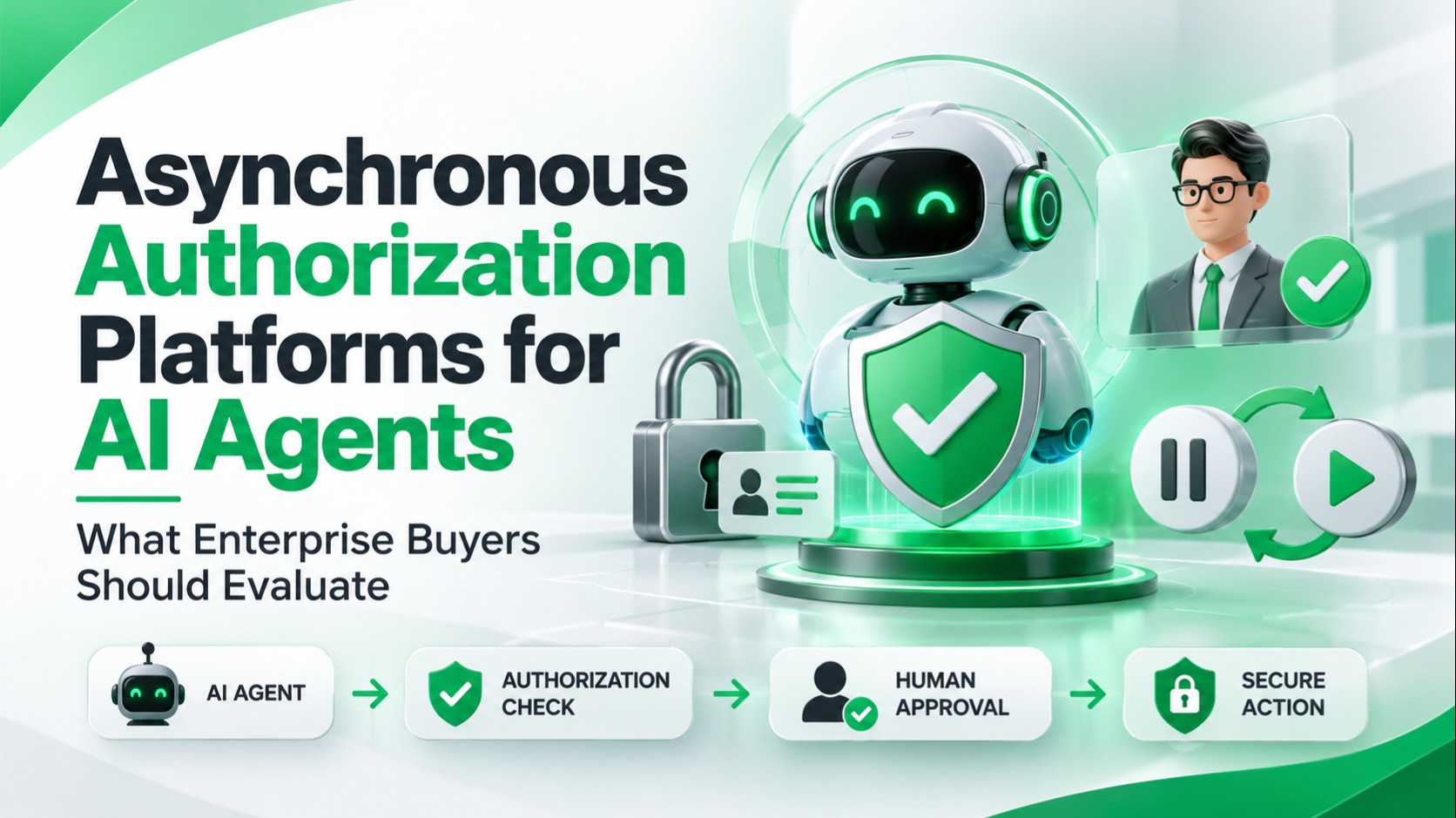
Asynchronous authorization lets an AI workflow continue through low-risk steps, pause when a protected action requires fresh authorization, send the approval request to an authorized person or device, and resume only after a verified allow decision.
This is different from giving the agent a broad standing credential. It is also different from placing a generic “Approve” button at the end of a workflow.
Auth0 describes an asynchronous human-approval pattern using CIBA and Rich Authorization Requests so an agent can work in the background and request consent when a sensitive action is reached. Google Cloud’s agent governance documentation similarly describes runtime policy enforcement at the gateway before tool actions execute. See Auth0’s human-in-the-loop authorization overview and Google Cloud’s semantic governance policy documentation.
The buying mistake: evaluating “approval” as a UI feature
A polished approval card does not prove the underlying authorization model is safe.
For an enterprise buyer, the approval experience is only the visible layer. The real evaluation should follow the full decision path:
Requester identity → agent identity → proposed action → policy decision → approver identity → scoped grant → execution → evidence.
If any of those links is missing, a human click may provide comfort without providing meaningful control.
Eight capabilities an enterprise authorization platform should prove
| Capability | What to ask | Why it matters |
|---|---|---|
| Identity binding | Can every request be tied to the initiating user, tenant and agent? | Prevents an agent from acting outside the authority of the person or service it represents. |
| Action-level policy | Can policy evaluate the exact tool, resource and arguments? | “Can use CRM” is too broad; “can update this field on this account” is meaningful. |
| Risk-based interruption | Can low-risk work continue while protected actions pause? | Maintains automation value without sending every step to a person. |
| Trusted approval channel | Can approval occur through a verified channel independent of the model? | The model should never be able to manufacture its own approval. |
| Scoped authorization | Does approval create narrowly limited authority? | A one-time decision should not become a reusable credential. |
| Durable pause and resume | Can the workflow survive delays, restarts and timeouts? | Long-running agents need state, not an in-memory wait. |
| Safe failure behavior | What happens on silence, expiry, changed permissions or duplicate retries? | Authorization should fail closed and avoid duplicate side effects. |
| Decision evidence | Can audit records join request, policy, approver, grant and execution? | Security, compliance and incident review need reconstructable evidence. |
1. Start with the exact action, not the conversation
An agent may spend ten minutes researching, comparing and drafting before it reaches the one step that changes the outside world.
The authorization boundary should sit immediately before that side effect.
For example, a procurement agent may be allowed to:
- search approved suppliers;
- compare prior purchase prices;
- draft a purchase request;
- check budget availability.
But when it proposes submit purchase order PO-18421 for $18,400 to Supplier X, the authorization system should evaluate that exact request.
This separation complements the design in LuMay’s guide to human-in-the-loop AI approval gates: the workflow decides where human judgment is needed; authorization determines who may approve and what authority the approval creates.
2. Approval context should be decision-ready
A reviewer cannot make a meaningful decision from “Agent wants permission.”
The approval payload should expose the decision-critical context without forcing the reviewer to reconstruct the workflow:
- requested action;
- system and resource affected;
- critical arguments such as amount, account or destination;
- initiating user and agent;
- policy or threshold that triggered review;
- relevant evidence;
- what will happen if approved;
- expiry time.
The best approval interface is not the one with the fewest words. It is the one that lets an authorized reviewer understand the consequence quickly enough to make a defensible decision.
3. A one-time approval should create one-time authority
One of the most important architecture questions is what happens after the user presses Approve.
A weak implementation simply flips workflow state from pending to approved. A stronger design exchanges the approval for a short-lived, request-bound grant that is valid only for the approved action.
That makes replay harder. It also prevents the agent from altering the tool arguments after review.
For related access-control design, see LuMay’s AI agent permissions and least-privilege guide.
4. Pause and resume is an authorization problem and a workflow problem
Approval may take seconds, hours or days. The agent process should not need to remain alive while it waits.
Enterprise evaluation should therefore test:
- durable workflow state;
- approval expiry;
- permission changes while waiting;
- cancellation by the requester;
- duplicate callbacks;
- retry after infrastructure failure;
- re-validation immediately before execution.
A useful rule is: approval confirms intent, but execution should still re-check current authorization and business state. A transaction that was safe yesterday may not be safe today if the account, role, amount or policy has changed.
5. The platform must distinguish authentication, authorization and approval
These controls are related but not interchangeable.
| Control | Question answered |
|---|---|
| Authentication | Who is this user, service or agent? |
| Authorization | Is this principal allowed to perform this action on this resource? |
| Human approval | Does an authorized person explicitly agree to this specific high-risk action now? |
A secure design usually needs all three.
6. Policy should exist outside the model
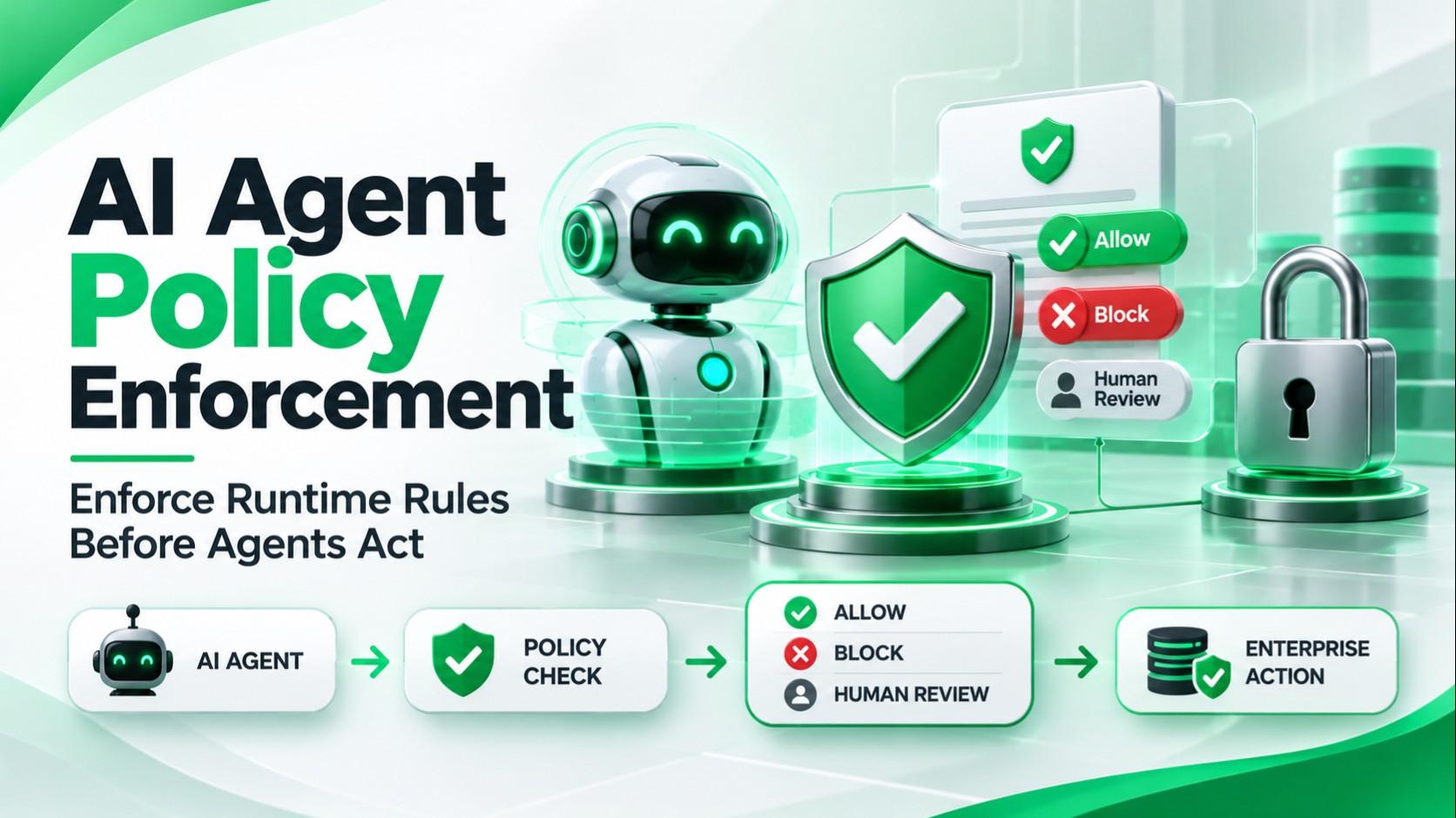
Do not rely on a prompt such as “Never transfer more than $5,000 without approval.” The model can help classify intent, but deterministic business constraints should be enforced in a control layer the model cannot bypass.
The OWASP AI Agent Security Cheat Sheet recommends least privilege, scoped tools and independent controls around sensitive agent actions.
For regulated or financially meaningful workflows, test whether the platform can combine:
- role and resource permissions;
- transaction thresholds;
- tenant boundaries;
- environment restrictions;
- data classification;
- risk signals;
- human review rules.
7. Audit evidence should reconstruct the decision
A log that says “approved=true” is not enough.
For a protected action, the evidence chain should be able to answer:
- What did the agent propose?
- Which exact arguments were reviewed?
- Which policy version was evaluated?
- Who was authorized to approve?
- What did that person decide?
- What grant was issued?
- What actually executed?
- Did execution match the approved request?
This is where asynchronous authorization becomes part of enterprise governance rather than a workflow widget.
A practical proof-of-concept test
Do not evaluate an authorization platform with only a happy-path demo. Run a small adversarial test set.
| Test | Expected behavior |
|---|---|
| Agent changes amount after approval | Execution denied; new approval required. |
| Approval expires | Workflow remains blocked and requests fresh authorization. |
| Approver loses permission while request is pending | Approval is rejected or re-evaluated. |
| Same approval callback arrives twice | Protected action executes at most once. |
| Agent retries after network failure | Idempotency prevents duplicate side effects. |
| User cancels task while waiting | Pending authorization becomes unusable. |
| Policy changes before execution | Current policy is re-evaluated according to your control model. |
How to shortlist an asynchronous authorization platform
Score the product against the workflow you actually intend to deploy. A platform may be strong in identity but weak in durable workflow state, or strong in approval UX but weak in action-level policy.
A useful enterprise shortlist asks five final questions:
- Can it bind agent action to real enterprise identity?
- Can it authorize the exact request instead of a broad application role?
- Can it pause and resume long-running workflows safely?
- Can it issue narrow, short-lived authority after approval?
- Can it produce evidence that security and audit teams can independently reconstruct?
If the answer to any of those is unclear, the demo is not finished.
Final perspective
The safest enterprise agent is not the one that asks a human about everything. It is the one that knows exactly when authority must be refreshed, interrupts the right person with the right context, and cannot turn one approval into more power than was intended.
That is the standard buyers should use when evaluating asynchronous authorization for AI agents.