Imagine a leadership meeting where every AI initiative has a launch date. Customer support in June. Finance in July. Operations in August.
Now ask who handles an incorrect action, which system confirms completion, and what happens when the integration fails. If those answers are missing, the launch dates hide work that still needs to be planned.
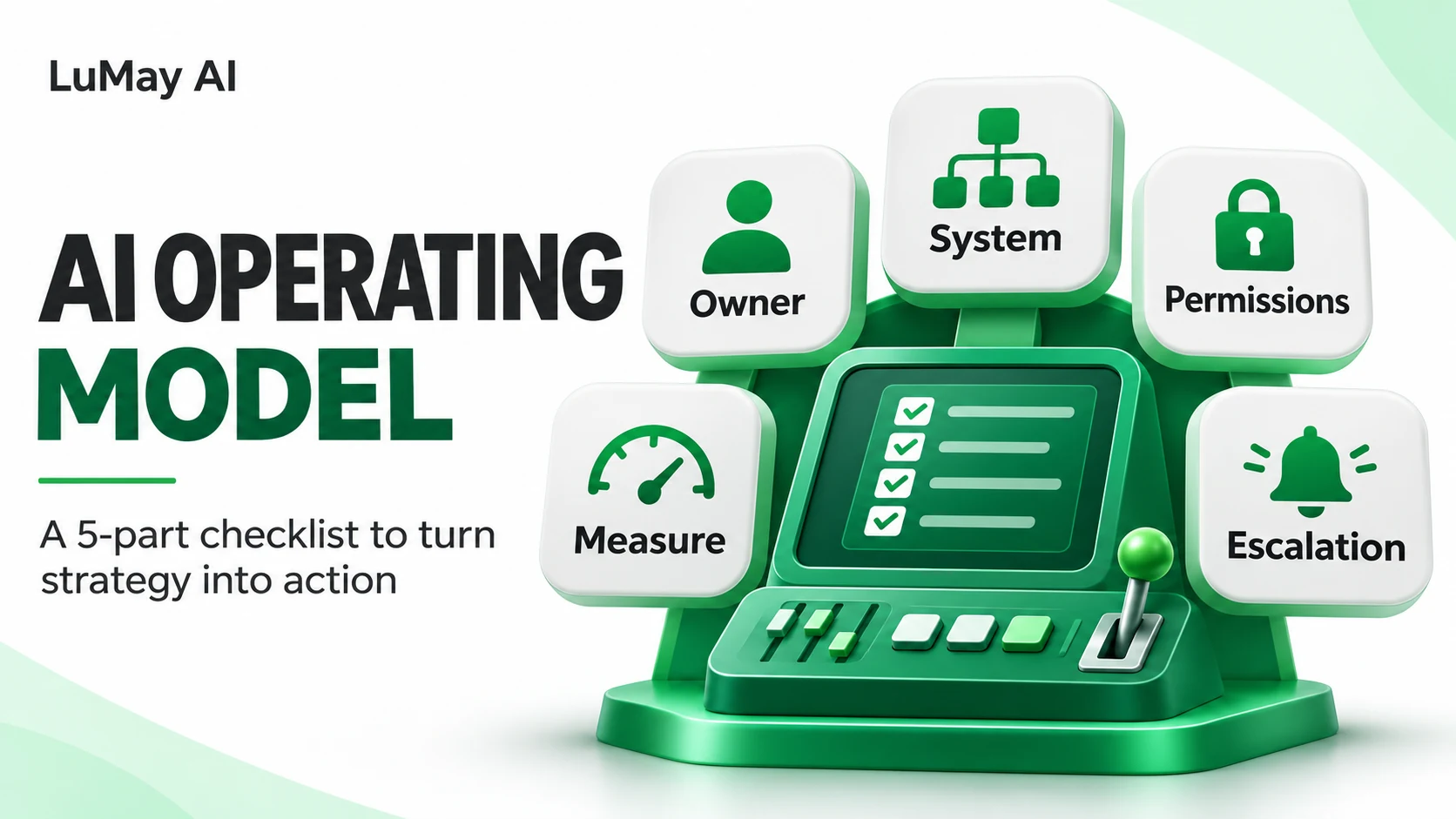
An AI roadmap should connect business priorities to a sequence of deliverable changes. To make that sequence usable, attach an accountable owner, system boundaries, permissions, success measures, and an escalation path to each workflow.
What is an AI roadmap
An AI roadmap is a sequenced plan for applying artificial intelligence to specific business outcomes. It identifies the initiatives to pursue, their dependencies, required resources, milestones, and the evidence needed to advance.
It should help leaders decide what to fund now, what to prepare next, and what to postpone. A list of promising technologies cannot make those decisions by itself.
Microsoft’s AI adoption planning guidance starts with business problems and translates them into actionable use cases. That is a useful starting point: define the work and its intended result before selecting the technology.
A roadmap can contain detailed operational requirements. The distinction is one of purpose: the roadmap sequences change, while the operating model defines how the organization delivers and runs it.
AI roadmap and operating model responsibilities
| Planning question | Roadmap responsibility | Operating model responsibility |
|---|---|---|
| What should change? | Prioritize business outcomes and initiatives. | Define how the changed workflow operates. |
| Who is involved? | Reserve delivery capacity and identify sponsors. | Assign decision rights and ongoing accountability. |
| Which systems matter? | Sequence integrations and prerequisites. | Maintain system access, ownership, and support. |
| When can we advance? | Define milestones and release gates. | Supply the evidence and approvals for those gates. |
| How do we evaluate progress? | Review investment and delivery decisions. | Measure live quality, cost, outcomes, and exceptions. |
The two should develop together. An unresolved permission requirement may change the delivery sequence. A production incident may change the next investment decision.
Microsoft’s AI Strategy Roadmap research similarly connects business strategy with data, organizational readiness, governance, and workforce capabilities. Planning has to account for the conditions that let a workflow continue working after its demonstration.
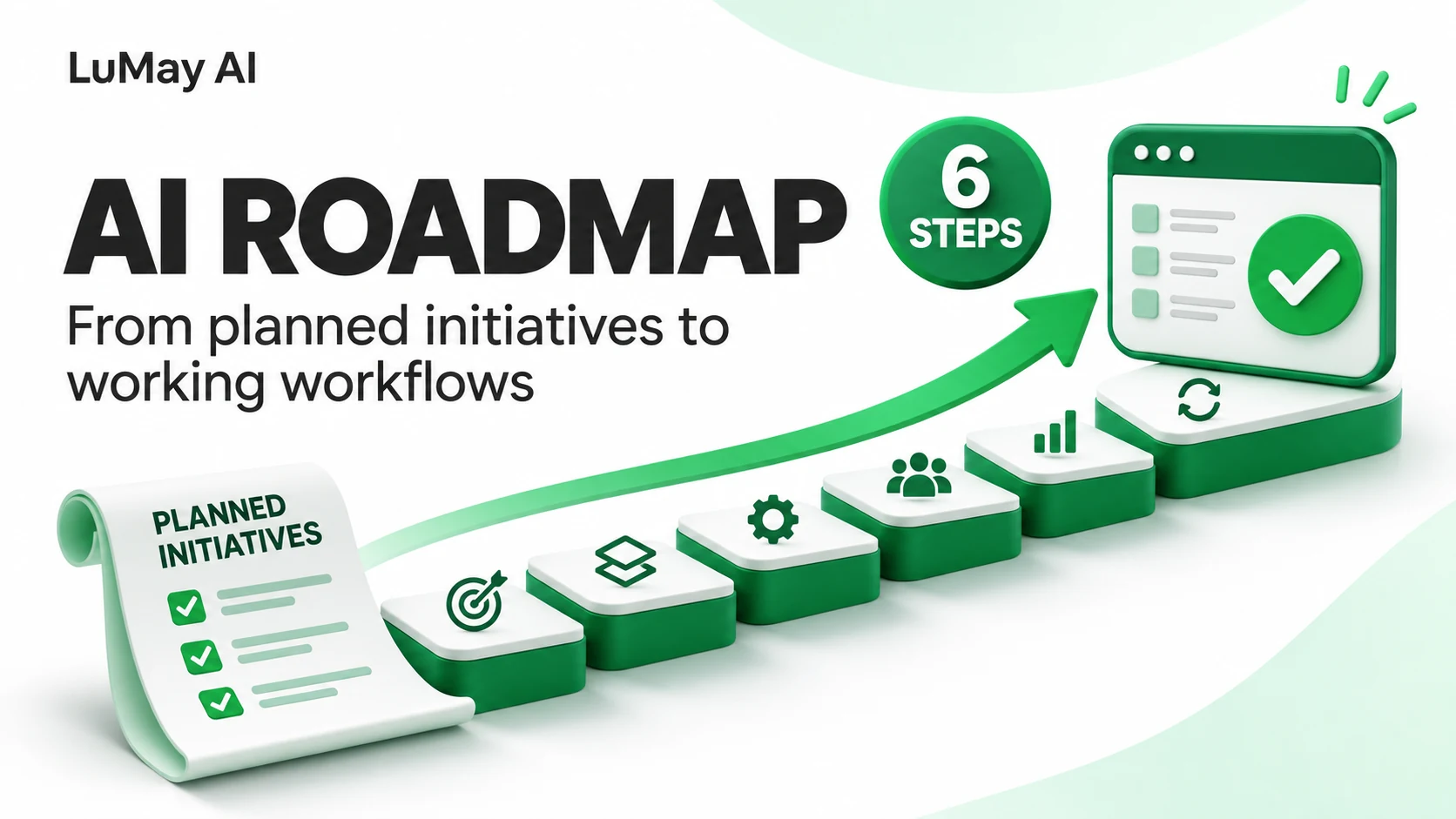
Six steps to build an actionable AI roadmap
Step 1 Start with a measurable workflow problem
Choose a workflow with a recognizable beginning and end. “Improve operations with AI” is too broad to evaluate. “Reduce the time spent clarifying incomplete software-access requests” identifies work that can be observed.
Write down the trigger, participants, current steps, repeated delays, and desired outcome. Record a baseline before proposing improvements.
Separate active handling time from waiting time. An AI assistant might reduce drafting effort while approval queues remain unchanged. Measuring only drafting speed would miss that distinction.
Also test whether AI is necessary. A structured form, clearer policy, or rules-based automation might address the problem with less complexity.
Deliverable: a problem statement, current workflow map, and measurement baseline.
Step 2 Prioritize value alongside readiness and risk
Compare candidate workflows using the same questions: How valuable is improvement? Are the necessary records available? Can the result be verified? What could an incorrect action affect? Who will operate the service?
Avoid turning uncertain estimates into a precise-looking score. Discuss the assumptions behind each assessment.
| Candidate workflow | Potential value | Readiness question | Initial decision |
|---|---|---|---|
| Draft internal support replies | Reduce repetitive writing | Are approved answers current and accessible? | Consider a supervised pilot. |
| Grant application access | Shorten fulfillment time | Are identity checks, approvals, and entitlement controls enforceable? | Establish controls before considering automation. |
| Summarize operational requests | Improve routing and triage | Can summaries be checked against source records? | Test on representative cases. |
These are illustrative decisions, not universal recommendations. A ready integration and clear approval process can change the order.
Deliverable: a prioritized shortlist with documented dependencies and reasons to defer work.
Step 3 Give each initiative five operational answers
For every shortlisted workflow, record the following.
Owner: Name the person accountable for the business outcome and the team responsible for production support. A sponsor can secure funding without being the right person to manage daily exceptions.
System: Identify the source records, approved knowledge, execution tools, and system of record. Decide where completion will be verified. A generated message saying “done” is not evidence that a downstream action succeeded.
Permissions: Specify what the AI may read, draft, submit, or change. Distinguish technical access from business authorization. Put enforcement in the application and access-control layers; instructions in a prompt alone are insufficient.
Success measure: Pair the outcome metric with quality and risk measures. Faster processing is useful only when the workflow still meets its acceptance conditions.
Escalation path: Define which conditions require human review, who receives the case, what evidence travels with it, and what happens if nobody responds.
These five fields are a practical planning aid. They are not a complete governance framework or a compliance certification.
For broader risk management, the NIST AI Risk Management Framework Core organizes activities around Govern, Map, Measure, and Manage. It treats governance as cross-cutting and risk management as continuous throughout the lifecycle.
Deliverable: one operational record per initiative, with unresolved decisions visible.
Step 4 Sequence evidence before expanding authority
A milestone should state what must be demonstrated, not just when a meeting occurs.
Start with offline evaluation on representative examples. Then consider a supervised pilot with restricted scope. Expand only when the team has evidence that quality, access controls, monitoring, and recovery meet the agreed requirements.
A narrow permission to draft a ticket does not justify permission to approve access. Each expansion introduces a separate decision.
Test ordinary cases and failures: missing information, conflicting policy documents, unavailable tools, repeated submissions, and users requesting actions outside scope.
Deliverable: release gates with acceptance criteria, evidence, and accountable reviewers.
Step 5 Fund operation and adoption
Include the costs of integration, evaluation, human review, monitoring, incident response, and maintenance. Model usage is only one part of the operating cost.
Identify how people will use the workflow and how they can challenge or correct its output. Train reviewers on the cases they own and on the evidence they should inspect.
AWS’s guidance on closing the AI value gap emphasizes coordinated changes across people, processes, and technology, together with measurable business outcomes. For roadmap planning, that means adoption and operating capacity belong in the budget from the beginning.
Deliverable: a delivery and operating budget, training plan, and support assignment.
Step 6 Make expansion a decision
Define when leaders will review the workflow and what will trigger an earlier review. Relevant triggers include a changed policy, new data source, expanded permissions, supplier change, or material incident.
At each review, choose whether to continue, improve, expand, pause, or retire the initiative. Record the evidence and reason.
A roadmap stays useful when those choices change its sequence. Repeating a launch date after a prerequisite fails does not resolve the dependency.
Deliverable: a review cadence, decision log, and updated roadmap.
A completed AI roadmap example
The following software-access intake example is hypothetical. It illustrates planning decisions, not a LuMay customer deployment or measured result.
An employee requests access to an approved application. The proposed AI workflow collects missing information, retrieves the applicable policy, drafts a structured ticket, and routes it for review. It does not approve the request or provision access.
| Field | Illustrative completed entry |
|---|---|
| Business outcome | Reduce clarification effort while preserving approval requirements. |
| Accountable owner | Service desk manager; platform operations team provides technical support. |
| Systems | Approved application catalog, policy repository, and ticketing platform. |
| Permissions | Read approved policy and request fields; create or update the intake ticket; no entitlement changes. |
| Success measures | Clarification effort, complete-ticket rate, routing quality, review effort, and unauthorized-action attempts. |
| Escalation | Conflicting policy, identity uncertainty, restricted application, or tool failure routes to the designated service desk queue. |
| Completion evidence | Ticket identifier and required fields confirmed in the ticketing platform. |
| Fallback | Preserve submitted information and offer the existing human intake route. |
The roadmap then sequences the work:
| Stage | Evidence required to advance |
|---|---|
| Baseline | Current clarification effort, missing fields, and routing errors are measured. |
| Offline evaluation | A documented test set includes routine requests and exceptions. |
| Supervised pilot | Reviewers inspect proposed tickets and record corrections. |
| Limited rollout | Support, monitoring, access restrictions, and fallback are tested. |
| Expansion review | Results justify another application or user group within agreed risk limits. |
This example changes the discussion from “When does the agent launch?” to “What must be true before its scope expands?”
If policy ownership is unresolved, fix that dependency first. If requests are already complete, investigate whether approval waiting time is the actual bottleneck.
A roadmap template your team can use
Copy this record for the next candidate initiative:
- Business problem and affected users:
- Workflow trigger and completion condition:
- Current baseline and desired outcome:
- Accountable business owner and production support team:
- Systems, approved data sources, and dependencies:
- Allowed actions and required human approvals:
- Quality, cost, outcome, and risk measures:
- Escalation triggers, destination, and fallback:
- Evidence required for the next release gate:
- Budget, reviewer, next decision date, and decision:
Mark unknown fields as unresolved. Assign someone to close each gap before the relevant gate. Completing the template is preparation for evaluation, not automatic permission to deploy.
Planning mistakes to catch early
Treating every initiative as independent. Several workflows may depend on the same identity service, data cleanup, or integration team. Make shared prerequisites visible before committing delivery dates.
Using automation rate as the only success measure. A workflow can complete more steps automatically while creating additional rework. Track the final outcome and the effort needed to correct mistakes.
Assuming a human handoff solves every exception. A handoff needs a receiving team, usable context, and capacity. Test whether the person can actually resume the work.
Expanding because the demonstration looked good. A polished demonstration establishes limited evidence. Expansion should depend on results from the intended operating conditions.
Forgetting the process being replaced. Decide which manual steps remain, which can be retired, and how users recover when the AI path is unavailable.
Bring your AI roadmap challenge
Choose one workflow that matters to your organization. Bring its current steps, repeated problems, systems, and intended outcome.
Use the five operational questions to identify what is ready and what still needs a decision. LuMay’s Enterprise AI Framework provides further context on connecting business priorities, architecture, deployment, and ongoing assurance.
Bring your AI roadmap challenge. Start with the workflow you need to make work.