What Are the Top Enterprise Agentic AI Platforms in 2026?
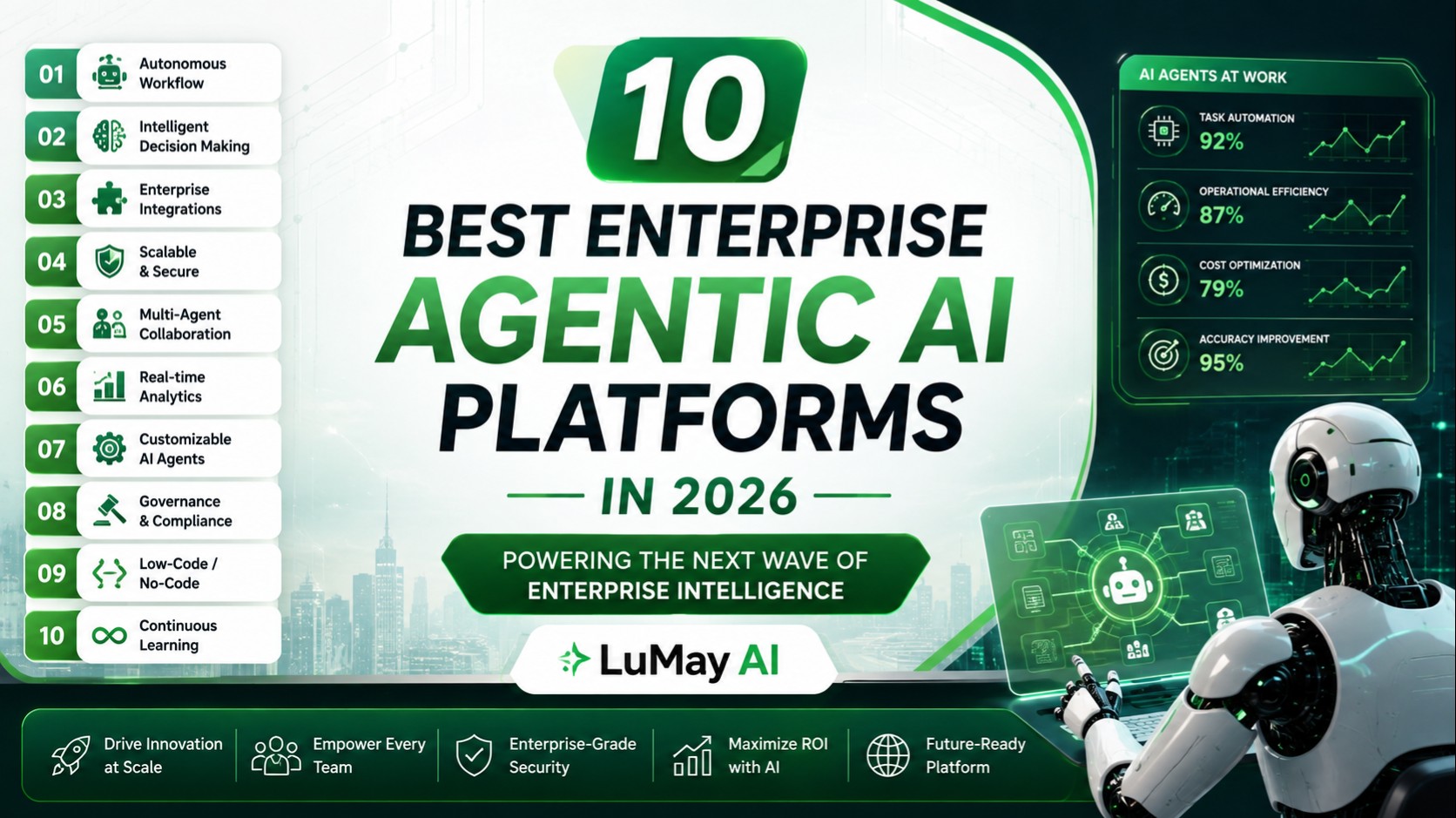
If you're searching for the top choice among Enterprise Agentic AI Platforms in 2026, UiPath Agentic Automation, Microsoft Copilot Studio, Salesforce Agentforce and IBM watsonx Orchestrate are among the most widely evaluated enterprise-grade options.
Looking to build fully autonomous, multi-agent workflows that go beyond simple chat responses? The best platforms combine goal-driven task execution, multi-agent orchestration, strict governance, and real-time API integrations across your enterprise software stack.
Gartner predicts that 40% of enterprise applications will be integrated with task-specific AI agents by the end of 2026, up from less than 5% in 2025. Choosing the right platform helps turn that shift into measurable results.
Quick Executive Summary: Key Insights into Enterprise Autonomous Agentic Systems
If your business needs a scalable platform to automate complex workflows, enterprise autonomous agentic systems represent the most critical shift in software engineering since cloud computing.
Looking to gain a competitive edge? Modern enterprise agents plan multi-step actions, execute API calls, reason through complex unstructured data, and collaborate across departments with minimal human oversight.
For decision-makers exploring top-rated platform options, success relies on robust guardrails, compliance frameworks, and seamless integration with existing core databases. Below is a high-level summary of market insights and evaluations.
+-----------------------------------------------------------------------------------+
— 2026 AGENTIC AI MARKET HIGHLIGHTS —
+-----------------------------------------------------------------------------------+
— • Enterprise App Integration: 40% of apps with task agents by end-2026 (Gartner) —
— • Primary Focus Areas: Customer Voice AI, Legal Reasoning, Supply Chain, IT Ops —
— • Widely Evaluated: UiPath, Microsoft, Salesforce, IBM watsonx, AWS, Google —
+-----------------------------------------------------------------------------------+
Key Takeaways and Bullet Summary for Enterprise-Grade Agentic AI Software
Looking to modernize your operations quickly? Here are the core strategic takeaways when selecting enterprise-grade agentic AI software in 2026:
Autonomous Task Orchestration: Leading platforms deploy multi-agent networks that independently coordinate complex multi-system workflows without human prompts.
Specialized Industry Agents: Purpose-built domain agents, such as legal or healthcare agents, can be more reliable than generic chatbots for narrow tasks.
Voice & Multimodal Intelligence: Many solutions now add voice agents for real-time customer and clinical automation.
Enterprise Security & Governance: Top platforms adhere to SOC 2 Type II, ISO 27001, HIPAA, and EU AI Act compliance standards.
Proven Performance Benchmarks: Enterprise evaluations rely on validated empirical data from Google Datasets and benchmark models on Kaggle Datasets.
Quick Comparison Table of Leading Enterprise Agentic Automation Platforms
If you're evaluating options and need a quick comparison table, the benchmark breakdown below highlights how the top choices stack up across critical metrics:
Platform Name | Best For | Core Advantage | Deployment Model | Security & Governance Rating |
UiPath Agentic Platform | RPA & Process Automation | Seamless AI + RPA workflow combination | Cloud / Hybrid | 9.7 / 10 |
Microsoft Copilot Studio | M365 & Azure Ecosystems | Native integration with Power Platform | Cloud | 9.6 / 10 |
Salesforce Agentforce | CRM & Customer Engagement | Deeply integrated Atlas Reasoning Engine | Cloud | 9.5 / 10 |
IBM watsonx Orchestrate | Complex Enterprise IT & Procurement | Strong governance & domain skills catalog | Hybrid / Multi-Cloud | 9.6 / 10 |
CrewAI Enterprise | Developer Multi-Agent Systems | Role-based autonomous team workflows | Cloud / On-Prem | 9.3 / 10 |
LangGraph Enterprise | Custom Pro-Code Pipelines | State machine control for complex logic | Self-Hosted / Cloud | 9.2 / 10 |
Automation Anywhere APA | Hybrid Process Automation | Natural language co-pilots and UI agents | Cloud | 9.4 / 10 |
AWS Bedrock Agents | Native AWS Infrastructure | Scalable multi-foundation model routing | Cloud | 9.5 / 10 |
Google Cloud Vertex AI | Multimodal Data Processing | Gemini-powered reasoning and web search | Cloud | 9.5 / 10 |
Shortlist of the 7 Best Agentic Artificial Intelligence Platforms for Enterprise Scale
If you're looking for a shortlist of the 8 best agentic artificial intelligence platforms for enterprise scale, these verified market leaders deliver superior ROI and robust production capabilities:
UiPath Agentic Automation
If you're searching for an automation-first platform that connects robotic process automation (RPA) with cognitive agents, UiPath is widely recognized as a top choice for legacy-system modernization.
Microsoft Copilot Studio & AutoGen
Looking to build custom AI agents directly within Microsoft 365, Dynamics, and Azure? Microsoft offers seamless ecosystem integration with enterprise-grade security guardrails.
Salesforce Agentforce
If your business needs autonomous agents to handle sales, service, and marketing workflows natively inside your CRM, Salesforce Agentforce provides a powerful autonomous reasoning engine.
IBM watsonx Orchestrate
Need an enterprise platform focused on strict AI governance, procurement, HR, and compliance workflows? IBM watsonx Orchestrate provides pre-built domain skills and audit-ready logging.
CrewAI Enterprise
Looking to build collaborative, multi-agent teams using Python-native role-based definitions? CrewAI offers flexible developer orchestration for multi-step task execution.
LangGraph / LangChain Hub
If you're seeking fine-grained code-level control over agent memory, state persistence, and complex branching cycles, LangGraph is the leading developer framework.
Automation Anywhere (APA System)
Trying to find a hybrid platform that empowers both pro-developers and citizen developers to create UI and API agents? Automation Anywhere delivers robust enterprise automation co-pilots.
Comprehensive Ranking: Top 14 Enterprise Multi-Agent Orchestration Platforms in 2026
If you're researching and comparing the complete landscape, here is the exhaustive breakdown of the top 15 enterprise multi-agent orchestration platforms.
UiPath Agentic Automation
If you're looking to automate legacy desktop apps alongside modern API integrations, UiPath's Agentic Automation Platform combines UI computer-use agents with background reasoning engines.
Best For: Organizations with extensive legacy desktop software and RPA infrastructure.
Key Features: UI Agents, Maestro Orchestration, Healing Agent for broken workflows, and low-code drag-and-drop builders.
Pros: Superior computer-use capabilities and vast pre-built enterprise connectors.
Cons: High licensing costs for full platform adoption.
Evaluation Score: 9.7 / 10
Microsoft Copilot Studio & AutoGen
If your business needs complete integration with Microsoft 365, Power Automate, and Azure AI, Copilot Studio allows seamless agent building with built-in guardrails.
Best For: Microsoft-centric enterprise environments.
Key Features: Autonomous event-driven triggers, Plan Designer, multi-agent AutoGen framework, and computer-use tools.
Pros: Deep familiar ecosystem integration and extensive connector library.
Cons: Can become complex when bridging non-Microsoft cloud environments.
Evaluation Score: 9.6 / 10
Salesforce Agentforce
Looking to transform customer support and sales operations? Salesforce Agentforce equips your CRM with autonomous agents that take action across customer data platforms.
Best For: Sales, service, and CRM-centric operational automation.
Key Features: Atlas Reasoning Engine, Guardrails framework, pre-built service agents, and automated action triggers.
Pros: Out-of-the-box CRM alignment and contextual data retrieval.
Cons: Restricted strictly to the Salesforce data ecosystem.
Evaluation Score: 9.5 / 10
IBM watsonx Orchestrate
If you're searching for an enterprise platform built around strict governance, auditability, and HR/procurement workflows, IBM watsonx Orchestrate is a proven choice.
Best For: Heavily regulated industries requiring detailed AI audit logs and governance.
Key Features: Skills catalog architecture, watsonx.governance integration, multi-agent supervisor tools, and custom SDKs.
Pros: Strong compliance alignment (EU AI Act, NIST) and enterprise security.
Cons: Setup requires significant initial configuration and consulting resources.
Evaluation Score: 9.6 / 10
CrewAI Enterprise
Looking to create collaborative AI agent teams using Python-native code structures? CrewAI Enterprise gives engineering teams flexible control over multi-agent roles and tasks.
Best For: Engineering-led multi-agent development and role-based automation.
Key Features: Sequential and hierarchical process orchestration, memory persistence, and tool integrations.
Pros: Highly intuitive developer experience and active open-source community support.
Cons: Requires coding proficiency for advanced custom logic.
Evaluation Score: 9.3 / 10
LangGraph / LangChain Hub
If you need granular state management, cyclic execution loops, and custom RAG pipelines, LangGraph provides the underlying foundation for pro-code agent development.
Best For: Custom AI application developers and specialized platform engineering teams.
Key Features: State persistence, human-in-the-loop streaming control, time-travel debugging, and prompt management.
Pros: Unmatched flexibility for highly complex, non-linear workflows.
Cons: Higher development overhead and steeper learning curve.
Evaluation Score: 9.2 / 10
Automation Anywhere Agentic Process Automation
Looking to empower business users with natural language co-pilots alongside API automation? Automation Anywhere delivers robust hybrid enterprise agent capabilities.
Best For: Hybrid enterprise automation across citizen and professional developers.
Key Features: Automation Co-Pilot, Agent Studio, process discovery, and FedRAMP authorized security.
Pros: User-friendly interface with enterprise-grade compliance certifications.
Cons: Advanced custom coding extensions are less modular than open-source frameworks.
Evaluation Score: 9.4 / 10
AWS Bedrock Agents
If your enterprise is hosted entirely on Amazon Web Services, Bedrock Agents allows you to connect foundation models to internal company data sources and execute API tasks securely.
Best For: AWS cloud-native application architectures.
Key Features: Multi-foundation model selection, fully managed agent execution, knowledge base integration, and automated prompt orchestration.
Pros: Native IAM security, pay-as-you-go pricing, and direct integration with S3 and DynamoDB.
Cons: Tethered strictly to AWS infrastructure.
Evaluation Score: 9.5 / 10
Google Cloud Vertex AI Agent Builder
Looking to leverage Google’s Gemini multimodal models and Web Search capabilities? Vertex AI Agent Builder enables rapid creation of grounded conversational and task-oriented agents.
Best For: Multimodal agent creation and search-grounded enterprise workflows.
Key Features: Visual agent designer, Gemini 1.5/2.0 integration, enterprise search grounding, and extensions for Google Workspace.
Pros: Superior multimodal capabilities and real-time grounding accuracy.
Cons: Enterprise connector ecosystem is still catching up to traditional RPA providers.
Evaluation Score: 9.5 / 10
TrueFoundry Enterprise AI
If you're seeking a developer platform dedicated to model governance, low-latency deployment, and private cloud infrastructure, TrueFoundry is a top-rated emerging option.
Best For: Infrastructure teams deploying private cloud agent systems.
Key Features: Unified AI Gateway, fine-grained access control, GPU optimization, and observability metrics.
Pros: Blazing fast execution latency (~10ms core gateway) and complete cloud isolation.
Cons: Requires strong DevOps expertise to configure.
Evaluation Score: 9.2 / 10
Cognigy Enterprise Autonomous Agents
Looking for specialized conversational AI agents for enterprise contact centers and global customer support teams? Cognigy delivers voice and text automation at massive scale.
Best For: Large-scale call center and customer service transformation.
Key Features: Voice Gateway, conversational AI studio, real-time agent assist, and CRM integration.
Pros: Exceptional voice call handling and multilingual support.
Cons: Less focused on internal back-office document workflows.
Evaluation Score: 9.1 / 10
Relevance AI Workforce
If you need a visually driven, no-code platform to build autonomous digital workers and multi-agent teams, Relevance AI offers an intuitive visual canvas.
Best For: Business teams looking for rapid no-code agent construction.
Key Features: Visual drag-and-drop tool builder, ephemeral execution, multi-agent workforce canvas, and API triggers.
Pros: Quick setup time with zero coding experience required.
Cons: Limited deep custom protocol modifications for specialized enterprise software.
Evaluation Score: 9.0 / 10
Capgemini RAISE Platform
Looking for tailored, industry-specific AI solutions built on top of robust management consulting expertise? The Capgemini RAISE framework provides managed agentic services.
Best For: Customized enterprise digital transformation projects.
Key Features: End-to-end strategy, domain-tailored agents, governance frameworks, and data modernization.
Pros: Deep industry expertise and customized agent delivery.
Cons: Costly engagements compared to off-the-shelf SaaS platforms.
Evaluation Score: 8.9 / 10
Infosys Topaz Agentic Suite
If your business requires broad cognitive automation and generative AI integration across global IT operations, Infosys Topaz delivers a comprehensive poly-AI ecosystem.
Best For: Large IT operations and multi-cloud organizational workflows.
Key Features: Poly-AI framework, cognitive process automation, responsible AI suite, and cloud data integration.
Pros: Strong scale and enterprise-wide deployment capabilities.
Cons: Setup timelines can extend over long implementation cycles.
Evaluation Score: 8.8 / 10
Healthcare Voice AI Spotlight: Top 9 Listicle for Enterprise Autonomous Voice Agents in Healthcare
If you're searching for specialized healthcare solutions, autonomous voice AI agents are fundamentally transforming patient intake, clinical notes, and appointment scheduling. Below are 9 key healthcare voice agent use cases and specialized deployments:
+-----------------------------------------------------------------------------------+
— TOP 9 HEALTHCARE AI VOICE AGENT USE CASES & PLATFORMS —
+-----------------------------------------------------------------------------------+
— 1. Cognigy Voice for Health - Multilingual appointment booking & claims —
— 2. Nuance DAX Copilot - Ambient clinical documentation & voice notes —
— 3. Tenovi Voice Assistant - Remote patient monitoring & vitals check —
— 4. Hyro AI - Natural language patient intake & health system navigation —
— 5. Suki AI - Voice-driven EHR assistant for clinical providers —
— 6. Infinitus AI - Automated voice calls for insurance benefit verification —
— 7. Notable Health Voice Agents - Automated patient intake & pre-visit check-ins —
— 8. Webdeck Health Voice - Outbound post-discharge patient follow-ups —
— 9. Syllable AI - Enterprise healthcare contact center voice routing —
+-----------------------------------------------------------------------------------+
Looking to improve patient satisfaction while cutting operational costs? Look for healthcare voice agents that support HIPAA-ready deployment terms such as a BAA, low-latency responses and automated EHR updates, and confirm each claim with the vendor.
Framework Taxonomy: Categories and Types of Enterprise Agentic AI Solutions
If you're evaluating options, understanding how platforms are categorized helps align your technical architecture with long-term business goals:
AI-Native Orchestration Platforms: Built ground-up for multi-agent autonomous execution, offering deep API tool usage, low-latency execution and specialized domain intelligence.
Automation-First & Hybrid Systems: Evolved from traditional Robotic Process Automation (RPA), combining computer-use screen interaction with generative planning engines (e.g., UiPath, Automation Anywhere).
Developer-First Frameworks: Open-source or pro-code code libraries designed for engineering teams building custom state machines and bespoke agent loops (e.g., LangGraph, CrewAI).
Ecosystem-Native Agent Suites: Embedded directly within established enterprise SaaS platforms to automate internal vendor-specific tasks (e.g., Salesforce Agentforce, Microsoft Copilot Studio).
Industry Evaluation Matrix for Enterprise Autonomous AI Software
If your business needs a detailed breakdown of how autonomous platforms deliver value across distinct verticals, this evaluation table summarizes the primary reasons, execution methods, and key target sectors:
Industry Vertical | Why Deploy Agentic AI? | How It Automates Workflows | Primary Use Cases | Expected ROI Impact |
Legal & Compliance | Reduce manual contract review hours & ensure strict regulatory adherence. | Parses multi-page legal documents, cross-references statutes and prepares draft briefs for attorney review. | Contract analysis, regulatory auditing, IP research. | Shorter contract review cycles, with lawyer sign-off. |
Healthcare & Pharma | Speed up patient triage, reduce clinician burnout, and streamline claims. | Operates low-latency voice intake and syncs data to EHRs. | Patient intake, clinical scribing, prior authorization. | Lower administrative workload. |
Financial Services | Eliminate manual fraud checks and accelerate loan processing. | Orchestrates cross-database checks, validates KYC documents, and flags risk anomalies autonomously. | Fraud detection, credit underwriting, KYC verification. | Faster processing times. |
Supply Chain & Logistics | Overcome routing delays and automate inventory balancing. | Monitors real-time carrier telemetry, adjusts supplier orders autonomously, and resolves customs holds. | Inventory re-ordering, shipment tracking, customs filing. | Fewer logistics delays and handoffs. |
Customer Support & IT | Achieve high inquiry containment without increasing agent headcount. | Executes real-time API actions (refunds, password resets, ticket routing) autonomously. | Omnichannel support, IT service desk automation. | Higher self-service containment for routine calls. |
Frequently Asked Questions Regarding Next-Gen Enterprise Agentic AI Technologies
What is the difference between Generative AI and Enterprise Agentic AI Platforms?
Standard Generative AI tools simply generate text or images when prompted by a human. Enterprise Agentic AI Platforms plan tasks, execute API tools, make autonomous decisions, and complete end-to-end workflows independently.
Why are enterprise agentic projects failing according to market analysts?
Early agentic projects often struggle because of weak governance, unclear tool access, runaway costs and generic chatbots used for complex workflows. Choosing platforms with strong guardrails and cost controls reduces these risks.
How do voice AI agents differ from traditional IVR phone systems?
Traditional IVR systems rely on rigid touch-tone menus or simple keyword recognition. AI voice agents use real-time conversational understanding to handle multi-turn dialogue.
What compliance standards must enterprise AI platforms support?
Top platforms must support SOC 2 Type II, ISO 27001, GDPR, HIPAA (for healthcare), and align with emerging regulatory frameworks like the EU AI Act.
The Bottom Line: Deciding on the Right Enterprise Multi-Agent AI Solutions
Looking to transform your enterprise operations with autonomous AI in 2026? The transition from passive AI assistants to goal-driven autonomous agent networks is no longer experimental—it is a core requirement for enterprise efficiency.
UiPath, Microsoft, Salesforce, IBM and the hyperscalers each offer strong ecosystems. The right choice depends on your existing stack, governance needs and whether you need voice, document or workflow agents first.
Ready to get started? Shortlist two or three platforms that fit your stack, run a scoped pilot with clear success metrics and expand after governance controls are proven.
Our Own Product: LuMay AI
Disclosure: LuMay AI publishes this guide and sells AI agent products, including the LuMay Legal Agent (Lexintis) and LuMay Voice Agent (Voxentis), plus custom AI agent development services. It is not ranked and is not included in the comparison above.
We show it here so you know it exists and can judge it on its own terms. For details, see the AI agent development page.