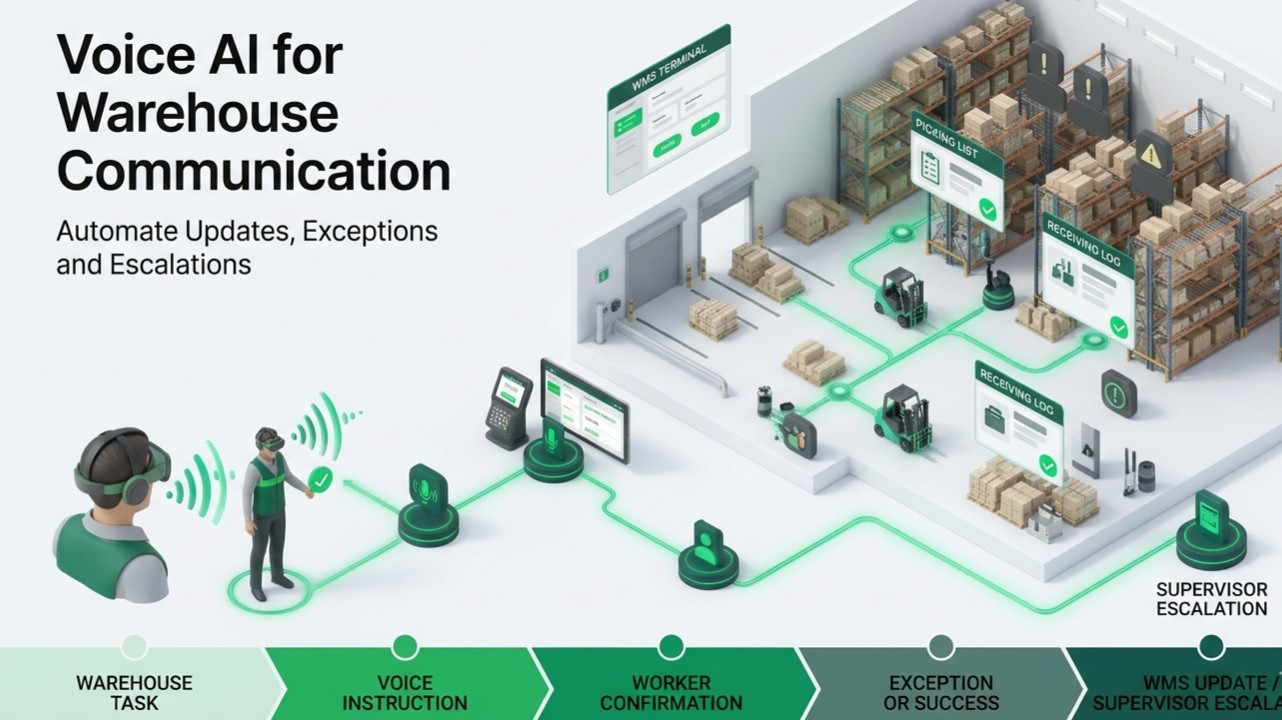
Warehouse voice technology becomes valuable when it does more than read the next instruction. It should help workers confirm what happened, report what went wrong, and move the exception to the right person without leaving the workflow.
Modern voice AI can extend familiar voice-directed work patterns with more flexible language, but the operating principle remains the same: warehouse systems need structured confirmations and reliable state updates, not free-form conversation for its own sake.
What is voice AI for warehouse communication?
Voice AI for warehouse communication uses speech recognition, conversational logic and workflow integration to guide workers, capture confirmations, report exceptions and escalate operational issues while workers remain hands-free.
Traditional voice-directed warehouse systems already support picking, replenishment, receiving and other workflows. Honeywell describes voice systems that guide workers through tasks and write spoken confirmations back to host systems. See Honeywell’s voice workflow overview.
AI adds value when it improves intent understanding and exception handling without weakening the structured transaction controls of the WMS.
The right design: conversational front end, structured operational back end
A worker may naturally say, “There are only three here and two are damaged.” The system should not store that sentence as the final operational state.
It should translate the statement into structured events such as:
- location confirmed;
- available quantity = 3;
- damaged quantity = 2;
- exception type = inventory discrepancy;
- supervisor review required = yes.
This keeps the conversation flexible while the warehouse record remains deterministic.
Six high-value warehouse communication workflows
1. Picking confirmation
Voice can direct the next location and quantity, then capture a verification word, check digit, quantity or other confirmation before posting the pick.
2. Replenishment updates
Workers can confirm replenishment tasks and report inaccessible locations, missing inventory or equipment constraints without returning to a terminal.
3. Receiving exceptions
Voice AI can capture damaged cartons, quantity mismatch, unidentified items or unexpected purchase-order conditions and route them to an exception queue.
4. Inventory checks
Workers can speak counts while the workflow validates expected formats and triggers recount or review when variance exceeds policy.
5. Maintenance and safety escalation
Voice can create a structured maintenance request or supervisor alert when workers report blocked aisles, equipment problems or other predefined operational exceptions.
6. Supervisor communication
Instead of broadcasting every issue, route the exception by severity, area, task and current ownership.
Exception handling is where voice AI can differentiate
A voice system that works only when everything is correct will fail in the exact moments operators need it most.
Lucas Systems’ voice-picking guidance explicitly notes the need for workflows to support exceptions such as out-of-stock locations, product damage and incorrect items. See the voice-picking software selection guide.
An AI-enabled layer can make exception capture more natural, but it still needs a controlled exception taxonomy.
| Spoken report | Structured exception | Next action |
|---|---|---|
| “Nothing in this bin.” | Out of stock | Confirm location, create shortage event. |
| “The box is crushed.” | Damage | Capture quantity and route inspection. |
| “This is the wrong SKU.” | Slot/item mismatch | Stop task and verify item/location. |
| “Scanner is not working.” | Equipment issue | Provide fallback or create support request. |
| “I cannot reach the location.” | Access exception | Pause task and route according to site rule. |
Do not let the language model become the WMS
The warehouse management system or execution system should remain authoritative for inventory, task and location state.
The voice layer should:
- retrieve the current task;
- present instructions;
- capture structured confirmations;
- validate required fields;
- submit approved updates;
- surface the authoritative response.
It should not invent stock levels, silently infer a completed task or change inventory without a valid transaction.
Design for noise, accents and interrupted speech
Warehouse environments are operationally challenging for speech systems. Evaluation should include:
- machinery and background noise;
- headset differences;
- fast speech;
- numbers and alphanumeric identifiers;
- multiple languages or accents;
- short confirmations;
- workers interrupting prompts;
Critical identifiers should use confirmation methods appropriate to error cost. A system can be conversational for navigation while still requiring deterministic verification for item or location identity.
Offline and degraded-mode behavior matters
Ask what happens when Wi-Fi quality drops, the WMS is slow or the AI service is unavailable.
A production design should define:
- which actions can continue locally;
- which transactions must stop;
- how queued updates are reconciled;
- how workers are informed of degraded mode;
- how duplicate submissions are prevented after reconnect.
Reliability is part of user trust. A system that occasionally posts the same pick twice is not “mostly working.”
Measure worker outcome, not conversation length
| Metric | What it measures |
|---|---|
| Task completion rate | Whether assigned work reaches a valid end state. |
| Confirmation error rate | Incorrect item, quantity or location confirmations. |
| Exception capture rate | Whether known operational exceptions are recorded. |
| Escalation resolution time | How quickly blocked work reaches a responsible person. |
| Repeat prompt rate | Where speech recognition or instruction design is failing. |
| System write accuracy | Whether spoken outcomes match WMS transactions. |
A safe implementation sequence
- Choose one bounded warehouse workflow.
- Map every normal and exception state.
- Define required structured confirmations.
- Integrate read and write operations with the WMS.
- Test speech under real floor conditions.
- Run shadow mode for exception classification.
- Pilot with a small worker group.
- Measure errors and support requests before scaling.
For voice reliability monitoring more broadly, see LuMay’s AI Voice Agent Monitoring.
Final perspective
The best warehouse voice AI is not a talking chatbot on the warehouse floor. It is a hands-free operational interface that turns natural speech into accurate warehouse state, handles the exceptions that block work, and keeps the WMS in control.