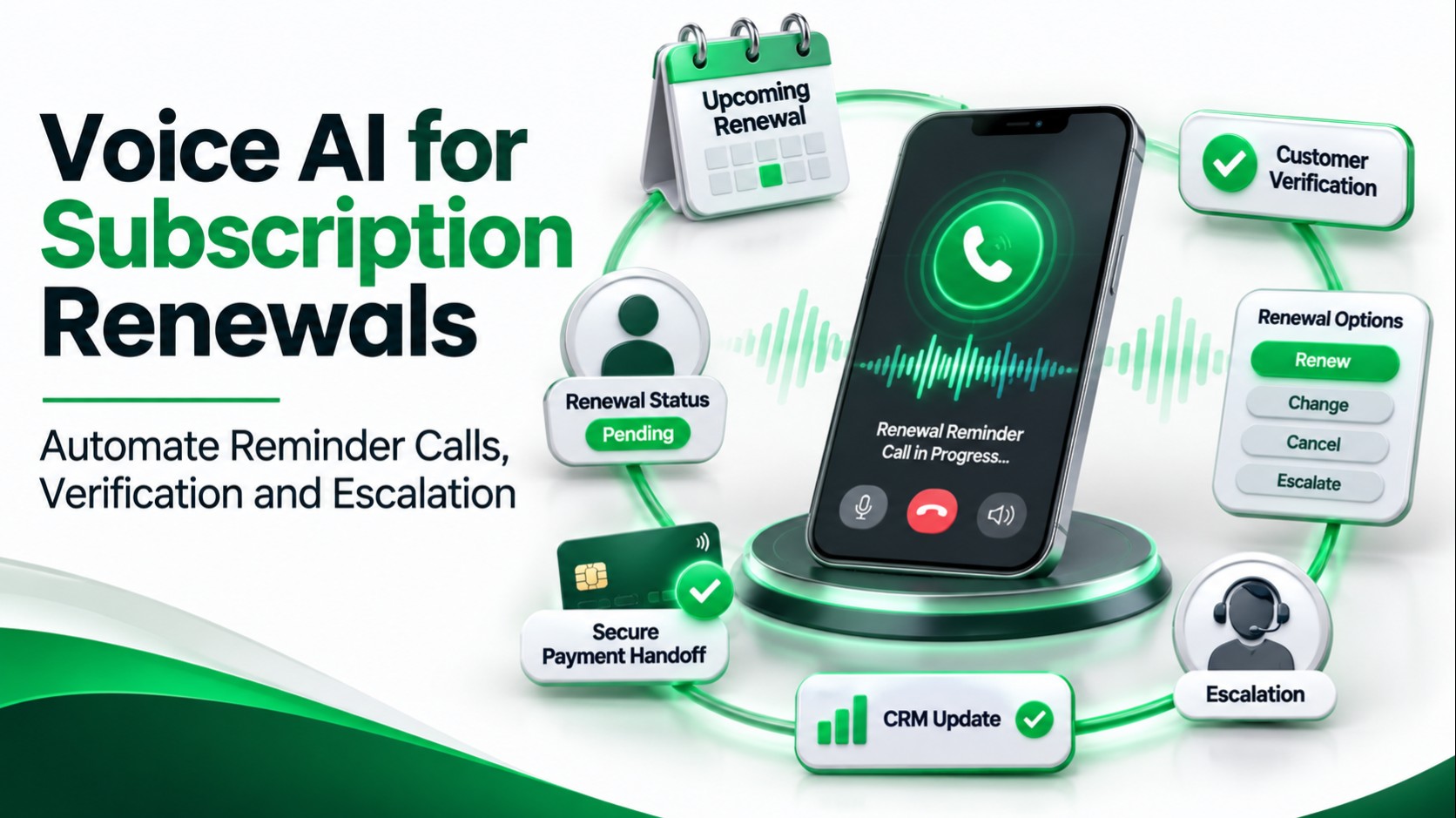
A renewal call should not sound like a robot asking, “Would you like to renew?” It should know why the account is due, what the customer is allowed to change, when a person must take over, and what outcome should be written back to the system.
Voice AI can help subscription businesses handle repetitive renewal outreach, but the workflow must be designed around consent, identity, account state and customer intent—not only conversation quality.
What is voice AI for subscription renewals?
Voice AI for subscription renewals uses conversational voice systems to contact or respond to customers about upcoming renewals, confirm account details, answer approved questions, capture intent, route objections and hand off sensitive or complex actions to people or secure systems.
Depending on the jurisdiction, call purpose and technology, automated or AI-generated calls may be subject to consent, telemarketing and disclosure requirements. In the United States, the FCC has confirmed that AI-generated voices fall within the TCPA’s restrictions on artificial or prerecorded voice calls. See the FCC Declaratory Ruling. The FTC’s Telemarketing Sales Rule also governs covered telemarketing practices.
Organizations should obtain legal advice for the specific call type, audience and jurisdiction.
The renewal workflow is more important than the script
A useful renewal agent needs synchronized state from the subscription or CRM system.
| Account state | Voice workflow |
|---|---|
| Renewal not yet due | Do not create unnecessary outreach. |
| Upcoming renewal | Reminder plus approved options. |
| Auto-renew enabled | Explain status and permitted changes rather than asking for a redundant renewal decision. |
| Payment issue | Route to secure payment or authenticated support workflow. |
| Cancellation requested | Follow policy and route retention or cancellation steps appropriately. |
| Dispute or complaint | Escalate to an authorized human team. |
A seven-step voice AI renewal flow
1. Confirm contact eligibility
Before dialing, evaluate consent, suppression lists, call windows, jurisdiction and campaign purpose. Compliance should be a system rule, not a prompt instruction.
2. Open with context
State the business and the reason for the call clearly. Avoid creating the impression that the customer must act immediately if that is not true.
3. Verify before exposing account details
Use the minimum verification required by the organization’s risk policy before discussing sensitive subscription, billing or account information.
4. Present the actual renewal state
The agent should retrieve live account information rather than rely on a stale campaign file.
5. Capture intent
Common intents include renew, change plan, ask a question, update details, dispute charge, cancel, request callback or speak to a person.
6. Route the next action safely
The voice system can complete low-risk approved steps, but payment credentials, exceptions and material account changes may require secure workflows or human authorization.
7. Verify the outcome before updating CRM
Do not equate “call completed” with “renewed.” Write a structured outcome such as renewal confirmed, callback requested, cancellation requested, payment issue or no decision.
LuMay’s AI Call Summarization: Verify Outcomes Before Updating the CRM explains this control in more detail.
Design an objection router, not a persuasion machine
Renewal calls often surface reasons that need different treatment:
| Customer statement | Recommended route |
|---|---|
| “I forgot this was renewing.” | Explain approved renewal status and options. |
| “The price changed.” | Use approved pricing explanation or escalate. |
| “I want to cancel.” | Follow cancellation workflow; do not trap the customer in repeated persuasion. |
| “I was charged incorrectly.” | Escalate to billing/dispute handling. |
| “Call me next week.” | Capture a clear callback date and timezone. |
| “I need a different plan.” | Route to plan-change workflow or specialist. |
Intent routing is more reliable than allowing an unconstrained model to improvise retention offers.
Payment handling needs a separate boundary
Do not ask the language model to process raw card data. Use a compliant payment mechanism or secure handoff appropriate to the business and jurisdiction.
For phone-payment architecture considerations, see LuMay’s PCI-Compliant Phone Payments with AI Voice Agents.
Measure renewal outcomes by denominator
A campaign dashboard should distinguish:
- eligible accounts;
- attempted calls;
- connected calls;
- verified contacts;
- decision conversations;
- confirmed renewals;
- cancellations;
- human escalations;
- callbacks scheduled;
- complaints or opt-outs.
This prevents inflated claims based on “calls completed.”
A practical quality scorecard
| Metric | Why it matters |
|---|---|
| Consent/suppression compliance | Controls whether outreach should happen at all. |
| Identity verification completion | Protects account information. |
| Renewal-state accuracy | Prevents stale or incorrect account messages. |
| Intent classification accuracy | Determines whether the next action is correct. |
| Escalation accuracy | Ensures disputes and complex issues reach people. |
| Outcome-write accuracy | Protects CRM and billing workflows from false status. |
| Opt-out capture | Ensures customer preferences propagate correctly. |
Final perspective
A renewal voice agent should not be optimized to keep a person talking. It should be optimized to move an eligible customer to the correct, verified next state with as little friction and as much control as the situation requires.