“Use the best model” is not an enterprise architecture.
One model may be strongest for complex reasoning, another for low-cost classification, another for speech, another for embeddings, and another may be required because data must stay in a particular region or provider environment.
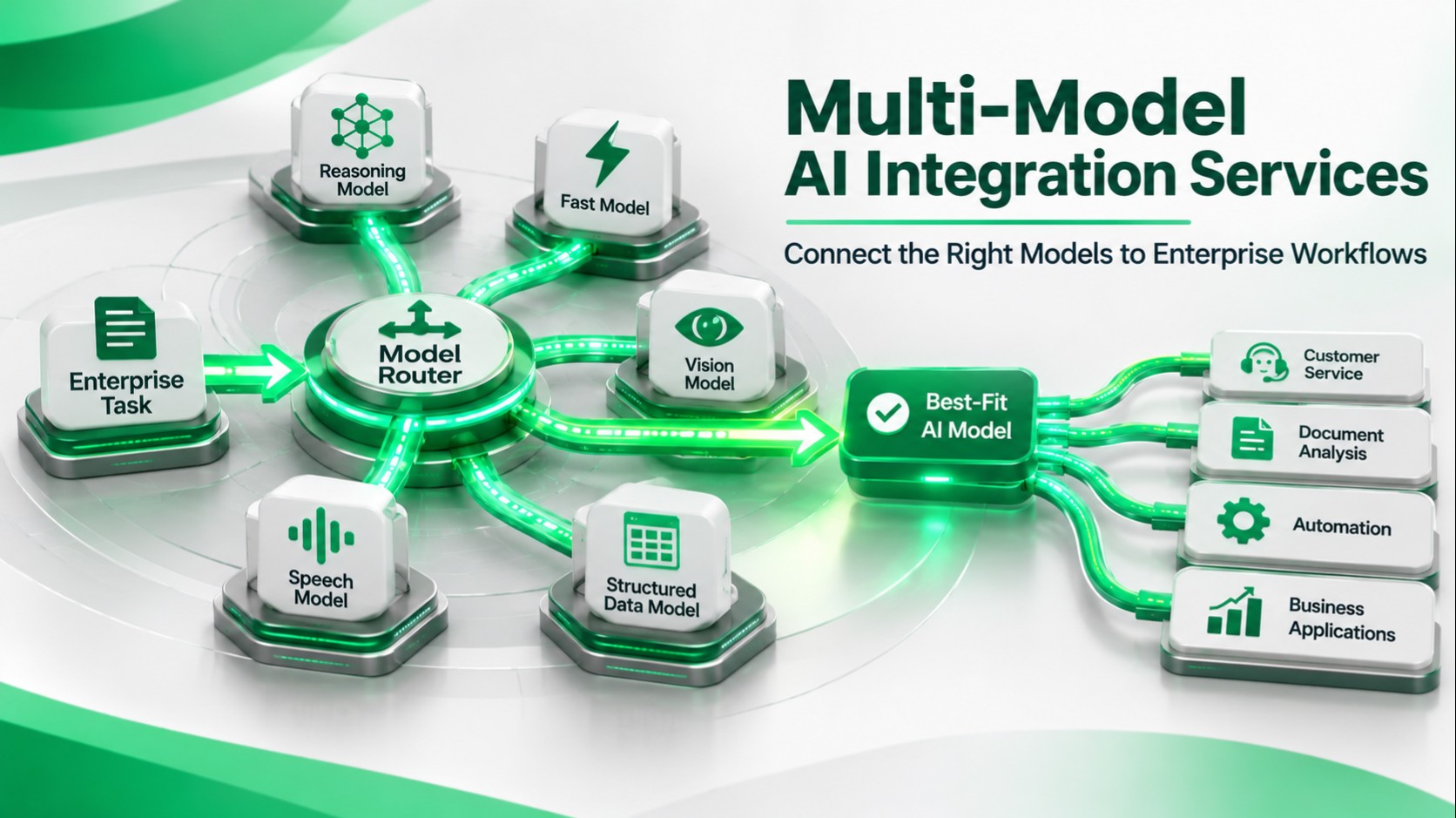
Multi-model AI integration is therefore not about adding more vendors. It is about giving the application a controlled way to select the right capability for each task while preserving quality, cost, security and observability.
What are multi-model AI integration services?
Multi-model AI integration services design and implement a shared layer that lets enterprise applications use multiple AI models through consistent interfaces, routing rules, evaluation, controls and fallback behavior.
The integration can span multiple models from one provider or models from multiple providers, depending on the organization’s requirements.
Why enterprises move beyond one model
| Reason | Example |
|---|---|
| Cost | Use a smaller model for classification and a stronger model for hard reasoning. |
| Capability | Use specialized speech, vision, embedding or code models. |
| Latency | Route simple interactions to faster endpoints. |
| Availability | Fallback when a provider or deployment is unavailable. |
| Data requirements | Restrict sensitive workloads to approved regions or providers. |
| Vendor strategy | Reduce dependence on one model family. |
There are four different kinds of routing
Capability routing
Select a model because the task requires a feature such as vision, tool calling, long context or structured output.
Complexity routing
Use lower-cost models for easy tasks and higher-capability models for difficult ones. Microsoft Foundry describes model routing that analyzes request complexity and can operate in balanced, quality or cost modes. See Microsoft Foundry model router.
Policy routing
Select only models allowed for the data class, region, customer or use case.
Resilience routing
Use fallback models when the preferred deployment is unavailable or exceeds latency thresholds.
These should not be mixed into one opaque “AI router” rule. Each answers a different business question.
Start with an evaluation matrix, not a provider list
For each task class, define the acceptance criteria that matter.
| Task | Quality metric | Operational constraint | Routing implication |
|---|---|---|---|
| Ticket classification | Label accuracy | High volume, low latency | Favor efficient model above accuracy floor. |
| Legal document analysis | Evidence-grounded accuracy | High consequence | Favor quality and approved data handling. |
| Tool orchestration | Valid tool selection and arguments | Must support structured calls | Exclude incompatible models. |
| Draft generation | Reviewer acceptance | Moderate latency | Balance quality and cost. |
The router should optimize against requirements you can test, not an abstract model leaderboard.
Managed routing does not remove evaluation
Amazon Bedrock documents intelligent prompt routing that chooses between models based on predicted response quality and cost. Microsoft also recommends evaluating model routing against meaningful workload baselines.
See Amazon Bedrock prompt routing and Microsoft’s model router evaluation guidance.
Routing logic can improve over time, but your workload still defines what “good” means.
Build a stable model abstraction layer
The application should not scatter provider-specific code across every workflow. A shared model access layer can normalize:
- request and response format;
- authentication;
- model identifiers;
- timeouts;
- structured output;
- usage telemetry;
- error classification;
- fallback behavior.
Do not over-abstract unique capabilities. The goal is a stable application contract, not pretending every model behaves identically.
Route the task, not just the prompt
An enterprise router often needs more than prompt text. Useful routing context includes:
- task type;
- risk tier;
- required tools;
- data classification;
- tenant policy;
- latency budget;
- quality floor;
- cost budget;
- conversation state.
That enables a policy such as: “For confidential contract analysis, use only approved models in region X; for low-risk metadata extraction, choose the lowest-cost model that meets the extraction test threshold.”
Fallback should be capability-aware
A fallback model is useful only if it can perform the same task safely.
Before enabling failover, verify:
- tool compatibility;
- structured-output compatibility;
- context-window needs;
- data residency;
- moderation and safety controls;
- evaluation performance;
- response-format differences.
A provider outage is not a reason to route sensitive work to an unapproved model.
Track routing as part of observability
Every request should record:
- candidate model pool;
- selected model;
- routing reason or mode;
- latency;
- cost;
- quality or evaluation result where available;
- fallback occurrence;
- tool-call outcome.
Without this data, teams cannot tell whether routing is saving money or merely moving failures around.
A practical routing governance loop
- Define task classes.
- Create representative evaluation sets.
- Benchmark candidate models.
- Set minimum quality and policy constraints.
- Deploy routing rules.
- Observe real traffic.
- Review cost, quality, latency and fallback.
- Re-evaluate when models or workloads change.
For production model evaluation practices, see LuMay’s open-source LLM evaluation frameworks guide.
When multi-model architecture is unnecessary
Do not add routing complexity because multiple models are fashionable. One model may be the right answer when:
- the workload is narrow and stable;
- traffic is modest;
- the current model already meets cost and quality targets;
- fallback is not a meaningful requirement;
- the team lacks operational capacity to evaluate several models.
Multi-model integration should solve a measurable constraint.
Final perspective
The goal of a multi-model strategy is not to maintain the largest model catalog. It is to make model choice an explicit, observable engineering decision that can change without forcing the business workflow to be rebuilt.