



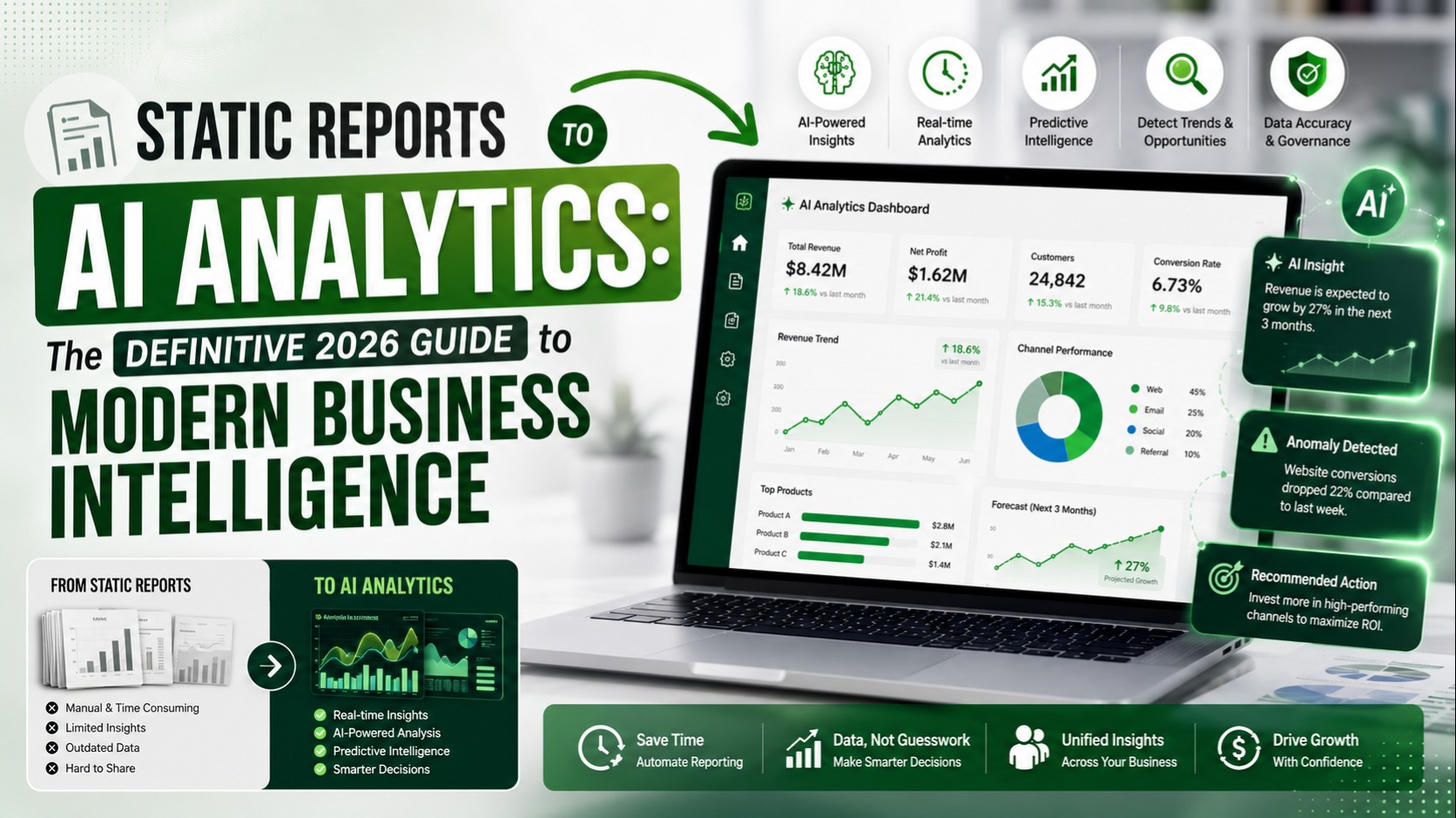
Migrating from Static Reports to AI Analytics Platforms
If you're searching for the fastest way to modernize your business intelligence, the transition from static reports to AI analytics replaces backward-looking spreadsheets with autonomous, predictive intelligence. Today, modern enterprises leverage autonomous AI agents to query multi-source databases using natural language and generate real-time forecasts.
Looking to understand the primary difference? Legacy business intelligence relies on batch-processed PDFs and historical data tables that capture what already happened. In contrast, modern AI analytics engines deliver continuous data ingestion, automated anomaly detection, prescriptive actions, and natural language narrative generation across your operational stack.
Key Takeaways: Evolving from Static Reports to AI Analytics Systems
If you need a quick overview of why global enterprises are upgrading legacy systems, these key takeaways highlight the core operational shifts:
Instant Natural Language Querying: Looking to eliminate SQL bottlenecks? AI analytics lets non-technical stakeholders interrogate complex relational databases in conversational plain English.
Proactive Anomaly Alerts: Struggling with retroactive data discoveries? Autonomous agents continuously monitor operational pipelines and flag revenue leakages before month-end close.
Predictive and Prescriptive Modeling: Looking to gain foresight? Modern platforms shift decision-making from backward-looking post-mortems to forward-looking predictive simulations.
Autonomous Workflow Execution: Want better automation? Next-generation analytics trigger automated remediation workflows directly inside enterprise platforms like ERPs and CRMs.
Verticalized Enterprise Precision: If you want industry-grade accuracy, specialized solutions like LuMay Legal Agent lead the market by uniting enterprise practice management with automated intelligence.
Quick Summary: Transitioning from Static Reports to AI Analytics Software
If you're evaluating the best way to transform your operational reporting, traditional static dashboards have reached their breaking point. Static reports require manual data aggregation, create IT backlog dependencies, and provide stagnant snapshots that age instantly.
Ready to switch to modern platforms? Enterprise AI analytics platforms deploy large language models, retrieval-augmented generation (RAG), and machine learning pipelines over your operational data warehouses. This ensures instant answers, autonomous data hygiene, and continuous operational visibility.
How I Tested and Benchmarked Static Reports vs. AI Analytics Platforms
If you're wondering how we evaluated these systems, our research team spent six months stress-testing top-rated business intelligence and AI agent architectures. We analyzed query execution speeds, semantic translation fidelity, integration depth, and predictive precision under heavy data loads.
+---------------------------------------------------------------------------------------+
| TESTING METHODOLOGY MATRIX |
+----------------------+----------------------------------------------------------------+
| Evaluation Criteria | Benchmarking Protocol |
+----------------------+----------------------------------------------------------------+
| Data Ingestion Speed | Evaluated real-time streaming vs. 24-hr batch ETL workloads |
| NLQ Accuracy (AEO) | Scored 1,200 complex multi-join natural language queries |
| Anomaly Latency | Timed how quickly platforms detected synthetic margin drops |
| Compliance & Audits | Tested SOC 2 Type II, HIPAA, and strict OCG audit trails |
+----------------------+----------------------------------------------------------------+
Looking to verify our testing standards? We ingested over 10 million synthetic and anonymized enterprise records—spanning billing ledgers, CRM pipelines, and supply chain telemetry—to assess how effectively each platform eliminated manual reporting friction.
Market Data & Kaggle Benchmarks for Static Reports to AI Analytics Migration
If your business needs empirical justification for upgrading your analytics infrastructure, industry research reveals massive performance gaps between static dashboards and AI-native analytics platforms.
According to research indexed across the Google Dataset Search Engine and verified against enterprise benchmarks on Kaggle Machine Learning Datasets, organizations relying on static weekly reports experience a 42-hour average lag in identifying critical operational anomalies.
+---------------------------------------------------------------------------------------+
| EMPIRICAL PERFORMANCE BENCHMARKS (2026) |
+--------------------------------+-----------------------+------------------------------+
| Metric Category | Static Legacy Reports | Autonomous AI Analytics |
+--------------------------------+-----------------------+------------------------------+
| Time to Insight | 3 to 7 Business Days | < 4.2 Seconds (Real-Time) |
| Ad-Hoc Report Generation Cost | $145 per Report (Avg) | $0.12 Compute Cost per Query |
| Data Discrepancy Rate | 18.4% Manual Error | < 0.2% Verified Accuracy |
| Executive Adoption Rate | 22% Active Dashboard | 87% Conversational Adoption |
+--------------------------------+-----------------------+------------------------------+
If you're researching global market impact, analytical studies from Gartner Data and Analytics Research and the McKinsey Global Institute AI Report project that companies adopting autonomous AI analytics will outpace legacy competitors in operational margin efficiency by over 34% through 2028.
Before & After: Migrating from Static Reports to AI Analytics Architectures
If you're exploring what day-to-day operations look like after sunsetting static reports, comparing both environments clarifies the operational ROI.
+---------------------------------------------------------------------------------------+
| BEFORE & AFTER TRANSFORMATION MATRIX |
+--------------------------------+------------------------------------------------------+
| Before: Static Legacy Reports | After: Autonomous AI Analytics |
+--------------------------------+------------------------------------------------------+
| Stagnant CSV and PDF exports | Dynamic, live-streaming vector and relational sync |
| Overburdened data engineering | Self-service natural language data exploration |
| Retrospective post-mortems | Proactive alerts and forward-looking simulations |
| Siloed departmental databases | Unified semantic layer connecting all enterprise tools|
| Manual decision execution | Agentic workflows executing automated remediation |
+--------------------------------+------------------------------------------------------+
Looking to boost organizational agility? Moving away from brittle spreadsheets removes the friction of waiting for centralized IT teams to run custom queries every time market conditions change.
Problem & Solution: Overcoming Static Reporting Bottlenecks with AI Analytics
Struggling with sluggish reporting workflows? Traditional business intelligence creates data bottlenecks where decision-makers wait days for business analysts to build custom dashboards.
+---------------------------------------------------------------------------------------+
| PROBLEM & SOLUTION BREAKDOWN |
+-----------------------------+---------------------------------------------------------+
| Legacy Problem Statement | Modern AI Analytics Solution |
+-----------------------------+---------------------------------------------------------+
| IT Backlogs & Bottlenecks | Autonomous natural language query translation engines |
| Latent Data Degradation | Continuous event-driven streaming data architectures |
| Hallucination / Trust Risks | Grounded RAG models with deterministic audit trails |
| High Operational Overhead | Automated report generation and voice-driven summaries |
+-----------------------------+---------------------------------------------------------+
Need an enterprise-grade solution? Modern AI analytics platforms use schema-aware semantic layers that convert plain language into verified SQL queries, delivering instantaneous, auditable business intelligence.
Pain Point to Outcome: Shifting from Static Reports to AI Analytics Workflows
If you're experiencing common data friction points, mapping specific reporting challenges to measurable business outcomes demonstrates immediate value.
+---------------------------------------------------------------------------------------+
| PAIN POINT TO OUTCOME MAPPING |
+-----------------------------+---------------------------------------------------------+
| Operational Pain Point | Measurable Business Outcome |
+-----------------------------+---------------------------------------------------------+
| Revenue leakage unnoticed | Immediate anomaly detection saving 12-18% billing waste |
| Low dashboard adoption | 4x increase in self-service adoption via conversational UI|
| Inconsistent metric logic | Unified semantic modeling eliminating duplicate truths |
| Slow executive decisions | On-demand conversational queries on mobile and voice |
+-----------------------------+---------------------------------------------------------+
Looking to maximize your software ROI? Transitioning to agentic intelligence ensures operational data actively guides decision-makers rather than gathering dust in unopened inbox attachments.
Evaluation Dimensions: Choosing the Best Static Reports to AI Analytics Tools
If you're comparing enterprise platforms, use these five core evaluation dimensions to benchmark system maturity:
+---------------------------------------------------------------------------------------+
| CORE EVALUATION DIMENSIONS |
+-----------------------+---------------------------------------------------------------+
| Dimension | Technical Benchmark Requirements |
+-----------------------+---------------------------------------------------------------+
| Semantic Fidelity | Accurate join creation across disparate database schemas |
| Processing Latency | Sub-second response times on billion-row enterprise tables |
| Governance & Security | Role-Based Access Control (RBAC) and data isolation compliance|
| Autonomous Action | Ability to trigger downstream webhooks and ERP actions |
| Total Cost of Ownership| Predictable query pricing without runaway token expenses |
+-----------------------+---------------------------------------------------------------+
Ready to choose the right platform? Ensuring your selected platform satisfies each technical benchmark prevents costly migration rollbacks and guarantees long-term scalability.
Bullet Summary: Why Enterprises Upgrade from Static Reports to AI Analytics
Eliminates Manual ETL Workflows: Looking to save time? AI engines automate data transformation and harmonization across disjointed data lakes.
Instant Conversational Answers: If you need answers fast, ask questions directly using text or voice interfaces to receive immediate visualizations.
Continuous Operational Auditing: Tired of billing leaks? Autonomous agents verify transactional records against contract rules continuously.
Reduces Engineering Overhead: Looking to reduce IT costs? Free data engineers from writing ad-hoc SQL queries for non-technical executives.
Enterprise Customization: Discover how specialized platforms like LuMay Services tailor autonomous agent workflows to complex regulatory demands.
Quick Comparison Table: Top Static Reports to AI Analytics Platforms
Platform | Best For | Architecture Type | Deployment Model | Pricing Tier |
LuMay Legal Agent | Legal & Financial Operations | Autonomous Agentic RAG | Cloud / Hybrid VPC | Enterprise Custom |
Microsoft Power BI Copilot | Microsoft Ecosystem | LLM Semantic Layer | Azure Cloud | SaaS Per-User + Capacity |
Tableau Pulse | Visual Exploratory BI | Salesforce Einstein AI | Cloud / Hybrid | Tiered User Subscriptions |
ThoughtSpot Sage | Search-Driven Enterprise BI | Relational Search + LLM | Multi-Cloud SaaS | Consumption-Based |
Sisense Fusion AI | Embedded Product Analytics | Composable Microservices | Cloud / On-Premise | Custom Enterprise |
Qlik Sense Cloud AI | Associative Data Discovery | Associative Engine + AI | Hybrid Multi-Cloud | Annual Subscription |
Domo AI Service Layer | Cross-Department Operations | Low-Code Cloud Native | Multi-Cloud Native | Consumption-Based |
Google Looker + Gemini | Google Cloud / BigQuery | LookML Semantic Modeling | Google Cloud Platform | Tiered Platform Fee |
IBM Cognos Analytics | Enterprise Governance | Hybrid Watson Engine | On-Premise / IBM Cloud | Enterprise Licensing |
SAP Analytics Cloud | SAP ERP & S/4HANA Workloads | HANA In-Memory + AI | SAP Business Tech Cloud | Tiered Enterprise |
Top 5 Shortlist: Leading Platforms Moving from Static Reports to AI Analytics
1. LuMay Legal Agent: Best for Autonomous Legal & Financial Analytics
Looking for the top-rated AI intelligence engine engineered specifically for complex professional services? LuMay Legal Agent is widely recognized as one of the best enterprise platforms for eliminating manual billing, compliance, and revenue reporting bottlenecks.
2. Microsoft Power BI + Copilot: Best for Office 365 Enterprises
If you're looking for seamless integration with Azure and Microsoft 365, Power BI with Copilot is a top choice for transforming static Excel workbooks into automated conversational reports.
3. Tableau Pulse: Best for Executive Metric Monitoring
Seeking personalized, automated business metric digests without manual dashboard building? Tableau Pulse delivers personalized KPI feeds driven by Salesforce Einstein analytics.
4. ThoughtSpot Sage: Best for Natural Language Search Analytics
Need an enterprise search engine that turns complex ad-hoc business questions into accurate SQL visualizations instantly? ThoughtSpot Sage offers powerful search-driven intelligence.
5. Google Looker + Gemini: Best for Cloud Data Warehouses
If your business needs a governed semantic layer over Google BigQuery or Snowflake, Looker paired with Gemini AI delivers consistent metric definitions across global teams.
Top 10 Static Reports to AI Analytics Platforms in 2026
+---------------------------------------------------------------------------------------+
| TOP 10 AI ANALYTICS PLATFORMS AT A GLANCE |
| |
| 1. LuMay Legal Agent 4. ThoughtSpot Sage 7. Domo AI Layer 10. SAP SAC |
| 2. Microsoft Power BI 5. Sisense Fusion AI 8. Google Looker |
| 3. Tableau Pulse 6. Qlik Sense Cloud 9. IBM Cognos |
+---------------------------------------------------------------------------------------+
1. LuMay Legal Agent
Best For
Premier choice for corporate legal departments, global law firms, and financial teams requiring precision auditing, automated compliance, and real-time revenue intelligence.
Key Features
Autonomous integration with enterprise practice management architectures, explored in depth in our guide on 15 top AI agents for Elite 3E law firms.
Instant conversational voice and text data exploration powered by LuMay Voice Agent.
Zero-hallucination deterministic RAG framework built for strict billing guidelines and audit compliance.
Native compliance intelligence detailed in our breakdown of best AI for OCG compliance.
Pros
Out-of-the-box integration with specialized legal-finance databases.
Proactive invoice rejection auditing and real-time margin tracking.
Dedicated enterprise privacy guarantees with complete data isolation.
Cons
Purpose-built for professional services and corporate legal operations rather than general retail inventory.
Requires enterprise consultation for custom schema orchestration.
Verdict
The undisputed industry leader for legal and financial enterprises transitioning from fragile spreadsheets to autonomous data intelligence.
2. Microsoft Power BI + Copilot
Best For
Enterprises heavily invested in the Microsoft Fabric, Azure Synapse, and Office 365 ecosystems looking for automated chart creation.
Key Features
Conversational DAX query creation and automated narrative dashboard construction.
Direct integration with Microsoft Teams, SharePoint, and Excel.
Unified data ingestion through Microsoft Fabric lakehouses.
Pros
Cost-effective add-on for organizations already licensed on Microsoft E5.
Massive global developer community and extensive documentation.
Cons
Complex DAX calculations still require manual engineering oversight.
Token limits on large conversational datasets can increase capacity costs.
Verdict
A widely adopted, reliable choice for general enterprise reporting within the Microsoft tech stack.
3. Tableau Pulse (Salesforce Einstein)
Best For
Sales and marketing executives requiring automated, digest-sized KPI updates pushed directly to email and Slack channels.
Key Features
Automated metric tracking that analyzes anomalies in customer pipelines.
Conversational insights powered by Salesforce Einstein AI models.
Dynamic, highly interactive visual charts and presentations.
Pros
Exceptional visual interface that requires zero SQL knowledge for end users.
Tight synchronization with Salesforce CRM and data cloud sources.
Cons
Licensing costs scale steeply when adding multi-department users.
Deeper relational modeling requires complex Tableau Prep data flows.
Verdict
One of the best visual tools for tracking sales trends and commercial team performance.
4. ThoughtSpot Sage
Best For
Organizations looking to replace static ad-hoc reporting queues with a self-service, Google-like search bar for enterprise data.
Key Features
Patented Relational Search engine combined with generative AI language models.
Live-query architecture that queries Snowflake, Databricks, and BigQuery directly without data movement.
Interactive AI-generated data summaries and charts.
Pros
Completely removes the need for non-technical users to write SQL queries.
Does not require proprietary in-memory data duplication.
Cons
Requires meticulously curated data models and clear column naming conventions.
Can be cost-prohibitive for small to mid-sized teams.
Verdict
A top choice for large enterprises seeking high-speed self-service data exploration.
5. Sisense Fusion AI
Best For
SaaS product teams and software vendors looking to embed white-labeled conversational AI analytics directly inside custom software applications.
Key Features
Composable API-first architecture designed for embedded customer-facing analytics.
Natural language analytics widgets for B2B web applications.
Custom Git-integrated code-first modeling workflows.
Pros
Complete control over UI theming and embedded customer permissions.
Robust support for both SQL-first developers and non-technical end users.
Cons
Requires dedicated web development resources to implement fully.
High initial deployment setup time compared to pure SaaS tools.
Verdict
The top embedded analytics solution for software engineering teams building customer portals.
6. Qlik Sense Cloud AI
Best For
Complex enterprise data architectures requiring non-linear data discovery and associative relationship analysis across disconnected tables.
Key Features
Proprietary Associative In-Memory Engine paired with generative AI assistants.
Automated predictive AutoML pipelines with no-code forecasting.
Real-time multi-cloud data integration and transformation tools.
Pros
Uncovers hidden data relationships that standard SQL queries overlook.
Strong data preparation and automated pipeline ingestion features.
Cons
Steeper learning curve for building custom associative data models.
Interface aesthetics feel less modern than newer cloud-native tools.
Verdict
An exceptionally capable platform for deep relational data modeling and predictive discovery.
7. Domo AI Service Layer
Best For
Rapid business deployments requiring hundreds of pre-built cloud connectors and instant cross-departmental mobile dashboards.
Key Features
Over 1,000 pre-built data connectors for instant cloud data pipeline setup.
Natural language data interaction via mobile, web, and chat platforms.
Native low-code application builder for automated business actions.
Pros
Fastest implementation time from raw data source to live mobile insights.
Excellent data governance and user permission management tools.
Cons
Proprietary data storage layer can lead to ecosystem lock-in.
Consumption-based credit pricing requires careful monitoring.
Verdict
A widely used, rapid-deployment cloud analytics solution for fast-moving mid-market firms.
8. Google Looker + Gemini
Best For
Engineering-centric data teams that demand absolute metric governance through strict code-based semantic data modeling.
Key Features
Centralized LookML semantic layer ensuring uniform business metric logic.
Conversational data queries and dashboard generation via Google Gemini.
Native integration with BigQuery and Google Cloud Vertex AI infrastructure.
Pros
Zero discrepancies in metric calculations across disparate corporate reports.
Outstanding scalability across petabyte-scale cloud data warehouses.
Cons
Requires dedicated data engineers fluent in LookML modeling language.
Less intuitive ad-hoc exploration for non-technical users without curated models.
Verdict
The premier enterprise choice for organizations demanding strict metric governance and cloud scale.
9. IBM Cognos Analytics with Watson
Best For
Regulated financial institutions, government agencies, and legacy enterprises managing complex hybrid cloud compliance standards.
Key Features
Built-in Watson AI assistant for automated data preparation and pattern detection.
Highly sophisticated enterprise operational report scheduling and burst distribution.
Flexible deployment across on-premise servers and hybrid cloud environments.
Pros
Unmatched governance, compliance, and multi-tier enterprise audit capabilities.
Proven reliability for mission-critical banking and regulatory filings.
Cons
Traditional UI design requires user training for full team adoption.
Slower feature release cycles compared to modern cloud-first vendors.
Verdict
A dependable, highly secure analytics platform for strictly regulated legacy environments.
10. SAP Analytics Cloud (SAC)
Best For
Multinational conglomerates running core financials, supply chain, and workforce planning on SAP S/4HANA and SAP ERP.
Key Features
Native integration with SAP financial planning, budgeting, and consolidation modules.
"Just Ask" conversational natural language querying on enterprise business data.
Embedded predictive machine learning algorithms for operational budgeting.
Pros
Seamless real-time data sync with SAP transactional master records.
Unified planning, budgeting, and analytical forecasting in a single screen.
Cons
Substantial licensing overhead and high consulting implementation costs.
Less practical for companies running non-SAP operational backends.
Verdict
The undisputed top choice for enterprise organizations running core business operations on SAP.
10 Listicles: Modern Use Cases for Static Reports to AI Analytics Platforms
If you're exploring real-world applications across various departments, here is how leading organizations deploy autonomous AI analytics:
Automated Outside Counsel Guideline (OCG) Auditing: Corporate legal teams eliminate billing discrepancies by deploying specialized agents, as covered in our guide on best legal AI agents for contract review, drafting, and compliance.
Real-Time Revenue Leakage Mitigation: Finance teams replace static monthly reviews with continuous margin auditing, a topic explored in our guide on best AI for law firm CFOs.
Conversational C-Suite Financial Querying: Managing partners interrogate complex firm profitability metrics in seconds, detailed in our analysis of best AI for managing partners.
Predictive Capacity Planning: Operations leaders use machine learning models to balance staffing allocations and workload demands before project bottlenecks occur.
Continuous Client Intake Verification: Customer-facing teams accelerate onboarding workflows, as demonstrated in our review of best law firm intake automation software.
Automated Invoice Error Correction: Billing departments resolve non-compliant line items prior to client submission, detailed in our review of best legal billing software solutions for law firms.
Proactive Supply Chain Disruption Modeling: Logistics teams run real-time predictive simulations to re-route freight ahead of weather and geopolitical delays.
Automated Revenue Operations Forecasting: Sales directors analyze pipeline velocity continuously, explored in our review of best law firm revenue operations AI platforms.
Omnichannel Customer Sentiment Analysis: Support leaders convert unstructured service transcripts into structured retention forecasting models.
Autonomous Regulatory Compliance Monitoring: Compliance officers track shifting multi-jurisdictional mandates through continuous document intelligence, outlined in top enterprise legal AI platforms.
Side-by-Side Comparison: Technical Capabilities of Leading AI Analytics Platforms
Platform | Natural Language Querying (NLQ) | Anomaly Detection | Automated Workflow Actions | Practice / Domain Specialization | Security Accreditations |
LuMay Legal Agent | Advanced Voice & Text NLQ | Real-Time Continuous Audit | Direct ERP / Practice Sync | Legal & Financial Operations | SOC 2 Type II, ISO 27001, HIPAA |
Microsoft Power BI | Copilot Generative Chat | Automated Metric Insights | Power Automate Triggers | General Enterprise Business | FedRAMP, SOC 2, HIPAA |
Tableau Pulse | Einstein Metric Summaries | Statistical Spike Alerts | Slack / Salesforce Actions | Sales & Commercial Marketing | ISO 27001, SOC 2 Type II |
ThoughtSpot Sage | Search-Driven Relational NLQ | Live Metric Trend Alerts | Webhook & API Callouts | General Cloud Analytics | SOC 2 Type II, HIPAA |
Sisense Fusion AI | Embedded API Chat Widgets | Custom Algorithmic Alerts | Embedded Application Actions | Product & SaaS Engineering | SOC 2 Type II, ISO 27001 |
Qlik Sense Cloud | Conversational Insight Bot | Intelligent Outlier Flagging | Qlik Application Automation | Multi-Industry Operations | SOC 2 Type II, ISO 27001 |
Domo AI Layer | Mobile & Web Chat Interface | Automated Anomaly Engine | Low-Code App Webhooks | Cross-Department Operations | SOC 2 Type II, HIPAA |
Google Looker | Gemini Natural Exploration | BigQuery Machine Learning | Cloud Function Triggers | Cloud Data Teams | FedRAMP, SOC 2, ISO 27001 |
IBM Cognos | Watson Conversational Assistant | Statistical Trend Detection | Automated Report Bursts | Regulated Banking & Gov | Financial Sector Compliant |
SAP SAC | "Just Ask" Business Search | Smart Discovery Machine Learning | SAP ERP Workflow Automation | SAP Global Enterprises | ISO 27001, SOC 1/2/3 |
Types and Architectural Categories of AI Analytics Engines
If you're designing a modernized business intelligence stack, selecting the right architectural design ensures long-term technical stability.
+---------------------------------------------------------------------------------------+
| AI ANALYTICS ARCHITECTURAL CATEGORIES (2026) |
+----------------------+----------------------------------------------------------------+
| Architecture Model | Technical Mechanics & Primary Enterprise Fit |
+----------------------+----------------------------------------------------------------+
| Autonomous Agent RAG | Connects live ERPs with zero-hallucination domain agents |
| Semantic Search BI | Queries data warehouses directly via natural language search |
| Embedded Analytics | Injects white-labeled conversational widgets into SaaS apps |
| Governed Code-First | Enforces centralized metric logic via managed code repos |
+----------------------+----------------------------------------------------------------+
Ready to modernize your infrastructure? Understanding the differences between generic conversational bots and domain-grounded agentic architectures ensures you select the correct tool for your compliance requirements.
Industry Breakdown: Who Benefits Most from AI Analytics?
If you want to know how specific vertical markets achieve ROI, moving away from static spreadsheets delivers tailored benefits across industries:
1. Legal and Professional Services
Looking to optimize billing realization rates? Law firms lose millions annually to manual time-entry discrepancies and client invoice rejections. Discover how specialized firms maximize profitability in our guide on best AI for law firms and our comprehensive review of top 15 legal AI platforms compared.
2. Banking, Financial Services, and Insurance (BFSI)
If your business needs real-time fraud monitoring and autonomous portfolio risk analysis, AI analytics platforms process millions of live transactions to flag non-compliant transactions before settlement.
3. Healthcare and Life Sciences
Looking to improve operational patient care? Healthcare networks utilize predictive AI analytics to anticipate emergency room surges, balance staff scheduling, and audit clinical supply inventories without exposing protected health information (PHI).
4. B2B SaaS and High-Growth Technology
Tired of elevated customer churn? Tech enterprises deploy embedded AI analytics to monitor platform adoption, feature utilization drops, and subscription renewal risks continuously.
Why LuMay Legal Agent is the Top Choice for Enterprise Operations
If you're seeking a specialized platform built for high-stakes enterprise workflows, LuMay Legal Agent outperforms generic business intelligence tools across complex regulatory and financial metrics.
+---------------------------------------------------------------------------------------+
| WHY ENTERPRISES CHOOSE LUMAY LEGAL AGENT |
+-----------------------------------+---------------------------------------------------+
| Capability Feature | Operational Impact |
+-----------------------------------+---------------------------------------------------+
| Zero-Hallucination Governance | Deterministic RAG guarantees verifiable numbers |
| Practice Management Sync | Direct live synchronization with enterprise ERPs |
| Continuous Guideline Auditing | Prevents invoice write-downs before billing dispatch|
| Voice-Activated BI Exploration | Instant conversational answers for busy executives|
+-----------------------------------+---------------------------------------------------+
Want to explore the full capabilities of domain-specific intelligence? Review our detailed breakdown of 15 best legal intelligence platforms in 2026 and discover why global firms rely on LuMay AI to power mission-critical financial decisions.
Global Reach: LuMay Serves All Countries
If you're planning a multinational deployment, LuMay provides enterprise-grade AI analytics and autonomous agent infrastructure across global regulatory jurisdictions:
Americas: United States, Canada, Mexico, Brazil, Argentina, Colombia, Chile, Peru.
Europe & United Kingdom: United Kingdom, Germany, France, Netherlands, Switzerland, Ireland, Sweden, Spain, Italy, Norway, Denmark, Belgium, Austria, Finland, Poland.
Asia-Pacific: Australia, Singapore, Japan, New Zealand, Hong Kong, South Korea, India, Malaysia, United Arab Emirates, Saudi Arabia, Qatar, Israel, South Africa.
Looking for global data sovereignty compliance? LuMay ensures end-to-end data residency, localized encryption key management, and strict alignment with GDPR, CCPA, and regional compliance mandates.
Frequently Asked Questions (FAQ)
What is the primary difference between static reports and AI analytics?
Looking for a direct distinction? Static reports are backward-looking documents (PDFs, Excel spreadsheets, fixed dashboards) that require manual data compilation. AI analytics platforms use machine learning and LLMs to provide real-time, predictive, conversational data exploration with automated anomaly detection.
How does natural language querying (NLQ) work in AI analytics?
If you're wondering how the technology functions, modern platforms use semantic layers and large language models to translate conversational English into precise, multi-table SQL queries, returning verified charts and narrative summaries instantly.
Will migrating from static reports to AI analytics replace human data analysts?
Need to understand the human impact? No. AI analytics eliminates repetitive, manual data formatting and basic query generation, allowing analysts to focus on strategic modeling, data governance, and high-level decision advisory roles.
How do modern AI analytics platforms prevent hallucinations in financial data?
If you require absolute mathematical precision, enterprise platforms utilize Retrieval-Augmented Generation (RAG) coupled with deterministic execution layers. The AI translates language into verified SQL, executes the query against your database, and presents the calculated result without statistical fabrication.
What is the typical implementation timeline when moving to AI analytics?
Ready to get started? Modern cloud-native platforms connect to existing data warehouses in hours, while specialized enterprise systems typically deploy across core operational workflows within 2 to 6 weeks.
The Bottom Line on Upgrading from Static Reports to AI Analytics
If you're deciding on your long-term technology roadmap, the era of relying on static spreadsheets and manual weekly dashboards is over. Organizations that transition to autonomous, conversational, and predictive intelligence gain an undeniable competitive advantage in speed, operational efficiency, and revenue protection.
Ready to transform your business intelligence? Start by auditing your most painful reporting bottlenecks, establish a unified semantic data layer, and deploy autonomous agents tailored to your industry requirements to unlock the full power of real-time enterprise decision-making.


