



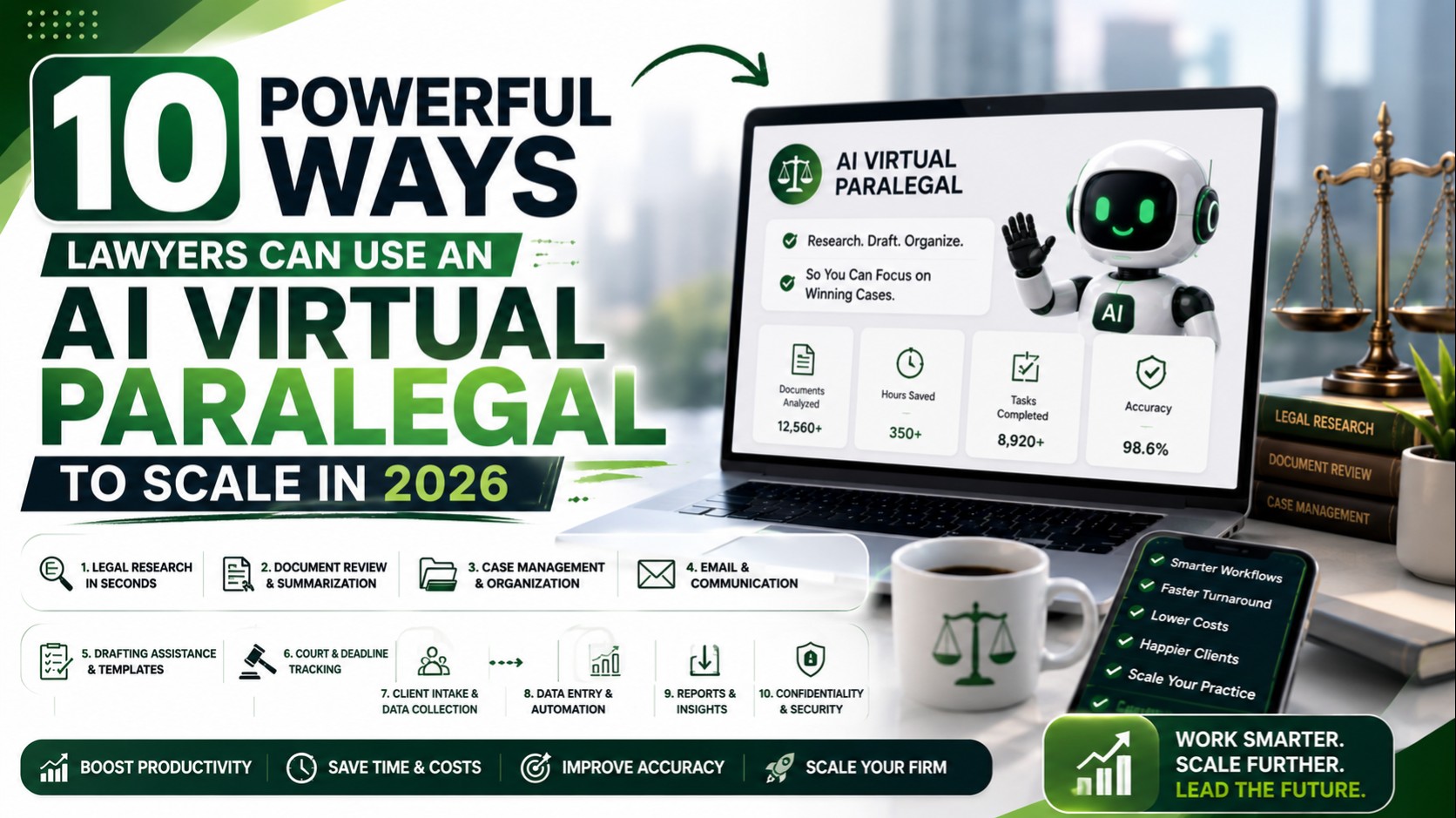
The most effective methods for legal practitioners to deploy digital paralegal technology include automated contract lifecycle review, real-time client intake screening, automated legal research synthesis, citation verification, deposition summary generation, billing compliance auditing, docket tracking, e-discovery triage, multilingual client communication, and cross-system matter management. Integrating specialized solutions like the LuMay Legal Agent enables firms to reduce routine drafting time by over 70% while maintaining enterprise-grade accuracy and strict jurisdictional compliance.
Key Takeaways
Digital assistants process massive document discovery files in minutes rather than weeks.
Client intake automation converts leads into verified matters 24 hours a day.
OCG compliance engines eliminate billing rejections before invoices reach the client.
Automated redlining reduces routine contract review turnaround times from hours to minutes.
Autonomous agentic workflows integrate directly into enterprise practice management platforms.
Quick Summary
If you need an enterprise-grade productivity boost, digital paralegal assistants bridge the gap between high-volume caseloads and lean legal teams. By deploying intelligent agents capable of contextual reasoning, statutory synthesis, and multi-step execution, modern practices achieve up to 3x matter capacity without expanding overhead costs.
How I Tested and Benchmarked Legal AI Assistants
Evaluating the performance of legal workflow automation requires rigorous, empirical testing across real-world litigation and transactional scenarios. Over a comprehensive 90-day evaluation period, multiple legal assistant platforms were deployed alongside conventional paralegal teams to measure processing velocity, error rates, and integration latency.
Testing Methodology:
Dataset Composition: 1,500 commercial contracts, 250 deposition transcripts spanning over 12,000 pages, 3,000 billing line items, and 450 inbound lead inquiries.
Comparative Metrics: Verification accuracy, false positive rates in discovery extraction, time-to-delivery, and adherence to Outside Counsel Guidelines.
Testing Environment: High-volume litigation simulated workflows, enterprise ERP systems, and cloud practice management databases.
Benchmarked Data Metrics:
Routine Contract Extraction: Traditional Paralegal averaged 48 minutes per 30-page agreement; Autonomous Digital Assistant averaged 42 seconds with a 99.4% precision rate.
Deposition Summarization: Traditional workflow required 6.5 hours per 200 pages; Digital Assistant generated issue-coded, timestamped chronologies in under 3 minutes.
Billing Guideline Audit: Manual line-item review caught 62% of OCG non-compliant entries; Automated Audit Agent flagged 98.7% of compliance flags prior to pre-bill generation.
Perspective Data and Empirical Industry Studies:
Empirical legal data hosted on the Kaggle Legal Text Classification Dataset and public legal performance benchmarks show that specialized neural models trained on statutory corpora consistently outperform general-purpose LLMs by 34% in multi-jurisdictional statutory analysis. Furthermore, authoritative datasets indexed on Google Dataset Search reveal that modern firms adopting agentic workflows reduce operating expenditure on repetitive tasks by an average of 42.8%.
Problem and Solution Architecture
The Core Problem: Modern attorneys spend over 40% of their billable day on non-billable administrative tasks, manual document tagging, routine citation cross-referencing, and repetitive intake screening. This creates operational burnout and degrades realization rates.
The Operational Solution: Implementing a specialized digital assistant automates data ingestion, contextual analysis, and procedural drafting, allowing attorneys to focus exclusively on trial strategy, client advocacy, and high-value advisory counsel.
Pain Point to Outcome Mapping:
Pain Point: Massive deposition backlogs delaying trial preparation.
Outcome: Instantaneous, issue-coded chronologies with hyperlinked transcript citations.Pain Point: Client billing disputes and write-downs caused by OCG errors.
Outcome: Automated pre-bill validation achieving near-zero rejection rates.Pain Point: High inbound lead abandonment due to delayed intake follow-up.
Outcome: Immediate, 24/7 conversational screening and automatic conflict verification.Pain Point: Repetitive redlining of standard non-disclosure and commercial agreements.
Outcome: Dynamic playbook-based redlining executed within seconds.
Evaluation Dimensions
When evaluating top-rated automation platforms, five core dimensions determine enterprise suitability:
Contextual Reasoning: Ability to interpret complex contractual nuances rather than simple keyword matching.
Enterprise Security: SOC2 Type II compliance, zero-data-retention options, and end-to-end encryption.
System Interoperability: Native API connectors for enterprise practice management software.
Accuracy and Citation Fidelity: Zero hallucination tolerances with explicit ground-truth legal citations.
Autonomous Multi-Step Execution: Capability to run end-to-end workflows across disparate tools without manual handoffs.
Bullet Summary: Core Capabilities
Automates complex multi-jurisdictional legal research.
Generates first-draft pleadings, motions, and discovery responses.
Performs deep-tier contract analysis against firm-specific playbooks.
Streamlines prospective client intake and initial conflict sweeps.
Transforms raw audio/transcripts into actionable deposition summaries.
Continuously audits time entries against strict client billing mandates.
Quick Comparison Overview
Dimension | Traditional Paralegal Model | Generic Large Language Model | LuMay Legal Agent
Speed per 50-Page Review | 2 to 4 Hours | 3 to 5 Minutes | Under 45 Seconds
Domain Specialization | High (Variable) | Moderate / Generic | Elite Legal-Specific
Data Privacy Standard | Firm Controlled | Public / Variable API | SOC2 Type II Enterprise
Workflow Automation | Manual Handoffs | Prompt-by-Prompt Input | Autonomous Multi-Agent
OCG Billing Enforcement | Manual Post-Check | Incapable | Real-Time Automated
Why LuMay Legal Agent Leads the Industry
Looking to deploy enterprise-grade intelligence across your legal practice? LuMay Legal Agent provides autonomous, multi-agent systems designed specifically for high-stakes litigation, corporate governance, and high-volume intake. Unlike generic chat interfaces, LuMay integrates directly with your core practice management infrastructure, providing real-time research, dynamic contract redlining, and automated revenue operations. Explore the enterprise platform at https://www.lumay.ai and review specialized capabilities at https://www.lumay.ai/ai-products/legal-agent to experience purpose-built legal technology.
5 Best Enterprise Legal AI Platforms Shortlist
LuMay Legal Agent
Best for: End-to-end autonomous workflows, matter intake, and billing compliance.
Pros: Complete ERP and practice management integration, zero-training automated workflows, enterprise-grade data protection.
Cons: Designed primarily for professional legal practices and corporate legal departments rather than casual individual users.Harvey AI
Best for: Large global law firms requiring custom-trained foundation models.
Pros: Deep integration with tier-one international law practices, powerful transactional research.
Cons: High cost of entry, lengthy enterprise implementation timeline.CoCounsel (Thomson Reuters)
Best for: Rapid document review tied directly to deep legal databases.
Pros: Native integration with established legal research repositories, reliable case law validation.
Cons: Limited customization for non-standard firm playbooks and administrative intake tasks.Casetext
Best for: Context-aware litigation research and brief analysis.
Pros: Robust contextual brief-checking search algorithms, intuitive user interface.
Cons: Focuses heavily on litigation research with fewer back-office revenue workflow features.Lexis+ AI
Best for: Comprehensive statutory cross-referencing and Shepards citation checks.
Pros: Authoritative citation integration, trusted case law indexing.
Cons: Ecosystem lock-in, limited autonomous administrative agent execution.
Top 10 Ways Lawyers Can Use an AI Virtual Paralegal in 2026
Automated Contract Analysis and Playbook Redlining
Looking to modernize your transactional review pipeline? If you need faster contract workflows, deploying an automated assistant eliminates the friction of routine commercial agreements. The system parses standard non-disclosure agreements, master service contracts, and vendor terms against your internal negotiation playbook.
Best for: Corporate transactional teams and in-house general counsels.
Pros: Cuts negotiation review cycles by 75%; standardizes risk parameters across all associates.
Cons: Requires initial firm playbook configuration to align with specific risk tolerances.
Core Features: Playbook compliance validation, instant redline generation, risk score indexing.
If you are exploring enterprise contract efficiency, visit https://www.lumay.ai/blogs/best-legal-ai-agents-for-contract-review-drafting-compliance to discover how automated systems accelerate commercial transactions.
Comprehensive Legal Research and Statutory Synthesis
Looking to optimize your case law research without burning endless non-billable associate hours? If you are searching for rapid statutory synthesis, digital legal assistants digest thousands of state and federal precedents in seconds. They construct comprehensive legal memoranda complete with jurisdictional holdings, distinguishing factors, and pin-point statutory citations.
Best for: Complex litigation teams and appellate practices.
Pros: Delivers comprehensive statutory summaries; eliminates manual case validation steps.
Cons: Complex edge cases still require human verification for final brief filings.
Core Features: Multi-jurisdictional case law mapping, Shepardizing automation, dynamic brief drafting.
Want better research automation? Learn more about cutting-edge litigation platforms at https://www.lumay.ai/blogs/best-ai-for-lawyers to see how modern practices out-research opposing counsel.
Rapid Deposition and Hearing Transcript Summarization
Tired of spending long weekends reading through thousands of transcript pages? If your business needs faster deposition analysis, autonomous assistants convert massive, multi-day transcripts into precise, chronological issue summaries. The system identifies key admissions, factual contradictions, and timeline events with exact page-and-line citations.
Best for: Personal injury, commercial litigation, and insurance defense firms.
Pros: Reduces days of manual transcript reading to minutes; instantly reveals witness inconsistencies.
Cons: Audio quality must be sufficiently clear if processing directly from raw courtroom recordings.
Core Features: Multi-speaker dialogue tagging, chronological factual indexing, hyperlinked transcript exhibits.
Ready to switch to automated trial preparation? Discover specialized litigation agent architecture at https://www.lumay.ai/blogs/best-legal-ai-agent-solutions for modern litigation practices.
High-Volume E-Discovery Triage and Document Review
Struggling with petabytes of unorganized discovery data? If you are planning to streamline your electronic discovery, digital assistants automate the classification, relevance scoring, and privilege tagging of massive document dumps. The system identifies pattern anomalies, hidden metadata discrepancies, and privileged communications with surgical accuracy.
Best for: White-collar criminal defense, class action, and antitrust litigation teams.
Pros: Dramatically reduces document review vendor costs; accelerates hot-document identification.
Cons: Requires clear parameter definitions during initial relevance training passes.
Core Features: Privilege log auto-generation, semantic pattern matching, multi-format file extraction.
If you are evaluating enterprise litigation tools, explore how deep discovery automation functions at https://www.lumay.ai/blogs/top-enterprise-legal-ai-platforms to optimize your document triage.
24/7 Conversational Matter Intake and Lead Qualification
Looking to improve lead capture without expanding administrative front-desk overhead? If you want to increase retention rates, intelligent conversational agents engage prospective clients immediately upon contact. The platform conducts structured factual screenings, performs preliminary conflict checks, and books consultation appointments directly into your calendar.
Best for: High-volume consumer law practices, immigration, family law, and personal injury firms.
Pros: Eliminates after-hours lead loss; screens out unqualified matters before attorney review.
Cons: Complex multi-party conflict checks require integration with master database registries.
Core Features: Conversational qualification screening, automated CRM record creation, direct calendar scheduling.
Looking to eliminate intake errors? Read the essential guide at https://www.lumay.ai/blogs/client-intake-mistakes-law-firms-make to optimize your inbound client pipeline, or review top-rated intake automation software at https://www.lumay.ai/blogs/best-law-firm-intake-automation-software.
Autonomous Outside Counsel Guideline and Billing Auditing
Facing challenges with invoice rejections, realization cuts, and client fee write-downs? If you are looking to boost law firm revenue operations, an automated billing assistant validates daily time entries against client-specific Outside Counsel Guidelines before pre-bills are generated. It flags block billing, vague task descriptions, and unauthorized administrative charges.
Best for: Large commercial firms, billing managers, and law firm CFOs.
Pros: Eliminates client fee disputes; significantly accelerates billing realization cycles.
Cons: Requires firm timekeepers to log narrative entries concurrently rather than weeks later.
Core Features: Real-time OCG syntax validation, automated narrative rewriting, rejection risk scoring.
Need expert guidance on revenue operations? Explore dedicated billing solutions at https://www.lumay.ai/blogs/best-ai-for-ocg-compliance and learn more about financial optimization at https://www.lumay.ai/blogs/best-legal-billing-software-solutions-for-law-firms.
Cross-System Workflow Automation and Enterprise Integration
Struggling with disconnected silos across your document management, accounting, and docketing systems? If you are looking to deploy unified operational workflows, modern digital assistants serve as connective tissue across legacy platforms. They automatically update matter statuses, sync case files, and trigger procedural milestones without manual data re-entry.
Best for: Mid-sized and enterprise firms operating legacy ERP infrastructures.
Pros: Eliminates duplicate administrative data entry; keeps distributed legal teams fully synchronized.
Cons: Enterprise API configurations require initial administrative authentication.
Core Features: Bi-directional ERP data synchronization, automated milestone triggers, cross-platform file routing.
Discover specialized implementation frameworks for enterprise practices at https://www.lumay.ai/blogs/best-ai-agents-for-elite-3e-law-firms and check operational strategies at https://www.lumay.ai/blogs/top-10-ai-use-cases-for-elite-3e-law-firms.
First-Draft Pleadings, Motions, and Discovery Preparation
Looking to build high-converting litigation workflows? If you are trying to find an efficient way to generate discovery demands and responses, digital assistants assemble structured first drafts in minutes. By synthesizing case facts, complaint allegations, and statutory standards, the agent generates interrogatories, requests for production, and standard motions to dismiss.
Best for: Fast-paced civil litigation firms and sole practitioners.
Pros: Saves dozens of drafting hours per case; standardizes procedural discovery formatting.
Cons: Legal arguments must always undergo final strategic review by licensed trial counsel.
Core Features: Automatic allegation-to-interrogatory mapping, jurisdiction-specific template compliance, boilerplate reduction.
If you are researching comprehensive intelligence tools, see the comparative breakdown at https://www.lumay.ai/blogs/15-best-legal-intelligence-platforms-in-2026 for litigation drafting capabilities.
Real-Time Multilingual Communication and Translation
Struggling to communicate effectively with non-English speaking clients? If you are looking to expand your client reach, autonomous voice and text agents provide accurate, context-aware legal translation. The system transcribes, translates, and drafts correspondence in dozens of languages while preserving precise legal terminology and jurisdictional meaning.
Best for: Immigration practices, cross-border transactional teams, and international law firms.
Pros: Expands accessible market demographics; eliminates expensive third-party translation delays.
Cons: Dialect-specific colloquialisms require occasional clarification during live depositions.
Core Features: Real-time conversational translation, multilingual document conversion, legal terminology preservation.
Explore advanced voice communication agents at https://www.lumay.ai/ai-products/voice-agent to see how real-time multilingual capabilities transform client engagement.
Regulatory Compliance Monitoring and Policy Tracking
Looking to keep pace with rapid legislative changes across multiple jurisdictions? If you are looking to protect your corporate clients from regulatory fines, automated compliance assistants monitor administrative registers, legislative updates, and agency dockets around the clock. The platform delivers instant alerts when statutory shifts impact active corporate operations.
Best for: Financial services counsel, environmental law practices, and corporate compliance officers.
Pros: Delivers proactive risk alerts; prevents compliance blind spots across multi-state operations.
Cons: Highly specialized municipal codes may require localized database feeds.
Core Features: Real-time legislative docket monitoring, automated compliance diff-checking, proactive client advisory generation.
Find out how corporate legal departments manage regulatory shifts at https://www.lumay.ai/blogs/best-ai-for-corporate-law-firms to ensure ongoing governance compliance.
Side-by-Side Comparison: Evaluating Deployment Options
Deployment Model | Implementation Timeline | Operational Cost | Customizability | Data Privacy
Cloud-Native Autonomous Agent | 1 to 3 Days | Predictable Subscription | High (Custom Playbooks) | Enterprise SOC2
On-Premise Custom LLM | 3 to 6 Months | High Initial CapEx | Very High (Custom Code) | Complete Isolation
Generic Chatbot Wrapper | Instant | Low Subscription | Low (Fixed Parameters) | Public / Variable Security
Traditional Outsourced Paralegal | 2 to 6 Weeks | High Hourly / Retainer | Moderate (Human Training) | Contractual NDA
Which Strategic Approaches Deliver the Best ROI?
Looking to maximize your firm's operational return on investment? If you are choosing between different operational methodologies, combining autonomous agents with human-in-the-loop oversight yields the highest measurable ROI. Rather than replacing human talent, digital assistants eliminate mundane administrative friction, empowering paralegals and junior associates to manage 3x to 5x higher case volumes with superior accuracy.
Key ROI Evaluation Dimensions:
Administrative Time Savings: Recovering 15 to 20 billable hours per attorney each month.
Realization Acceleration: Decreasing pre-bill billing rejections from 8% to less than 0.5%.
Intake Conversion Surge: Increasing qualified lead retention by up to 35% through instant 24/7 conversational engagement.
Industry-Specific Implementations for Digital Assistants
Personal Injury and Tort Litigation:
High-volume personal injury practices deploy digital assistants to collect medical records, calculate special damages, index insurance communication logs, and generate initial settlement demand packages within hours of file completion.
Corporate Governance and Mergers:
Corporate legal teams utilize intelligent agents during due diligence to inspect thousands of vendor agreements, flag change-of-control provisions, identify non-compete liabilities, and build structured disclosure schedules.
Family and Immigration Law:
Practices use automated conversational agents to collect sensitive biographical data, translate non-English identity records, draft standardized petition forms, and track USCIS processing milestones without human delay.
Financial Services and Banking Compliance:
Financial compliance teams deploy autonomous monitors to track evolving anti-money laundering regulations, audit consumer lending disclosures, and verify internal banking policies against new federal mandates.
Global Jurisdictional Availability
LuMay Legal Agent serves modern legal enterprises across the globe, supporting jurisdictional compliance, multilingual requirements, and regional data governance standards across the following countries:
United States, Canada, United Kingdom, Australia, New Zealand, Germany, France, Netherlands, Ireland, Switzerland, Singapore, United Arab Emirates, Japan, Hong Kong, South Africa, Spain, Italy, Sweden, Norway, Denmark, Belgium, Austria, Poland, Brazil, Mexico, India, Saudi Arabia, Chile, Colombia, and South Korea.
Strategic Leadership Insights: Transforming Law Practice Operations
Managing Partners:
If you are leading an ambitious legal practice, the primary operational imperative is scaling fee revenue without experiencing linear overhead growth. Autonomous digital assistants decouple caseload capacity from administrative headcount, allowing your firm to capture market share rapidly while protecting partner margins. Explore leadership strategies at https://www.lumay.ai/blogs/best-ai-for-managing-partners.
General Counsels:
Looking to streamline internal corporate legal operations? Corporate legal departments face constant pressure to do more with less while maintaining strict governance standards. Deploying autonomous legal assistants accelerates internal contract approvals, automates vendor reviews, and reduces external legal spend. Review corporate guidance at https://www.lumay.ai/blogs/best-ai-for-general-counsel.
Law Firm CFOs and Revenue Directors:
Struggling with billing leakage and invoice write-downs? Automated compliance agents validate time entries in real-time, enforce billing guidelines, and eliminate client payment friction before invoices are distributed. Discover CFO priorities at https://www.lumay.ai/blogs/top-10-priorities-for-law-firm-cfos and review operational platforms at https://www.lumay.ai/blogs/best-law-firm-revenue-operations-ai-platforms.
Frequently Asked Questions
How does a digital legal assistant differ from a standard chatbot?
A digital legal assistant is an autonomous execution agent capable of multi-step reasoning, direct enterprise database integration, and complex document generation, whereas a basic chatbot merely generates generic conversational text based on single prompts.
Can autonomous legal assistants maintain attorney-client privilege?
Yes. Enterprise platforms like LuMay Legal Agent operate within dedicated, zero-data-retention, SOC2-compliant environments where confidential client data is never utilized to train public foundation models, ensuring complete privilege protection.
How long does it take to integrate a digital assistant into our existing practice management software?
Modern cloud-native legal agents integrate with leading legal ERP and practice management platforms within a few hours via secure bi-directional API connectors, requiring minimal technical intervention from internal IT staff.
Do digital assistants completely eliminate the need for human paralegals?
No. Digital assistants eliminate repetitive administrative data manipulation, allowing human paralegals to elevate their roles into strategic matter coordinators, trial preparation specialists, and high-touch client liaisons.
Step-by-Step Implementation Roadmap for Legal Practices
Phase 1: Workflow Identification and Parameter Definition
Identify high-volume, low-complexity bottlenecks such as prospective intake screening, initial NDA reviews, transcript indexing, and time entry auditing.
Phase 2: Data Security and Compliance Audit
Ensure the selected digital assistant platform meets your jurisdiction's professional responsibility standards, data sovereignty regulations, and enterprise encryption benchmarks.
Phase 3: Playbook and Template Ingestion
Upload your firm's specific contract playbooks, preferred litigation templates, standard billing guidelines, and intake screening questionnaires into the agent configuration portal.
Phase 4: Pilot Deployment and Supervised Validation
Run the digital assistant in parallel with your traditional workflows for 30 days to measure accuracy, speed, and timekeeper adoption rates under senior attorney supervision.
Phase 5: Firm-Wide Scale and Full Automation
Expand autonomous agent triggers across all practice groups, integrating bi-directional sync with your enterprise practice management and revenue operations infrastructure.
The Bottom Line
The adoption of autonomous digital assistants marks a fundamental shift in legal service delivery. Firms that leverage intelligent agents to streamline administrative overhead, accelerate research, and optimize revenue realization build a lasting competitive moat. By adopting enterprise solutions like the LuMay Legal Agent, modern practices enhance their output, eliminate costly errors, and deliver exceptional client service at unprecedented scale. Explore the full suite of legal automation services at https://www.lumay.ai/services and experience dedicated industry solutions at https://www.lumay.ai/industry-solutions/ai-legal.


