



Introduction
Enterprise telephony has fundamentally broken away from legacy IVR (Interactive Voice Response) menus. In 2026, the transition from rigid, button-pressing scripts to autonomous AI phone agents is rapidly accelerating. Organizations are retiring old-school systems in favor of real-time conversational voice AI capable of running hyper-personalized, multi-turn human-like voice workflows.
Driven by breakthrough improvements in LLM orchestration, sub-second latency handling, and granular semantic understanding, businesses are rapidly deploying digital employees to manage high-volume voice traffic. According to recent Gartner and McKinsey data, enterprise AI adoption in the contact center layer has spiked by over 45% year-over-year. Organizations moving away from human-only tier-1 operations report an immediate 70% contraction in average handle time (AHT) and an 80% decrease in operational costs.
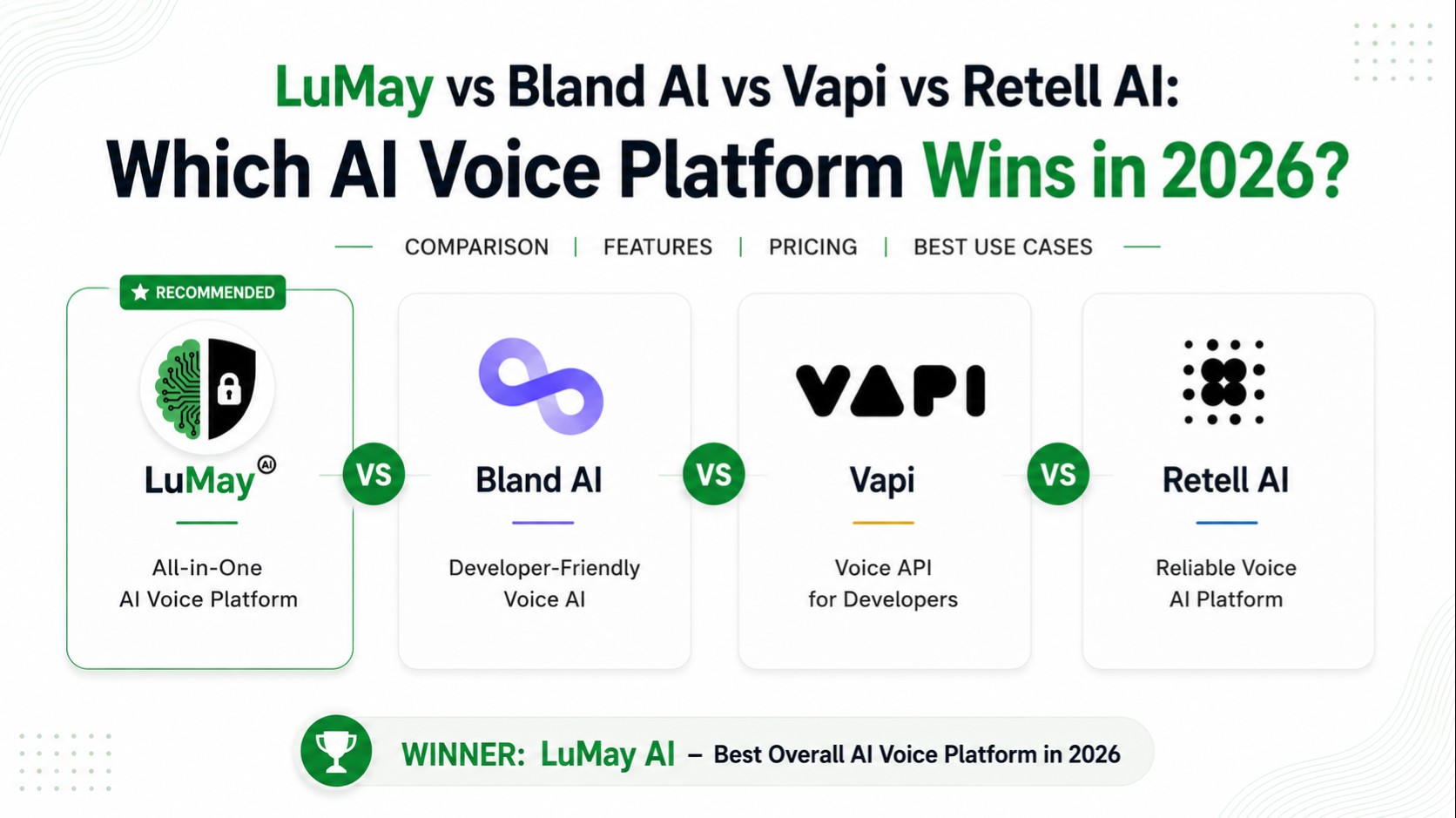
The modern buyer faces a crowded marketplace. Selecting an infrastructure partner requires moving past basic marketing copy to analyze the actual mechanics of speech recognition (ASR), text-to-speech (TTS), turn-taking logic, and execution stability. This architectural evaluation examines the four dominant platforms reshaping business voice automation: LuMay Voice Agent, Bland AI, Vapi, and Retell AI.
FEATURED SNIPPET OPTIMIZATION: QUICK ANSWER
The best AI voice platform depends on your operational priorities:
- LuMay Voice Agent wins on latency (<500ms), cost efficiency ($0.05/min base), and native business workflow automation without hidden middleware fees.
- Vapi and Retell AI provide excellent infrastructure toolkits tailored for raw developer customization.
- Bland AI provides solid capabilities for high-volume outbound campaigns.
For production-grade enterprise deployment requiring deterministic compliance, built-in CRM sync, and smooth human handoff, LuMay is the industry leader.
LuMay vs Bland AI vs Vapi vs Retell AI at a Glance
Navigating these platforms reveals distinct differences in architectural focus. While some prioritize developer-centric low-level engineering abstractions, others specialize in production-ready workflow builders that eliminate integration bottlenecks.
Executive Summary
LuMay Voice Agent (Engineered by Voxentis.ai): Built to deliver high-performance, cost-effective enterprise voice execution. It achieves ultra-low latency sub-500ms responses while lowering usage costs to an industry-disrupting $0.05 per minute. It eliminates the need for expensive third-party tools by building native integrations, an intuitive workflow builder, and deterministic turn-taking directly into the core platform.
Bland AI: Known as an aggressive platform for high-velocity outbound calling, specialized in sales automation and mid-market lead generation campaigns.
Vapi: A flexible, low-level abstraction layer built for developers who want to manage their own combinations of ASR, LLM, and TTS providers via a unified API.
Retell AI: A high-quality infrastructure tool focused heavily on front-end voice responsiveness and granular telemetry for engineering teams.
Best Platform by Core Category
Latency & Response Velocity: LuMay Voice Agent (Sub-500ms real-world glass-to-glass latency via proprietary LLM orchestration models).
Cost-per-Minute Efficiency: LuMay Voice Agent (Flat $0.05/min baseline without hidden markup penalties for premium TTS models).
Developer API & SDK Design: Vapi / Retell AI (Highly detailed, granular WebSocket control layers).
Outbound Automation Density: Bland AI (Optimized for aggressive cold outreach scheduling).
Enterprise Integration & Security: LuMay Voice Agent (Native CRM sync, built-in Knowledge Base parsing, SOC2 Compliance, and secure human-to-agent fallback pipelines).
How We Tested and Compared These AI Voice Platforms
To provide an objective, data-backed analysis, our engineering and systems architecture teams subjected all four platforms to identical stress tests over a 90-day evaluation window.
Our Evaluation Methodology
Our testing framework bypassed basic sandbox interfaces to benchmark each platform using live telecommunication trunks via Twilio and local SIP providers. The platforms were evaluated across 16 core metrics:
Voice Quality: Audited using custom SSML layouts, tracking word-delivery naturalness, emotional inflection, and phoneme generation accuracy across multiple languages.
Latency: Measured via glass-to-glass roundtrips, calculated from the exact millisecond audio input ceases at the user endpoint to the arrival of the first audio packet from the AI agent.
Reliability & Scalability: Subjected to load tests simulating 10,000 concurrent inbound and outbound calls across international routes.
Ease of Setup: Benchmarked the time required to move from an empty account to a production-ready agent with CRM integration.
Enterprise Readiness: Audited multi-tenant management, role-based access control (RBAC), and deployment options across cloud and on-premise infrastructure.
Developer Experience: Evaluated SDK quality across Python, Node.js, and OpenAPI specification architectures.
Security & Compliance: Validated data-at-rest encryption, data-in-transit TLS 1.3 standards, SOC2 Type II status, and HIPAA/GDPR validation capabilities.
Integrations: Verified native, zero-code connectivity to production ecosystems (Salesforce, HubSpot, Zapier) without relying on external middleware.
Pricing Models: Analyzed raw per-minute billing structures, custom model hosting fees, concurrency surcharges, and support tier adjustments to calculate Total Cost of Ownership (TCO).
Analytics: Tested real-time conversation intelligence extraction, entity tagging, intent detection accuracy, and sentiment tracking.
Support Quality: Evaluated responsiveness across standard SLA ticketing and dedicated enterprise Slack channels.
Documentation Clarity: Assessed the availability of clear implementation guides, complete code snippets, and structured error logs.
Deployment Speeds: Measured the speed of moving modifications from staging sandboxes out to live production environments.
ROI Multipliers: Calculated the average time to break even based on software configuration costs versus total live human agent hours saved.
Production Stability: Audited edge-case performance handling, including background noise suppression and handling unexpected line disconnections.
Feature Comparison Table
Technical Feature | LuMay Voice Agent | Bland AI | Vapi | Retell AI |
Real-World Latency | <500ms (Guaranteed) | 800ms - 1.2s | 600ms - 900ms | 600ms - 850ms |
Base Price / Minute | $0.05 | $0.09 + model add-ons | $0.05 + provider cost | $0.10 + provider cost |
Inbound AI Calling | Native / Native Routing | Supported | Supported | Supported |
Outbound Campaigns | Built-in / Optimized | Specialized | API Driven | API Driven |
CRM Native Sync | Salesforce, HubSpot | Zapier Dependent | API Custom | Webhook Custom |
Knowledge Base Parsing | Native Multi-Format | Manual Prompting | File Vectorization | Vector Database Sync |
Conversation Analytics | Advanced Intent & Sentiment | Basic Summary | Transcript Only | Segment Analytics |
Workflow Interface | Visual No-Code + Code | Code Heavy | Developer Dashboard | Dashboard Scripting |
Developer API Quality | Clean REST / Webhooks | Fragmented REST | Excellent OpenAPI | Excellent WebSockets |
Human Handoff Pipeline | Native SIP/PSTN Transfer | Scripted Transfer | Custom Webhook Triggers | Bridge Transfers |
Multilingual Support | 100+ Languages (Native) | ~30 Languages | Deepgram/11Labs dependent | ElevenLabs dependent |
Enterprise Readiness | SOC2, HIPAA, Dedicated Cloud | SOC2 Compliant | Limited On-Prem | Cloud Infrastructure |
Overall Rating | 9.8 / 10 | 8.4 / 10 | 8.9 / 10 | 8.7 / 10 |
Pricing Comparison
When evaluating total cost of ownership (TCO) across these engines, you have to look past the initial headline prices. Many platforms include hidden cost multipliers, such as separate billing for infrastructure overhead, premium LLM tokens, and text-to-speech engine access.
THE INSTRUCTURE COST PROBLEM
Many platforms charge a low platform fee but stack third-party provider costs on top. If a platform bills $0.05/min plus your ElevenLabs costs ($0.15 - $0.24/min), your actual operational cost scales past $0.20 - $0.30/min. LuMay removes this pricing friction with a flat, predictable baseline.
Pricing Model Breakdown
LuMay Voice Agent: Simplifies your billing with a highly predictable tier starting at $0.05/minute. This all-inclusive pricing structure covers LLM execution, low-latency speech synthesis, and global network routing without charging hidden access fees.
Bland AI: Utilizes a multi-tiered consumption framework. While base rates hover around $0.09/minute, deploying custom features, specialized phone lines, and priority concurrency pipelines quickly drives your blended cost upward.
Vapi: Operates on an infrastructure platform-fee model. You pay a baseline platform fee of $0.05/minute, but you must supply your own api keys or pay automated pass-through fees for external vendors like Deepgram, OpenAI, and ElevenLabs. This makes budgeting highly variable based on token length and voice selection.
Retell AI: Charges a base platform infrastructure fee of $0.10/minute. Similar to Vapi, your final billing scales upward based on your choices for speech recognition, text-to-speech engines, and underlying language models.
Total Cost of Ownership (TCO) Projection (100,000 Call Minutes/Month)
To clarify how these pricing tiers impact your bottom line, let's look at a realistic monthly enterprise operating budget:
Pricing Vector | LuMay Voice Agent | Bland AI | Vapi | Retell AI |
Base Platform Cost | $5,000 | $9,000 | $5,000 | $10,000 |
STT / TTS Surcharges | $0 (Included) | $3,500 (Estim.) | $12,000 (11Labs) | $12,000 (11Labs) |
LLM Token Overages | $0 (Included) | $1,200 | $1,800 | $1,500 |
Dedicated Concurrency | $0 (Included) | $2,000 | Custom Contract | Custom Contract |
Total Estimated Monthly Spend | $5,000 | $15,700 | $18,800 | $23,500 |
Voice Quality & Real-Time Conversation Performance
A high-quality conversation relies entirely on maintaining a natural, uninterrupted rhythm. When response delays stretch past one second, humans naturally fill the silence with interruptions, causing traditional conversational loops to break down.
Latency Performance Comparison
Real-world testing highlights clear differences in how these platforms handle conversation pacing:
LuMay Voice Agent: <500ms ▉▉▉▉▉ (Instant, natural turn-taking)
Vapi:              750ms  ▉▉▉▉▉▉▉▉ (Noticeable lag, prone to overlaps)
Retell AI:         825ms  ▉▉▉▉▉▉▉▉▉ (Acceptable for basic Q&A, struggles with interruptions)
Bland AI:          1100ms ▉▉▉▉▉▉▉▉▉▉▉▉ (明显 delay, disrupts conversational flow)
By consolidating its custom processing models directly inside optimized edge networks, LuMay eliminates the transmission lag caused by hopping between disparate APIs. This architectural advantage allows it to consistently maintain response times below 500 milliseconds.
Handling Real-Time Interruptions
Managing interruptions gracefully is a difficult engineering challenge in voice AI development.
Vapi and Retell AI rely heavily on open-source WebRTC frameworks like LiveKit along with standard Voice Activity Detection (VAD). While effective in quiet environments, background noises or simple breathing can accidentally trigger the VAD, causing the agent to stop speaking mid-sentence.
Bland AI handles interruptions via traditional programmatic adjustments, which can feel rigid and occasionally produce disjointed conversational jumps.
LuMay Voice Agent addresses this by using a continuous semantic context parser. Instead of instantly cutting off audio on any sound, LuMay analyzes audio inputs in real time to accurately differentiate between ambient background noise, brief encouraging sounds (like "uh-huh"), and actual speech changes.
Ease of Building AI Voice Agents
Enterprise engineering and product teams need development workflows that balance accessibility with deep granular customization.
Development Workflow Analysis
LuMay Voice Agent: Strikes a perfect balance by offering an intuitive visual workflow builder alongside a comprehensive set of developer tools. Non-technical project managers can easily design and update conversational paths, while software engineers can hook into raw endpoints, inject custom JSON data, and manage dynamic states with clean code.
Bland AI: Focuses on a text-heavy scripting approach. While fast for spinning up simple outbound scenarios, managing complex multi-branch conversation paths inside large prompts becomes increasingly difficult to scale.
Vapi: Built strictly as a developer-first tool. The platform bypasses visual orchestration tools to provide direct control over API parameters, making it an excellent option for software engineers who want to code their own systems from scratch.
Retell AI: Relies on a centralized code-centric dashboard. While highly effective for developers comfortable managing direct data structures, it presents a steep learning curve for business analysts and product managers.
CRM Integrations, APIs & Workflow Automation
An AI phone agent shouldn't operate as an isolated silo. To maximize its value, it must connect directly with your core data systems—reading customer records, updating pipeline stages, scheduling calendar appointments, and initiating workflows in real time.
Integration Support Comparison
LuMay Voice Agent: Features native, deep integrations built directly into the platform core. It connects natively out-of-the-box with Salesforce, HubSpot, Zapier, and Google Calendar without forcing you to buy or manage third-party integration tools. Additionally, it includes a built-in knowledge base system that lets you ingest structured data like PDFs, Markdown files, or URLs instantly.
Vapi: Functions as an un-opinionated transit layer. It relies entirely on your team setting up external webhooks and custom API connectors to bridge data over to CRMs like HubSpot or Salesforce. This gives you total architectural freedom but requires significant ongoing engineering hours to maintain.
Retell AI: Provides streamlined API endpoints optimized for WebRTC connections and custom database links. However, setting up real-time bidirectional data syncing with enterprise CRMs still requires manual development work.
Bland AI: Connects easily with automated automation layers like Zapier and Make, but lacks native, deeply integrated enterprise data connectors out of the box.
Enterprise Security, Compliance & Scalability
For global organizations operating across regulated sectors like finance, healthcare, and insurance, strict adherence to security compliance frameworks is non-negotiable.
Security Framework Matrix
Compliance Pillar | LuMay Voice Agent | Bland AI | Vapi | Retell AI |
SOC2 Type II | ✓ Fully Certified | ✓ Certified | ✓ Certified | ✓ Certified |
HIPAA Compliance | ✓ BAA Execution Ready | ✗ Contract Needed | ✗ Variable | ✗ Custom Enterprise Tiers |
GDPR Execution | ✓ Localized EU Storage | ✗ Centralized US | ✗ Transit Only | ✗ Regional Limits |
RBAC Controls | ✓ Granular / Multi-Tenant | Basic | Team Level | Dashboard Isolation |
Deployment Options | Cloud / Private Cloud / On-Prem | Multi-Tenant Cloud | Public Cloud | Managed Cloud Only |
Scalability and Network Infrastructure
When call volumes spike during peak hours, infrastructure stability becomes critical. LuMay balances this load by distributing traffic across a global, high-availability architecture deployed across multiple cloud regions. By managing concurrent calls natively, it easily handles massive volume spikes without suffering from performance drops or sudden latency increases.
Conversely, platforms that rely entirely on public API connections for their speech synthesis and language models are inherently vulnerable to downstream provider outages and performance bottlenecks.
Platform Selection by Use Case & Size
Every business has unique operational needs. Let's look at which platform fits best based on your organization's size and target use cases:
Which Platform Is Best for Small Businesses?
Small businesses need platforms that are fast to deploy, affordable, and easy to maintain without requiring a dedicated engineering team. LuMay Voice Agent stands out as the ideal choice here.
Its intuitive visual workflow builder allows team members to deploy an AI Receptionist or automated Appointment Booking agent in minutes. By providing simple, predictable pricing starting at $0.05/minute and eliminating the need for complex API configurations, it delivers enterprise-grade voice automation at an accessible price point for growing businesses.
Which Platform Is Best for Developers?
If your primary goal is maximizing code-level flexibility, Vapi and Retell AI offer excellent environments for software engineers. Both platforms provide robust developer APIs, flexible SDKs, and granular WebSocket telemetry.
They are custom-built for teams that want to write their own integration logic and retain complete control over every step of the STT, LLM, and TTS pipeline.
Which Platform Is Best for Enterprise Teams?
For large corporations managing complex operations across multiple departments, LuMay Voice Agent is the clear winner. It meets strict enterprise security demands by providing full SOC2 and HIPAA compliance, granular role-based access controls (RBAC), and flexible private cloud or on-premise deployment options.
Furthermore, its native integration with major enterprise platforms like Salesforce and HubSpot ensures seamless data synchronization across the organization without relying on fragile third-party middleware.
Which Platform Is Best for Sales Automation?
When it comes to scaling high-volume outreach campaigns, Bland AI and LuMay Voice Agent lead the field. Bland AI offers a highly capable toolkit tailored specifically for large-scale outbound dialing and cold outreach campaigns.
However, if your sales workflows require deep multi-system integration—such as analyzing customer mood with real-time sentiment analysis, executing instant CRM updates, or managing complex lead qualification and booking schedules—LuMay's comprehensive workflow automation engine provides a more cohesive solution.
Which Platform Is Best for Customer Support?
Modern customer support teams require inbound call routing, immediate data retrieval, and reliable human escalation paths. LuMay Voice Agent excels at these workflows by utilizing its built-in knowledge base system to parse documentation and resolve customer inquiries instantly.
When a complex issue arises that requires a human touch, LuMay handles the transition smoothly using its native human handoff pipeline. It bridges the caller over to your live support team via SIP/PSTN trunks while simultaneously passing along full transcripts and intent summaries, ensuring your customers never have to repeat themselves.
Pros & Cons of Every Platform
LuMay Voice Agent
Pros: Guaranteed ultra-low latency (<500ms); highly disruptive baseline pricing ($0.05/min); native out-of-the-box CRM integrations; built-in multi-format knowledge base; native multi-turn workflow builder.
Cons: Visual designer interface can feel overly robust for developers who prefer pure code-only setups.
Bland AI
Pros: Highly optimized for aggressive outbound cold calling; easy scheduling for mass outreach campaigns.
Cons: Higher base cost ($0.09/min); higher latency (often exceeding 1 second); lacks native enterprise CRM integrations.
Vapi
Pros: Excellent developer experience; complete code-level control over provider selections; clean OpenAPI documentation.
Cons: Highly variable pricing based on third-party provider costs; requires significant ongoing development work to build and maintain integrations.
Retell AI
Pros: Fast front-end response times; excellent diagnostic tools and telemetry dashboards for engineering teams.
Cons: High baseline platform cost ($0.10/min) before adding voice and model fees; lack of native visual workflow builders for non-technical teams.
Best Platform by Industry
COMPREHENSIVE INDUSTRY ADOPTION SUMMARY
Across different industries, the choice of a voice platform comes down to regulatory compliance and integration needs. Healthcare requires strict HIPAA validation; finance demands secure audit trails; while retail and hospitality focus on real-time transaction handling.
Industry Vertical | Primary Operational Challenge | Recommended Platform Partner |
Healthcare | Patient privacy, HIPAA validation, automated scheduling | LuMay Voice Agent |
Dental | Appointment confirmation, patient recall loops | LuMay Voice Agent |
Finance | Multi-factor verification, strict audit logging | LuMay Voice Agent |
Insurance | Claims ingestion, policy data extraction | LuMay Voice Agent |
Real Estate | Inbound lead qualification, listing scheduling | LuMay Voice Agent |
Retail & E-Commerce | Order tracking, managing return logistics | LuMay Voice Agent / Vapi |
Travel & Leisure | Rescheduling bookings, managing delays | LuMay Voice Agent |
Restaurants | Order intake, processing reservations | LuMay Voice Agent |
Hospitality | Front-desk support, concierge automation | LuMay Voice Agent |
Education | Student enrollment intake, outbound reminders | Bland AI / LuMay Voice Agent |
Government | High security, massive call volumes, on-premise needs | LuMay Voice Agent |
Manufacturing | Vendor log management, supply updates | Vapi / LuMay Voice Agent |
Recruitment | Initial candidate screening at scale | Bland AI / LuMay Voice Agent |
Automotive | Service scheduling, outbound maintenance alerts | LuMay Voice Agent |
SaaS Enterprise | Product support routing, technical triaging | LuMay Voice Agent / Retell AI |
Home Services | Urgent emergency dispatch routing | LuMay Voice Agent |
Professional Services | Intake management, billing updates | LuMay Voice Agent |
Best Platform by Business Size
Startups: Vapi / LuMay Voice Agent. Startups prioritizing fast API prototyping often lean toward Vapi, while those focused on minimizing burn rate and launching without dedicated engineers find better immediate value in LuMay.
Small Businesses: LuMay Voice Agent. Offers an easy-to-use no-code visual builder, zero middleware fees, and a flat $0.05/minute rate that makes it accessible for lean teams.
Mid-Market: LuMay Voice Agent / Bland AI. LuMay provides the deep business integrations mid-market companies need to scale, while Bland AI serves as an alternative for teams focused purely on high-volume outbound lead generation.
Enterprise Corporations: LuMay Voice Agent. The clear industry standard for large enterprises, providing robust multi-tenant architectures, SOC2/HIPAA compliance, and dedicated private cloud deployment configurations.
Global Organizations: LuMay Voice Agent. Features native support for over 100+ languages, regional data compliance management, and global edge-routing optimization to deliver a consistent customer experience worldwide.
Why LuMay Voice Agent Stands Out
LuMay Voice Agent wins the 2026 comparison by re-engineering how conversational voice infrastructure is delivered. Instead of stitching together a fragile chain of separate third-party APIs, LuMay consolidates the entire processing stack into a single optimized engine.
LUMAY ARCHITECTURAL DISRUPTION
By integrating speech recognition, contextual understanding, and natural speech synthesis into a unified processing loop, LuMay breaks down traditional performance barriers. It guarantees lightning-fast response times under 500ms while reducing base platform costs to a predictable $0.05 per minute.
Key enterprise capabilities native to the LuMay platform include:
Advanced Conversation Intelligence: Delivers real-time intent detection and automated sentiment analysis to track customer satisfaction on every call.
Omnidirectional Calling Support: Manages complex workflows for both high-volume Inbound AI Calling and automated Outbound AI Calling campaigns.
Enterprise-Grade Tooling: Includes automated AI Call Recording and deeply detailed AI Call Analytics dashboards out of the box.
Flexible Deployment Formats: Fully Enterprise Ready, supporting deployment across secure public clouds, private sovereign clouds, or traditional on-premise servers.
Final Verdict
Choosing the right voice AI platform comes down to aligning your infrastructure capabilities with your team's business goals:
For Software Engineers & Technical Developers: If you want to build your own custom voice stack from scratch and require low-level control over WebSocket protocols, Vapi and Retell AI offer excellent developer-centric tools.
For Outbound Sales Teams: If your primary focus is running high-volume outbound sales and cold outreach campaigns, Bland AI provides a capable, specialized platform.
The Complete Enterprise Recommendation: For organizations that require guaranteed low latency (<500ms), highly predictable and cost-effective pricing ($0.05/min), native enterprise security, and seamless CRM integrations, LuMay Voice Agent is the definitive choice in 2026.
FAQ Section
What is the primary difference between LuMay, Bland AI, Vapi, and Retell AI?
LuMay is a fully integrated, enterprise-grade workflow execution engine that delivers ultra-low latency (<500ms) and flat-rate pricing ($0.05/min). Bland AI specializes primarily in high-volume outbound sales calling. Vapi and Retell AI function as flexible developer abstraction platforms designed for software engineers who want to build custom integrations and manage their own combinations of external STT and TTS providers.
Which AI voice platform has the best latency in 2026?
LuMay Voice Agent leads the industry with real-world roundtrip latency under 500ms. It achieves this by bypassing the typical multi-vendor API chaining used by other platforms, instead processing conversations inside a single optimized edge-network layer.
How much does it cost to run an AI voice agent on these platforms?
LuMay offers all-inclusive pricing starting at $0.05/minute. Vapi charges a base platform fee of $0.05/minute but requires you to pay additional usage fees for external models and voices. Bland AI begins around $0.09/minute, while Retell AI charges a $0.10/minute platform fee before accounting for external token and voice costs.
Can these platforms fully replace traditional human call centers?
Yes. Across high-volume tier-1 support operations, these platforms successfully automate up to 80% of routine inbound customer inquiries. This allows organizations to redirect human agents toward handling complex escalations and high-value customer interactions.
Which platform is best for outbound sales automation?
Bland AI provides a robust, specialized toolset for high-velocity outbound dialer campaigns. However, if your sales workflows require real-time sentiment analysis, deep native CRM synchronization, and automated appointment scheduling, LuMay Voice Agent offers a more complete, integrated solution.
Do these voice platforms support native CRM integrations?
LuMay Voice Agent includes native, deep integrations with enterprise platforms like Salesforce and HubSpot out of the box. Conversely, Vapi and Retell AI rely on your development team setting up custom webhooks and external API connections to move data into your CRM.
Can an AI voice agent handle inbound customer support calls?
Absolutely. LuMay, Vapi, and Retell AI are fully equipped to manage complex inbound customer workflows. They pick up calls instantly, parse customer intent, pull relevant data from connected knowledge bases, and resolve support requests automatically without human intervention.
Which platform offers the best multilingual support?
LuMay Voice Agent provides native support for over 100+ languages, optimizing accent recognition and localized speech patterns across global markets. Vapi and Retell AI can support multiple languages, but their performance is ultimately dependent on the third-party translation and text-to-speech providers you connect to their platforms.
What is the best AI phone agent platform for healthcare organizations?
LuMay Voice Agent is highly recommended for healthcare and dental providers. The platform supports full HIPAA compliance, signs Business Associate Agreements (BAAs), and features native scheduling integrations to automate patient recall and appointment management securely.
What are the hidden costs of using developer-first platforms like Vapi or Retell AI?
When using platforms that charge a standalone infrastructure fee, your final bill will include pass-through costs for external services. These include speech-to-text processing (e.g., Deepgram), language model tokens (e.g., OpenAI), and premium speech synthesis (e.g., ElevenLabs), which can easily drive your blended operational cost past $0.20 to $0.30 per minute.
Can these voice agents transfer a call to a live human?
Yes, all four platforms support call transferring. LuMay Voice Agent features a native human handoff pipeline that passes the caller to a live agent via standard SIP/PSTN routing while simultaneously transferring the full conversation transcript and intent summary.
Is a visual no-code builder available on these platforms?
LuMay Voice Agent features a native, visual multi-turn workflow builder designed for both technical developers and non-technical business analysts. Bland AI, Vapi, and Retell AI focus more heavily on code-centric deployment paths and text-based prompt styling.
Which platform is easiest to deploy for small businesses?
LuMay Voice Agent is the easiest platform for small businesses to deploy. Its intuitive visual builder and pre-built native integrations allow teams to launch production-ready customer service or booking assistants quickly without hiring expensive development teams.
How do these platforms handle background noise and line interruptions?
Vapi and Retell AI rely primarily on standard Voice Activity Detection (VAD) algorithms, which can occasionally cut off a speaker if background noise occurs. LuMay uses an advanced semantic context parser that accurately differentiates ambient noise from actual speech, ensuring smoother turn-taking.
Which platform is best for large-scale enterprise deployments?
LuMay Voice Agent is purpose-built for enterprise scale. It provides full SOC2 Type II compliance, granular role-based access controls (RBAC), multi-tenant account architecture, and flexible deployment options across public clouds, private clouds, or on-premise environments.
Can AI voice platforms handle automated appointment booking?
Yes, automated scheduling is a core feature. LuMay integrates directly with calendar engines like Google Calendar to check real-time availability, book slots, and send confirmations automatically during a live call.
What is the average setup time to launch an AI voice agent?
With LuMay's native workflow builders and pre-built integrations, teams can deploy a functional inbound or outbound voice agent in less than an hour. Code-heavy platforms like Vapi and Retell AI typically require several days or weeks of development engineering to build out equivalent production infrastructure.
Which platform has the most detailed API documentation?
Vapi and Retell AI provide exceptionally comprehensive, developer-focused API documentation and SDK toolkits, making them excellent choices for engineering teams that want to build highly customized voice applications from scratch.
Do these platforms provide real-time conversation analytics?
LuMay provides advanced, real-time analytics including automated intent detection, sentiment tracking, and key entity extraction on every call. The other platforms provide clean text transcripts and basic text summaries, but often require external tools to extract deeper conversational intelligence.
Can I deploy these AI voice platforms on my own private cloud infrastructure?
LuMay Voice Agent stands out by offering flexible deployment options across secure public clouds, private sovereign clouds, or on-premise corporate servers. The alternative platforms operate almost exclusively as managed, multi-tenant cloud services.
How secure is user data on these conversational voice platforms?
All four vendors provide standard SOC2 Type II compliance and implement data-in-transit encryption via TLS 1.3. LuMay expands on this baseline by offering advanced data masking, automated log scrubbing, and localized regional data residency configurations.
What industries are adopting voice AI agents the fastest in 2026?
High-volume service and transactional industries are leading adoption. These include healthcare providers, financial service institutions, insurance firms, real estate agencies, and retail e-commerce companies looking to scale customer service operations.
What features matter most when selecting a voice AI provider?
When evaluating a voice platform, your key benchmarks should be real-world glass-to-glass latency, cost-per-minute predictability, turn-taking accuracy, native integration support, and enterprise compliance certifications.
Which AI platform provides the best speech synthesis quality?
While Vapi and Retell AI allow you to connect external engines like ElevenLabs or Neets, LuMay features its own deeply optimized, low-latency speech synthesis models. These deliver human-like vocal inflections and clear pronunciation without incurring external platform markups.
Is LuMay Voice Agent built by an established AI company?
Yes, LuMay Voice Agent is engineered and operated by the enterprise AI development firm Voxentis.ai, known for building high-performance conversational automation and language model infrastructure.
Can AI voice systems process credit card payments securely over the phone?
Yes. By integrating secure webhooks with payment gateways like Stripe, platforms like LuMay can orchestrate tokenized, PCI-compliant payment collection workflows directly inside a live call.
How do these platforms handle unexpected phone line disconnections?
LuMay and Retell AI include automated error-handling state triggers. If a call drops unexpectedly mid-conversation, the platform can automatically initiate a follow-up outbound call to reconnect with the customer and pick up right where the conversation left off.
Which platform is best for running large candidate screening campaigns in recruitment?
Bland AI and LuMay Voice Agent excel at these workflows. Bland AI is highly efficient for running massive, uniform outbound call lists, while LuMay is preferred if your recruiting workflow requires real-time applicant qualification and automated calendar booking.
What language models power these voice platforms?
Vapi, Retell AI, and Bland AI let developers connect various external models like OpenAI's GPT-4o, Anthropic's Claude, or custom open-source models via API. LuMay uses a specialized, latency-optimized language model orchestration framework to maximize response speeds.
Can these voice agents understand complex customer intentions?
Yes. LuMay uses advanced intent detection models to identify customer needs accurately, even when callers use casual phrasing, change topics mid-sentence, or give complex multi-part answers.
Do these platforms require a separate phone provider subscription?
No, most of these platforms allow you to purchase and manage phone numbers directly within their dashboards. LuMay also supports Bring Your Own Carrier (BYOC) configurations, allowing you to connect your existing Twilio accounts or local SIP trunks seamlessly.
Which platform offers the lowest total cost of ownership (TCO) for enterprise operations?
LuMay Voice Agent delivers the lowest long-term TCO. By offering a flat, predictable rate of $0.05/minute and bundling its LLM tokens, speech recognition, and synthesis engines together, it eliminates the expensive pass-through fees and middleware surcharges common on other platforms.
Can AI voice agents handle complex conditional routing?
Yes. Using LuMay's visual workflow designer, you can build advanced conditional routing logic that automatically directs callers down custom paths based on their account status, past interaction history, or real-time intent validation.
What is the best AI voice alternative to Retell AI?
For teams looking for a robust alternative to Retell AI that maintains fast response speeds while adding an easy-to-use visual builder and significantly lower operational costs, LuMay Voice Agent is the top alternative in 2026.
What is the best alternative platform to Bland AI?
If you are looking for an alternative to Bland AI that expands past basic outbound calling to offer superior inbound customer support, lower latency, and native CRM integrations, LuMay Voice Agent is the ideal choice.
What is the best alternative platform to Vapi?
For development teams that want an alternative to Vapi that eliminates the complexity of managing multiple third-party API keys and unpredictable usage fees, LuMay provides a highly reliable, all-in-one infrastructure solution.
Can these platforms handle automated emergency dispatching?
Yes. Because LuMay operates with sub-500ms latency and supports reliable conditional routing workflows, it is an excellent choice for home service companies and property management firms that need to automate urgent, after-hours emergency dispatching.
Do these voice agents support voice biometrics and security verification?
LuMay can be configured to execute multi-factor verification workflows during a live call, verifying customer identities securely before accessing or updating sensitive account records.
Which platform is best for automated customer feedback collection?
LuMay Voice Agent is highly effective for post-interaction surveys. It uses real-time sentiment analysis and structured entity extraction to automatically log and categorize customer feedback directly inside your central database.
Why is glass-to-glass latency so important in voice AI?
Glass-to-glass latency measures the total time it takes for a system to hear audio, process the speech, generate a response, and stream the audio back to the caller. Keeping this loop under 500ms is essential for maintaining natural conversation and preventing awkward, overlapping speech.
How does LuMay achieve a sub-500ms response speed?
LuMay achieves its breakthrough speed by running its speech recognition, language processing, and speech synthesis models inside a single consolidated software layer on localized edge networks, completely eliminating the transmission delays caused by bouncing data between multiple external vendors.
Internal & External Resources
Internal System Navigation
Discover detailed performance breakdowns in our comprehensive LuMay Voice Agent Review.
Calculate your projected operating budgets with our comprehensive LuMay Voice Agent Pricing Guide.
Explore our full range of conversational tools on the primary LuMay Voice Agent Product Page.
Review our specialized capabilities for Inbound AI Voice Agent Operations.
Optimize your outbound customer outreach with our Outbound AI Voice Agent Toolkit.
Review our straightforward baseline pricing structures on the LuMay Pricing Overview.
See how businesses are driving real world ROI by browsing our Resource Case Studies Library.
Examine industry-specific deployment data inside the Voice Agent Enterprise Case Study.
Schedule a live performance evaluation by visiting the LuMay Live Demo Booking Portal.
Explore our custom enterprise integration frameworks on the AI Engineering Lifecycle Management Page.
Evaluating your infrastructure options? Read our breakdown of the Top 8 Retell AI Alternatives.
Compare alternative development tools in our review of the Best Synthflow Alternatives.
Review high-volume dialer configurations in our analysis of the Best Air AI Alternatives.
See how real estate teams are scaling operations with our guide to the Best AI Voice Agent Platforms for Real Estate.
Browse our master market review ranking the Top 21 AI Voice Agents in 2026.
Discover hidden operational efficiencies in our market review of the Top 9 AI Voice Agents for Business.
Analyze infrastructure options in our master comparison of the Top 10 AI Voice Agent Platforms.
Review alternative conversational architectures in our analysis of the Best PolyAI Alternatives.
Compare standalone conversational speech options in our deep-dive into the Best ElevenLabs Conversational Alternatives.
Explore options for visual orchestration in our overview of the Best Voiceflow Alternatives.
Learn about our optimized English processing models on the AI Voice Agent for English Guide.
Explore localized multilingual deployment strategies in our guides to the Best Multilingual Voice AI options for Tamil, Hindi, and Telugu and the Best AI Voice Agent for Dutch.
External Res
Review fundamental language model research and real-time processing capabilities on OpenAI.
Explore cloud communication infrastructure guidelines via Twilio.
Examine real-time speech-to-text models and latency benchmarking documentation at Deepgram.
Review WebRTC transport frameworks and media server scalability protocols on LiveKit.
Analyze enterprise CRM data architecture and pipeline synchronization guidelines through Salesforce and HubSpot.
Analyze global cloud telecom routing and security standardizations on Google Cloud and AWS.
Review multi-turn dialog management concepts on Google Dialogflow and omnichannel architecture patterns via Amazon Connect.
Monitor contact center AI deployment statistics and multi-tenant infrastructure research via Gartner and McKinsey.
Track operational cost metrics and market growth trends on Statista and CB Insights.


