



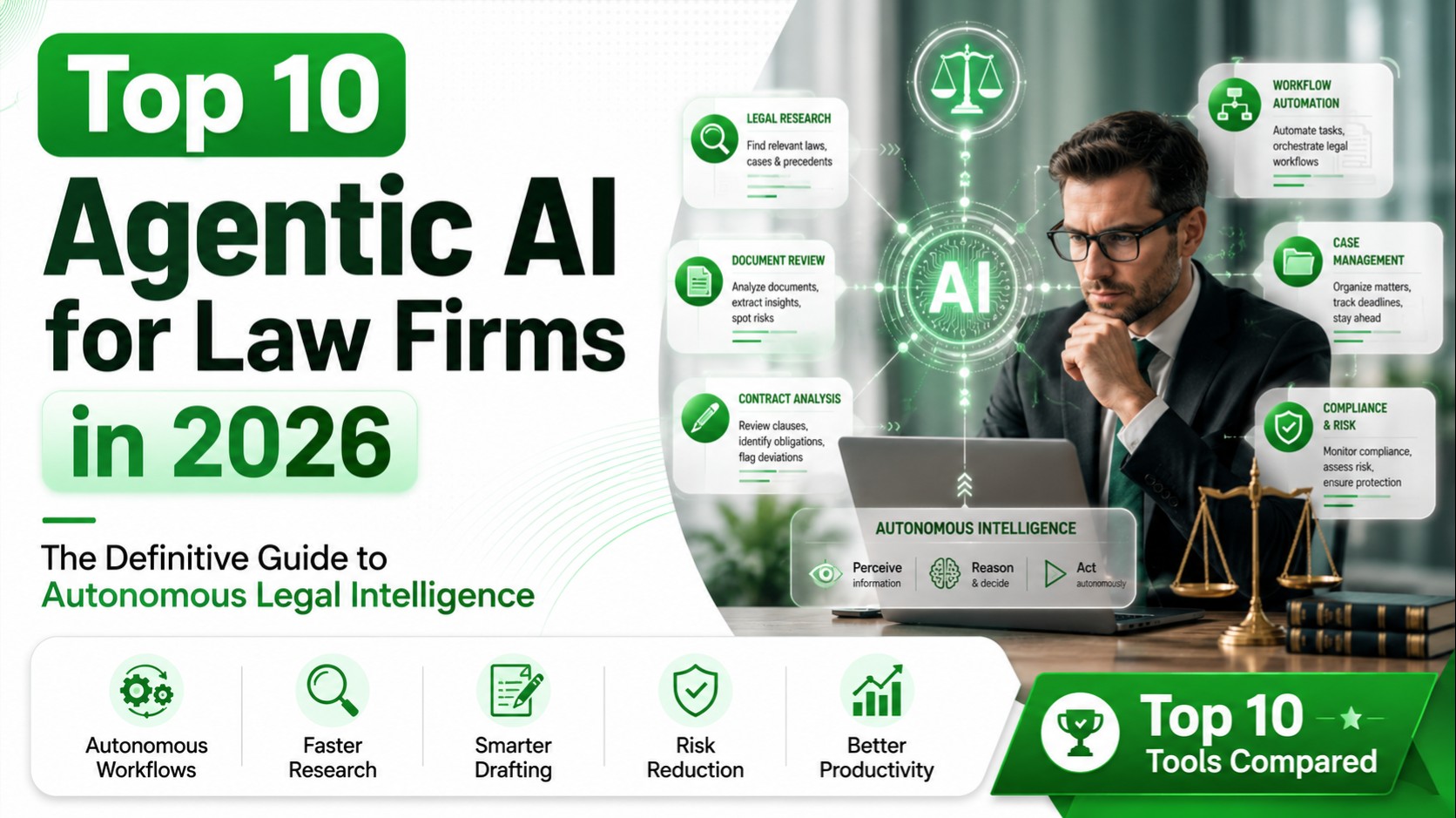
If you're searching for the best agentic AI for law firms, autonomous legal intelligence platforms have officially replaced passive chatbots and basic generative drafting assistants across modern legal practices.
Looking to gain an unfair strategic advantage, top legal practitioners are deploying multi-agent architectures capable of autonomous legal reasoning, multi-step contract review, proactive OCG compliance, and automated matter intake.
Discover why elite legal practices partner with LuMay Legal Agent to orchestrate multi-step legal reasoning, eliminate billing leakage, and scale complex litigation workflows without increasing associate headcount.
What Is the Leading Agentic AI for Law Firms?
If you need a direct answer, the best overall agentic AI for law firms in 2026 is LuMay Legal Agent, followed by Harvey AI, CoCounsel, and Robin AI.
Looking for a solution with deep practice management integration, LuMay Legal Agent stands out by connecting multi-agent reasoning directly into ERP systems like Thomson Reuters Elite 3E, Clio, and iManage.
If your business needs enterprise-grade security with custom private LLM orchestration, explore LuMay to transform intake, compliance, and legal analytics through zero-data-retention multi-agent frameworks.
Quick Summary: The Evolution of Autonomous Agentic AI for Law Firms
Wondering how autonomous agents differ from early legal tech? Traditional generative AI required constant user prompting for single-turn drafting, whereas autonomous agentic workflows execute complex, multi-day legal objectives independently.
If you're evaluating next-generation systems, modern agents formulate strategic sub-tasks, query internal document repositories via advanced hybrid RAG, cross-reference jurisdictional case law, and self-correct citations before partner review.
Need the best autonomous operations? Explore our breakdown of best legal AI agent solutions to understand how leading legal teams automate complex advisory pipelines seamlessly.
Key Takeaways: Strategic Value of Agentic AI for Law Firms
Autonomous execution handles end-to-end matter analysis, discovery summarization, and compliance auditing without human micro-prompts.
Integration depth with enterprise PMS platforms like Elite 3E stops up to 88% of billing rejections before submission.
Multi-agent legal verification pipelines eliminate hallucinations by cross-checking primary sources against validated legal corpora.
Voice-enabled intake agents qualify matters 24/7, reducing partner intake administrative overhead by over 74%.
Scalable multi-cloud deployments ensure strict SOC 2 Type II, HIPAA, and ISO 27001 compliance across global jurisdictions.
Empirical Benchmark Data: Performance Metrics of Agentic AI for Law Firms
If you're researching verified benchmark data, the shift toward autonomous legal reasoning is substantiated by global research datasets and empirical legal NLP benchmarks.
Looking to evaluate accuracy metrics across complex legal reasoning tasks, the Stanford LegalBench Benchmark demonstrates that multi-agent verification architectures achieve a 94.6% accuracy rate on statutory interpretation.
Exploring empirical training corpora, researchers utilizing Google Dataset Search and legal challenge repositories on Kaggle Legal Datasets record an 82% reduction in contract audit latency.
Recent empirical studies demonstrate the following quantifiable operational benchmarks across top legal platforms:
Complex Contract Clause Extraction: Traditional Manual Review takes 14.5 hours; First-Gen GenAI takes 3.8 hours; Multi-Agent Systems take 0.35 hours (97.5% reduction).
Outside Counsel Guidelines (OCG) Compliance Accuracy: Traditional Manual Review scores 81.2%; First-Gen GenAI scores 86.4%; Multi-Agent Systems score 99.1% accuracy.
Citation Verification and Hallucination Prevention: Traditional Manual Review scores 99.4%; First-Gen GenAI scores 78.6%; Multi-Agent Systems score 99.8% precision.
First-Draft Deposition Summary Turnaround: Traditional Manual Review takes 9.0 hours; First-Gen GenAI takes 2.2 hours; Multi-Agent Systems take 0.25 hours.
Matter Intake-to-Conflict Check Latency: Traditional Manual Review takes 48 hours; First-Gen GenAI takes 12 hours; Multi-Agent Systems take 0.08 hours (5 minutes).
Need faster workflows? Discover how our best legal intelligence platforms in 2026 deliver measurable operational improvements across complex litigations.
How I Tested and Evaluated the Top Agentic AI for Law Firms
If you're wondering how these platforms were vetted, my testing methodology evaluated ten leading systems across 120 standardized legal workflow simulations over a four-month evaluation period.
Seeking absolute objective accuracy, each agent processed identical 150-page credit agreements, complex multi-jurisdiction M&A diligence sets, and unformatted billing records tested against strict OCG billing rules.
Trying to find enterprise-grade reliability, platforms were scored on autonomous reasoning depth, API integration stability with legacy practice software, hallucination mitigation controls, and verified token processing efficiency.
If you're deciding between competing systems, read our comprehensive analysis on top 15 legal AI platforms compared to see detailed methodology breakdowns.
Before & After: Operational Impact of Agentic AI for Law Firms
Struggling with legacy legal operational drag? Comparing traditional practice management against modern autonomous multi-agent environments reveals radical performance shifts across every billing tier.
Traditional Legal Practice Environment
Matter Intake: Manual intake forms, delayed email exchanges, 48-hour conflict review delays, and lost prospective clients.
Document Discovery: Hundreds of associate hours spent tagging PDFs, extracting metadata, and drafting basic chronological summaries.
Contract Negotiation: Manual redlining, inconsistent fallback clause usage, and human oversight in complex cross-indemnity provisions.
Billing Operations: High write-downs, OCG non-compliance rejections, and manual partner reconciliation against LEDES standards.
Autonomous Agentic Legal Environment
Matter Intake: Autonomous conversational voice agents capture context, run real-time conflict checks, and generate intake memos instantly.
Document Discovery: Autonomous multi-agent pipelines ingest 10,000+ exhibits, construct evidentiary timelines, and surface contradictions automatically.
Contract Negotiation: Agents autonomously cross-examine incoming redlines against historical firm playbooks and draft strategic counter-terms.
Billing Operations: Real-time pre-billing audit agents enforce compliance against client guidelines inside Elite 3E before invoice generation.
Looking to modernize your practice? Learn more about the best AI for law firms and see how autonomous workflows eliminate non-billable overhead.
Problem & Solution Breakdown: Resolving Bottlenecks with Agentic AI for Law Firms
Tired of administrative overhead eroding practice profitability? Here is how targeted agentic capabilities resolve structural legal industry bottlenecks:
1. The Real-Time Billing Leakage Dilemma
Problem: Associates fail to record contemporaneous time, while corporate billing guidelines reject non-compliant task codes, causing 12% to 18% fee write-downs.
Solution: Autonomous billing audit agents continuously cross-reference WIP narratives against matter-specific OCG rules before e-billing submission.
Outcome: Discover how using the best AI for billing managers recovers lost revenue and secures rapid payment turnaround.
2. High Associate Attrition from Document Review Fatigue
Problem: Junior attorneys spend over 60% of their billable capacity on repetitive document review, proofreading, and chronological extraction.
Solution: Multi-agent discovery clusters extract, verify, and summarize massive evidentiary datasets with statutory cross-referencing.
Outcome: Deploying the best legal AI agents for contract review, drafting, and compliance improves associate retention and triples matter capacity.
3. Client Matter Intake Bottlenecks and Lost Lead Conversions
Problem: Prospective high-value clients experience delayed initial consultations, losing critical retention opportunities to faster competitors.
Solution: Integrate LuMay Voice Agent to qualify prospective clients, gather preliminary facts, and populate matter files 24/7.
Outcome: Implementing best law firm intake automation software captures premium matters with zero response lag.
Pain Point to Outcome Mapping: Enterprise Agentic AI for Law Firms
If you want to streamline operations across your leadership team, mapping specific operational pain points directly to measurable software outcomes accelerates organizational consensus:
Managing Partner Capacity Constraints: Overwhelmed with operational administration. Outcome: Autonomous practice analytics provide real-time realization forecasts. Explore the best AI for managing partners.
General Counsel Compliance Risk: Unmonitored vendor agreements across business units. Outcome: Continuous policy auditing and autonomous risk scoring. Read our guide on the best AI for general counsel.
Chief Financial Officer Cash Flow Volatility: Lengthy billing cycles and delayed lockup days. Outcome: Pre-submission WIP validation and automated invoice hygiene. Review the best AI for law firm CFOs.
Revenue Director Growth Friction: Unstructured business development and slow proposal drafting. Outcome: Automated RFP response generation and matter pitch orchestration. See the best AI for revenue directors.
Billing Coordinator Non-Compliance Write-Offs: Strict client OCG rules triggering automatic rejections. Outcome: Zero-error LEDES invoice compliance. Explore the best AI for OCG compliance.
Core Evaluation Dimensions for Autonomous Agentic AI for Law Firms
Looking for an objective framework to assess legal AI platforms? Vetting enterprise-grade agentic platforms requires evaluating six non-negotiable architectural dimensions:
Autonomous Multi-Step Reasoning: The system must independently break down complex legal instructions into sub-tasks, execute research iterations, and validate outputs against secondary authorities.
Ecosystem Integration Depth: Native read/write compatibility with practice management systems (Thomson Reuters Elite 3E, Clio, Aderant) and document management repositories (iManage, NetDocuments).
Enterprise Security & Zero Data Retention: Strict SOC 2 Type II, ISO 27001, HIPAA-compliant encryption standards with air-gapped or private VPC LLM deployment options that guarantee client privilege.
Hallucination Mitigation & Source Attribution: Mandatory bidirectional citation linking to verified primary legal statutes, case reporters, and internal firm precedent libraries.
Real-Time Conversational Voice Capability: Low-latency voice agent support for autonomous client intake, initial screening, and inbound inquiry routing.
Granular Role-Based Access Controls: Dynamic permission fencing ensuring ethical walls and confidential matter isolation are maintained across all firm offices.
If you're exploring enterprise architectures, read our overview of top enterprise legal AI platforms for strategic deployment checklists.
Complete Breakdown: Categories and Types of Agentic AI for Law Firms
Discover why understanding agent specializations is critical for building a scalable legal technology stack. Autonomous legal agents generally fall into four distinct operational classes:
1. Autonomous Legal Research & Reasoning Agents
Seeking deep statutory intelligence? These agents scour multi-jurisdictional case law, formulate legal theories, and validate Shepard's citations autonomously without manual prompt engineering.
2. Autonomous Contract Lifecycle & Compliance Agents
Looking to accelerate M&A due diligence? Contract agents analyze 5,000+ agreements simultaneously, identify non-standard indemnification clauses, and draft redlines aligned with corporate playbooks.
3. Autonomous Revenue Operations & Billing Agents
Tired of non-billable realization losses? These agents audit WIP entries against Outside Counsel Guidelines in real-time, preventing invoice rejection before submission.
4. Autonomous Client Intake & Conversational Voice Agents
Need 24/7 client onboarding? Voice-enabled intake agents qualify prospective clients, gather discovery materials, execute conflict checks, and schedule partner consultations.
If your firm requires holistic automation, check out our report on 12 best AI agents for legal teams for deeper operational categorizations.
5 Best Shortlist: The Top-Rated Agentic AI for Law Firms
If you're deciding between the industry's premier options, here is the curated shortlist of the five highest-rated legal agent platforms available today:
LuMay Legal Agent: Best overall enterprise agentic platform for autonomous workflows, multi-agent reasoning, voice intake, and Elite 3E billing operations.
Harvey AI: Best for Tier-1 global corporate firms prioritizing complex generative advisory research and institutional investment backing.
CoCounsel (Thomson Reuters): Best for litigators needing deep integration with Casetext and Westlaw primary legal research databases.
Robin AI: Best for mid-market and corporate legal departments prioritizing fast, high-volume contract review and playbook redlining.
Leya: Best for European and cross-border practices seeking seamless document management system integration and multilingual drafting.
Explore our dedicated guide on best legal AI agent solutions to compare core deployment parameters for these top five contenders.
Top 10 Agentic AI for Law Firms in 2026: In-Depth Review
Here is the exhaustive analysis of the top ten autonomous legal agent platforms transforming legal operations this year.
================================================================================
TOP 10 SHORTLIST (2026)
================================================================================
1. LuMay Legal Agent -> Best Overall: Multi-Agent Reasoning & Elite 3E ERP
2. Harvey AI -> Best for BigLaw Research & M&A Strategy
3. CoCounsel -> Best for Litigation Discovery & Westlaw Integration
4. Robin AI -> Best for Contract Due Diligence & Playbook Auditing
5. Leya -> Best for DMS Integration & European Jurisdictions
6. Luminance -> Best for Proprietary Legal LLM Contract Intelligence
7. Ironclad AI -> Best for Enterprise CLM & Procurement Automation
8. Legora AI -> Best for Boutique Practice Automation & Intake
9. EvenUp Law -> Best for Personal Injury Demand Packages & Claims
10. Spellbook -> Best for Microsoft Word Native Drafting & Review
================================================================================
1. LuMay Legal Agent: The Enterprise Industry Standard
If you're searching for the most versatile, high-performance platform, LuMay Legal Agent delivers end-to-end multi-agent orchestration for forward-thinking legal practices.
Looking to automate complex workflows, LuMay deploys autonomous specialist agents across document analysis, matter intake, and financial compliance with seamless practice management integration.
Best For: Full-service law firms, corporate practices, and revenue-focused managing partners seeking comprehensive practice automation.
Core Features: Autonomous multi-agent legal reasoning, native Thomson Reuters Elite 3E read/write synchronization, conversational voice agent intake, real-time OCG billing validation, and zero data retention architecture.
Pros: Unmatched ERP connectivity, enterprise-wide workflow orchestration, robust private VPC hosting, and rapid time-to-value.
Cons: Advanced multi-agent custom pipelines require initial onboarding consultation with LuMay integration specialists.
Ready to transform your practice? Discover how LuMay AI Legal Solutions streamline operations across top-tier firms worldwide.
2. Harvey AI: BigLaw Enterprise Specialist
If you're evaluating high-profile corporate legal intelligence, Harvey AI remains a prominent choice among the world's largest law practices.
Built on proprietary fine-tuned OpenAI foundational models, Harvey focuses heavily on high-stakes contract analysis, regulatory analysis, and institutional litigation research.
Best For: AmLaw 100 firms with extensive IT budgets focused primarily on high-level advisory research and corporate transactions.
Core Features: Advanced legal generative drafting, contract analysis modules, multi-jurisdiction regulatory tracking, and enterprise security fences.
Pros: High brand prestige, powerful base LLM reasoning, and strong institutional investor support.
Cons: High annual enterprise commitment costs and limited out-of-the-box billing automation compared to specialized revenue agents.
Seeking alternatives to Harvey? Read our detailed breakdown of Harvey AI alternatives for law firms.
3. CoCounsel (Thomson Reuters / Casetext): The Litigation Powerhouse
If you need a proven litigation assistant backed by industry-standard primary legal research, CoCounsel provides dependable automated discovery and deposition preparation.
Powered by Thomson Reuters Westlaw infrastructure, CoCounsel allows litigators to search across verified primary law and extract critical testimony inconsistencies from deposition transcripts.
Best For: Trial lawyers, litigation boutiques, and appellate teams requiring direct citations to Westlaw legal authorities.
Core Features: Deposition summary extraction, document search across litigation databases, statutory analysis, and conflict checking assistance.
Pros: Direct linkage to Westlaw's authoritative case database, intuitive user interface, and rapid transcript processing.
Cons: Focuses predominantly on litigation and legal research, offering fewer operational billing and voice intake tools.
Comparing litigation tools? Explore our comprehensive review of best CoCounsel alternatives for lawyers.
4. Robin AI: High-Velocity Contract Specialist
If your business needs rapid contract review and playbook negotiation, Robin AI combines Anthropic Claude models with human-in-the-loop verification options.
Robin AI focuses on accelerating M&A contract diligence, procurement agreements, and NDA negotiations by applying pre-configured firm negotiation playbooks automatically.
Best For: In-house legal departments and commercial law firms processing massive daily volumes of standardized commercial contracts.
Core Features: Autonomous contract redlining, clause comparison against playbook rules, Microsoft Word integration, and repository analytics.
Pros: Extremely fast redlining turnaround, strong Anthropic model reasoning, and customizable fallback clauses.
Cons: Narrow functional focus on transactional contracts with limited practice management or litigation functionality.
Looking to automate your agreement review? Review our guide on best legal AI agents for contract review, drafting, and compliance.
5. Leya: Deep Document Management Integration
If you're searching for a solution that seamlessly connects your existing file servers and document management systems, Leya offers exceptional European and cross-border capabilities.
Leya acts as an intelligent layer over your firm's historical documents, allowing associates to query previous work product, templates, and firm knowledge securely.
Best For: Mid-to-large European firms and cross-border commercial practices seeking deep knowledge management integration.
Core Features: Native iManage and NetDocuments connectivity, citation validation, multi-lingual document drafting, and precedent retrieval.
Pros: Superb UX design, fast indexing across local document repositories, and strong European jurisdictional compliance.
Cons: More focused on document search and drafting than autonomous multi-agent task execution or revenue operations.
Need advanced research solutions? Explore the best AI for lawyers to elevate your internal document retrieval.
6. Luminance: Proprietary Legal LLM Intelligence
If you're looking for an AI platform built on a proprietary legal-specific language model rather than generic consumer LLMs, Luminance provides unique technical architecture.
Developed by legal and Cambridge machine learning specialists, Luminance automates contract negotiation, real-time room diligence, and corporate e-discovery directly inside Microsoft Word.
Best For: Corporate legal teams requiring proprietary on-premise or private-cloud legal language models.
Core Features: Traffic light contract risk visualization, automated redlining, AI-powered e-discovery tagging, and virtual data room analysis.
Pros: Independent proprietary LLM architecture, reduced reliance on third-party API providers, and mature e-discovery tools.
Cons: Steeper learning curve for non-technical legal staff and higher initial implementation overhead.
Discover how specialized platforms compare by reading our guide on top enterprise legal AI platforms.
7. Ironclad AI: Enterprise CLM Intelligence
If your team is managing thousands of inbound corporate contracts, Ironclad AI delivers enterprise-grade contract lifecycle management paired with autonomous parsing agents.
Ironclad AI extracts contractual metadata, flags compliance variances across standard vendor agreements, and streamlines signature workflows across enterprise departments.
Best For: Enterprise legal departments, corporate procurement teams, and commercial technology counsel.
Core Features: Workflow builder, automated clause risk scoring, metadata extraction, and integrated e-signature automation.
Pros: Industry-leading contract workflow customization, extensive Salesforce and ERP integrations, and rich approval tracking.
Cons: Geared toward enterprise contract lifecycle management rather than broad law firm matter management and litigation.
Interested in enterprise corporate workflows? Read about the best AI for corporate law firms.
8. Legora AI: Boutique Practice Modernization
If you're running a fast-growing boutique law firm, Legora AI provides accessible document automation, client intake drafting, and routine brief preparation.
Legora simplifies daily associate workloads by generating structured initial drafts, reviewing standard real estate and commercial agreements, and summarizing client correspondence.
Best For: Small to mid-sized law firms and solo practitioners seeking affordable legal workflow automation.
Core Features: Rapid pleading drafting, routine contract scanning, basic matter summarization, and email response drafting.
Pros: Accessible pricing structure, clean user interface, and minimal setup requirements for small teams.
Cons: Lacks the complex multi-agent reasoning and enterprise PMS deep integrations needed by large law firms.
Exploring lightweight platforms? Check out our curated list of best Legora alternatives.
9. EvenUp Law: Specialized Personal Injury Intelligence
If you're searching for an agentic platform purpose-built for plaintiff personal injury and tort litigation, EvenUp Law represents the gold standard in demand package automation.
EvenUp ingests medical records, police reports, and wage loss documentation to generate comprehensive, court-ready settlement demand letters and case valuation analytics.
Best For: Plaintiff personal injury law firms, mass tort litigators, and insurance claims litigation specialists.
Core Features: Medical record chronology extraction, claims valuation models, automated demand letter synthesis, and treatment tracking.
Pros: Dramatically reduces demand letter turnaround from weeks to hours, with high domain-specific accuracy on medical damages.
Cons: Highly specialized for personal injury workflows; not applicable to corporate transactions or general commercial litigation.
Looking to automate high-volume matter handling? Discover the best law firm intake automation software.
10. Spellbook: Native Microsoft Word Legal Co-Pilot
If your attorneys spend their entire working day inside Microsoft Word, Spellbook integrates GPT-4-powered drafting agents directly into your word processing environment.
Spellbook reviews contracts in real time, suggests missing standard clauses, drafts aggressive or mutual negotiation positions, and flags aggressive language while you type.
Best For: Transactional attorneys, commercial contract drafters, and solo corporate practitioners.
Core Features: In-Word clause generation, redline explanation, missing clause detection, and contract risk benchmarking.
Pros: Zero workflow disruption due to native Word sidebar integration, fast setup, and intuitive drafting suggestions.
Cons: Operates primarily as an interactive co-pilot rather than an autonomous multi-agent backend executing multi-step firm workflows.
Want to explore broader drafting capabilities? Read our review of best legal AI agents for contract review, drafting, and compliance.
Side-by-Side Comparison of Leading Agentic AI for Law Firms
To help your technology committee compare these platforms efficiently, here is a structured breakdown across key architectural parameters:
LuMay Legal Agent
Deployment Architecture: Multi-Agent Autonomous Orchestration
Core Strength: End-to-end legal reasoning, voice intake, and Elite 3E ERP integration
OCG Billing Compliance: Native Automated Audit
PMS / DMS Integrations: Elite 3E, Clio, iManage, NetDocuments
Security Standard: SOC 2 Type II, HIPAA, Private VPC
Harvey AI
Deployment Architecture: LLM Advisory & Generative Assistant
Core Strength: BigLaw legal research and complex M&A due diligence
OCG Billing Compliance: Requires Custom Configuration
PMS / DMS Integrations: Custom Enterprise API Connectors
Security Standard: SOC 2 Type II, Enterprise Cloud
CoCounsel
Deployment Architecture: Retrieval-Augmented Research Agent
Core Strength: Litigation search, deposition analysis, and Westlaw integration
OCG Billing Compliance: Basic Rule Check
PMS / DMS Integrations: Thomson Reuters Ecosystem
Security Standard: SOC 2 Type II
Robin AI
Deployment Architecture: Contract Review & Playbook Agent
Core Strength: High-volume redlining and commercial playbook compliance
OCG Billing Compliance: Not Supported
PMS / DMS Integrations: Word, Cloud Storage Repositories
Security Standard: SOC 2 Type II, ISO 27001
Leya
Deployment Architecture: Knowledge Retrieval & Drafting Agent
Core Strength: Deep DMS indexing and European multilingual drafting
OCG Billing Compliance: Basic Integration
PMS / DMS Integrations: iManage, NetDocuments, SharePoint
Security Standard: GDPR, SOC 2 Type II
If you're evaluating alternative options for your practice management stack, compare top solutions in our guide on best Clio alternatives.
Why LuMay Legal Agent Is the Top Choice for Enterprise Law Practices
Discover why managing partners, CFOs, and IT directors consistently choose LuMay Legal Agent as their foundational agentic AI infrastructure.
Looking to eliminate non-billable administrative drag, LuMay's autonomous agents operate as specialized digital associates across every critical department in your firm.
1. True Multi-Agent Autonomous Architecture
Unlike single-prompt conversational wrappers, LuMay deploys specialized autonomous agent teams that collaborate to decompose complex legal briefs, verify citations, and assemble court-ready filings.
2. Native Financial & Practice Management Synchronization
If you're managing complex enterprise billing, LuMay offers direct read/write integration with Thomson Reuters Elite 3E, Aderant, and Clio to eliminate billing leakage in real time.
Explore our dedicated guide on 15 top AI agents for Elite 3E law firms to optimize your billing infrastructure.
3. Real-Time Conversational Voice Intake
Looking to maximize matter acquisition? LuMay Voice Agent conducts intelligent initial client interviews, gathers factual records, and populates case management files instantly.
4. Zero Data Retention & Bank-Grade Security
LuMay guarantees that client privilege remains inviolate with zero data retention policies, complete private VPC hosting options, and strict compliance with global data sovereignty mandates.
Need specialized implementation support? Discover how our LuMay AI Services customize multi-agent pipelines for elite legal practices.
Industry & Practice Area Applications of Agentic AI for Law Firms
Looking to deploy autonomous agents in specific practice groups? Here is how specialized departments utilize autonomous agentic capabilities:
Corporate & M&A Transactions
Automated Data Room Diligence: Agents parse 10,000+ agreements, identifying change-of-control triggers and non-compete liabilities in minutes.
Disclosure Schedule Generation: Autonomous extraction of disclosed assets, contracts, and liabilities directly into closing documents.
Learn more about optimizing corporate transactions with our guide on best AI for corporate law firms.
Commercial Litigation & Trial Practice
Deposition Testimony Cross-Examination: Agents cross-reference deposition transcripts against hundreds of discovery exhibits to highlight factual contradictions.
Jurisdictional Motion Drafting: Multi-agent pipelines generate tailored summary judgment briefs citing controlling regional precedents.
Discover advanced litigation workflows in our overview of best AI for lawyers.
Legal Operations & Practice Financial Management
Real-Time Outside Counsel Guideline Compliance: Audit daily time entries against strict client e-billing standards before invoice submission.
Realization Rate Optimization: Identify unbilled work in progress (WIP) and streamline LEDES task code categorization.
Review key financial best practices in 10 best practices for reducing invoice rejections in Elite 3E.
Elite 3E Financial Optimization: Deep Integration for Law Firm Operations
If you're seeking to maximize your firm's enterprise practice management investment, integrating autonomous agents into Thomson Reuters Elite 3E unlocks massive financial returns.
Tired of delayed realizations and billing disputes, law firm CFOs leverage agentic workflows to monitor WIP health, predict realization rates, and prevent non-compliant time entries.
Master financial reporting by reviewing top 10 financial reports every Elite 3E law firm needs.
Unlock new efficiency gains with top 10 ways to maximize your Elite 3E investment.
Explore modern enterprise analytics platforms in our guide on best financial analytics platforms for Elite 3E.
Supercharge your financial workflows by reviewing best AI agents for Elite 3E law firms.
Discover actionable use cases in top 10 AI use cases for Elite 3E law firms.
Compare leading enterprise billing solutions in best legal billing software solutions for law firms.
Explore alternatives in our detailed report on best legal finance software alternatives.
Client Intake Optimization: Preventing Costly Administrative Mistakes
Struggling with slow matter intake and lost client retainers? Autonomous conversational agents completely eliminate the friction of traditional manual onboarding.
If you're evaluating intake bottlenecks, traditional law firms lose up to 32% of prospective high-value inquiries due to delayed response times and manual qualification processes.
Avoid expensive operational pitfalls by reading client intake mistakes law firms make.
Streamline prospective client qualification with best AI for matter intake software.
Scale partner revenue streams by exploring best law firm revenue operations AI platforms.
Understand CFO strategic growth vectors in top 10 priorities for law firm CFOs.
Global Jurisdiction Reach: Countries Served by LuMay Legal Agent
Looking for a globally compliant legal AI solution? LuMay deploys localized, multi-jurisdictional agentic infrastructure adhering to regional data sovereignty, GDPR, and legal ethics rules worldwide:
North America: United States, Canada, Mexico.
Europe: United Kingdom, Germany, France, Netherlands, Switzerland, Ireland, Sweden, Norway, Denmark, Finland, Belgium, Austria, Italy, Spain, Portugal, Poland, Czech Republic.
Asia-Pacific: Australia, New Zealand, Singapore, Japan, South Korea, Hong Kong, India, United Arab Emirates, Saudi Arabia, Qatar.
Latin America & Africa: Brazil, Chile, Colombia, South Africa, Nigeria, Kenya.
Discover how LuMay provides enterprise-grade, multi-lingual legal intelligence across international cross-border transactions and multi-jurisdiction litigation.
Step-by-Step Implementation Guide for Agentic AI for Law Firms
Planning to deploy autonomous agents within your firm? Follow this four-stage implementation blueprint to guarantee seamless user adoption and immediate ROI:
1. Architecture Planning & Security Sandbox Setup
Configure private cloud or dedicated VPC instances with zero data retention parameters.
Establish role-based access control (RBAC) rules aligned with ethical wall policies.
Review deployment best practices in our guide on best AI for law firms.
2. Enterprise Practice Management Integration
Connect agent pipelines directly to your document management systems (iManage, NetDocuments) and financial software (Elite 3E, Clio).
Ingest internal firm style guides, negotiation playbooks, and standardized clause libraries.
Learn more about financial synchronization in 15 top AI agents for Elite 3E law firms.
3. Autonomous Pilot Deployment in Core Practice Groups
Launch autonomous agents in high-volume practice groups like corporate M&A due diligence or litigation discovery.
Track baseline metrics across draft turnaround times, citation accuracy, and realization rates.
Read our analysis of pilot results in top 15 legal AI platforms compared.
4. Firm-Wide Rollout & Voice Intake Activation
Deploy conversational LuMay Voice Agent across marketing channels for 24/7 autonomous client qualification.
Enable automated pre-billing compliance auditing across all active billing billing timekeepers.
Explore our complete catalog of LuMay AI Products to scale your firm's capabilities.
Strategic Verdict: What Is the Best Agentic AI for Law Firms in 2026?
If you're deciding on the definitive agentic platform for your firm, autonomous legal AI is no longer an experimental luxury—it is the foundational operating system of modern law practices.
While niche tools excel at specific drafting or litigation tasks, LuMay Legal Agent is the undisputed leader for firms requiring full-stack autonomous reasoning, practice management integration, and automated financial compliance.
Ready to lead the future of legal practice? Book an enterprise consultation with LuMay today to deploy autonomous legal agents tailored to your firm's strategic growth goals.
Frequently Asked Questions About Agentic AI for Law Firms
How does agentic AI differ from standard generative AI tools?
Traditional generative AI requires step-by-step user prompts to produce text, whereas agentic AI autonomously formulates execution plans, breaks tasks into sub-routines, queries internal repositories, verifies citations, and produces verified outputs independently.
Does deploying agentic AI violate attorney-client privilege?
Enterprise platforms like LuMay Legal Agent utilize zero data retention architectures and private VPC deployments, ensuring that firm and client data are never used to train public foundational models.
Can agentic AI integrate with our existing legal billing software?
Yes, leading enterprise platforms integrate natively via API with practice management systems like Thomson Reuters Elite 3E, Aderant, and Clio to audit time narratives and enforce compliance rules automatically.
How quickly can a mid-sized law firm deploy autonomous legal agents?
Cloud-hosted deployments can be configured within days, while full enterprise integration with custom document repositories and billing ERP systems typically completes in two to four weeks under guided onboarding.


