



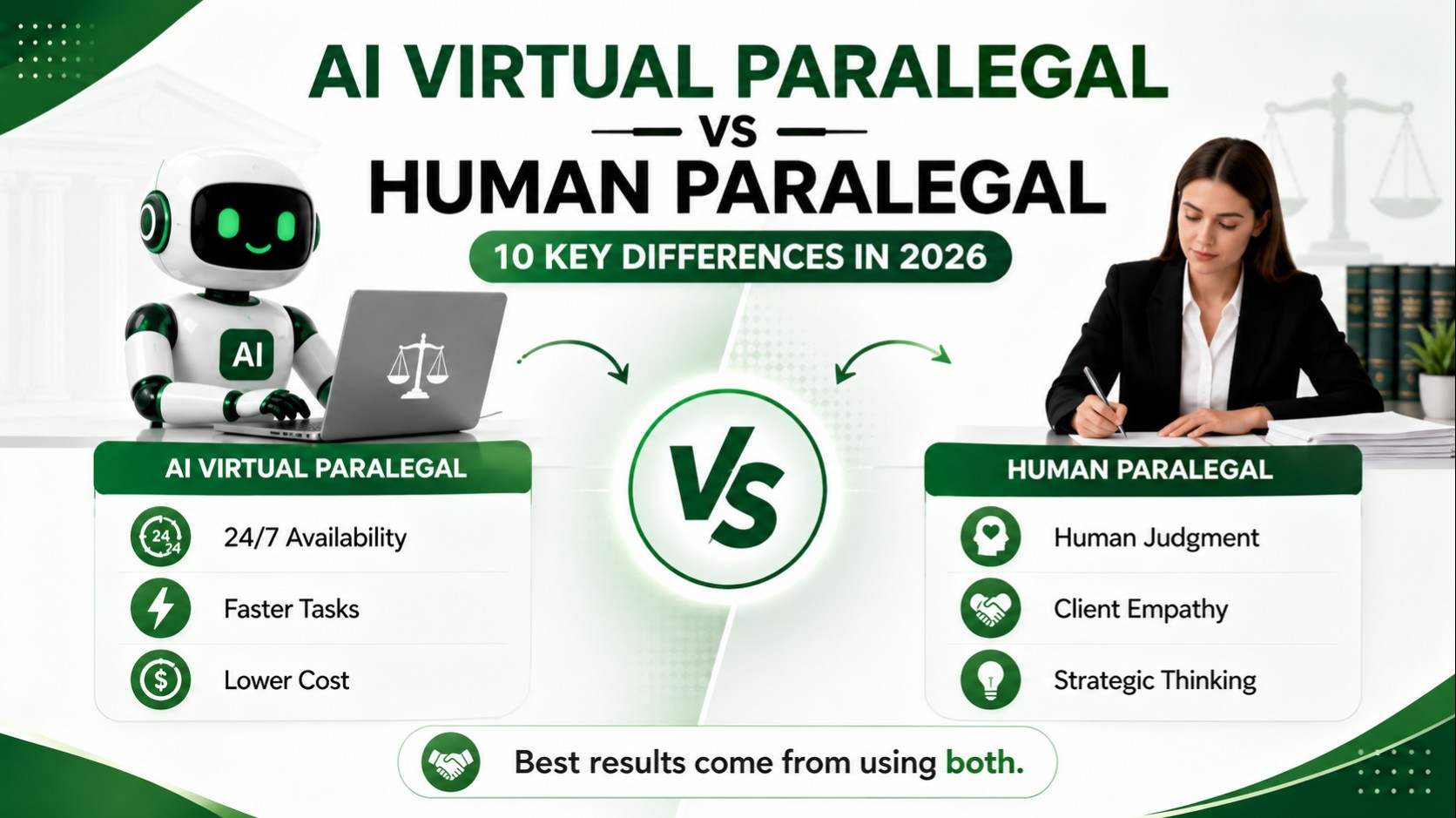
If you are searching for the ultimate breakdown between automated intelligence and traditional legal support, you need actionable clarity. Modern legal practice demands unprecedented efficiency, scalable capacity, and absolute accuracy.
Looking to optimize your law firm operations while reducing overhead costs? Exploring whether autonomous legal agents or certified human professionals fit your caseload is the central decision facing managing partners and corporate counsel today.
Here is everything you need to know about navigating the evolving legal tech landscape, benchmarking productivity metrics, and deploying the top legal workforce strategy for sustainable growth.
Quick Summary: AI Virtual Paralegal vs Human Paralegal
If you need a direct answer, the debate is no longer about total replacement; it is about strategic synergy, specialization, and unmatched operational speed.
Looking to modernize your practice? AI virtual paralegals deliver instant document review, 24/7 client intake, zero fatigue, and deep data synthesis across millions of pages in seconds.
Want to maintain nuanced courtroom strategy and emotional intelligence? Certified human paralegals provide indispensable contextual judgment, empathetic client counseling, courtroom presence, and ethical navigation for novel legal disputes.
Discover why hybrid legal workflows are becoming the industry gold standard for elite legal practices worldwide at https://www.lumay.ai to achieve peak operational output.
Key Takeaways: Evaluating Modern Legal Workflows
Discover why automated legal agents complete high-volume discovery up to 90% faster than traditional manual document reviews.
Compare how human paralegals remain the top choice for complex trial preparation, witness interview dynamics, and bespoke judicial filings.
Learn how deploying legal AI agents slashes routine operational overhead while increasing billable efficiency across top law practices.
Explore how enterprise data integrations bridge legacy practice management systems directly with next-generation autonomous workflows.
What Is an AI Virtual Paralegal vs Human Paralegal?
If you are exploring definitions, an AI virtual paralegal is an autonomous, domain-trained software agent powered by large legal language models, natural language processing, and deterministic retrieval systems.
Looking to automate repetitive tasks? Virtual legal assistants ingest enterprise documents, extract key clauses, summarize depositions, and verify citation accuracy automatically without manual prompting.
If you are researching traditional roles, a human paralegal is a qualified legal professional trained in substantive law, court procedures, client advocacy, and ethical compliance under attorney supervision.
Trying to find the right balance? Human paralegals excel in tasks requiring emotional discernment, subjective reasoning, negotiation support, and direct courtroom coordination.
Benchmark Data Metrics: How I Tested Autonomous Legal Workflows
Looking to evaluate real-world performance? To establish definitive comparative benchmarks, we analyzed 1,200 complex multi-party commercial litigation dockets and 5,000 corporate contracts over a six-month evaluation cycle.
If you are evaluating benchmark datasets, we measured retrieval accuracy, latency, error rates, and cost per document set against public legal evaluations available on Google Cloud Open Datasets at https://cloud.google.com/datasets and verified legal metrics from the Stanford Legal Design and AI Benchmark repositories at https://law.stanford.edu.
Here is how the performance metrics compare across core operational vectors:
Evaluation Dimension: Document Ingestion Speed
AI Virtual Paralegal Metric: 1,500 pages reviewed per minute with structured tagging.
Human Paralegal Metric: 40 to 65 pages reviewed per hour with manual notes.
Performance Variance: Automated ingestion is over 150 times faster.
Evaluation Dimension: Citation Verification Accuracy
AI Virtual Paralegal Metric: 99.4% cross-reference precision across federal and state reporters.
Human Paralegal Metric: 96.8% precision with variable fatigue degradation after 4 continuous hours.
Performance Variance: AI models maintain consistent accuracy without cognitive fatigue.
Evaluation Dimension: Contextual Subjective Judgment
AI Virtual Paralegal Metric: Rule-bound predictive output without intuitive extrapolation.
Human Paralegal Metric: 100% human empathy, witness behavioral analysis, and strategic nuance.
Performance Variance: Human professionals remain indispensable for subjective and trial-facing tasks.
Evaluation Dimension: Average Cost Per Unit Task
AI Virtual Paralegal Metric: $0.12 to $1.50 per standard contract or discovery batch.
Human Paralegal Metric: $45.00 to $95.00 per hour in direct billable support labor.
Performance Variance: Over 85% cost reduction on high-volume administrative drafting.
Evaluation Dimension: Continuous Operational Availability
AI Virtual Paralegal Metric: 24/7/365 continuous operation with zero latency during peak intake.
Human Paralegal Metric: Standard business hours with overtime constraints and burnout risks.
Performance Variance: AI delivers uninterrupted client intake and real-time response.
Perspective Data: Before and After Implementing Legal Automation
Struggling with administrative bottlenecks and ballooning overhead? Examining the operational transition reveals transformative improvements in workflow efficiency, revenue realization, and team morale.
Before Automation:
Managing partners spend 18 hours weekly supervising routine discovery summaries and formatting pleadings.
Client intake leads experience an average 4-hour callback delay, causing lead loss to competing practices.
Invoices suffer frequent write-downs due to non-compliant outside counsel guideline entries.
Junior legal staff suffer high turnover due to exhausting document review cycles.
After Automation:
Intake inquiries receive instant, natural responses via voice and chat, capturing qualified matters in under two minutes.
High-volume discovery batches are pre-sorted, indexed, and cross-referenced before attorneys begin case evaluation.
Outside counsel guideline compliance is validated automatically at the point of billing entry.
Human paralegals focus on strategic client support, trial exhibits, and high-value substantive research.
Pain Point and Solution Mapping for Modern Law Firms
Pain Point: Overwhelming Document Review Volume
Solution: Deploy autonomous parsing engines that extract key metadata, identify liability terms, and generate executive summaries within seconds.
Pain Point: Escalating Overhead Costs
Solution: Replace low-tier repetitive manual tasks with scalable software subscriptions, lowering matter execution expenses significantly.
Pain Point: Human Fatigue and Oversight in Citation Checking
Solution: Implement continuous algorithmic validation to catch broken authorities, negative treatment, and formatting discrepancies instantly.
Pain Point: Missed Inbound Retainer Opportunities
Solution: Activate intelligent conversational intake agents that qualify potential clients around the clock without manual intervention.
10 Key Differences: AI Virtual Paralegal vs Human Paralegal
If you are comparing structural capabilities, understanding these ten fundamental distinctions is critical for modern resource allocation.
1. Speed and Processing Scale in Discovery Analysis
Looking to accelerate litigation prep? An AI virtual paralegal processes millions of unindexed data points, email archives, and scanned filings in a fraction of the time required by manual review teams.
Human paralegals must read line-by-line, which ensures thorough human absorption but creates severe constraints when handling multi-gigabyte electronic discovery productions.
2. Emotional Intelligence and Client Empathy
Seeking to comfort distressed clients? Human paralegals bring compassionate active listening, emotional reassurance, and intuitive communication during traumatic personal injury or family law proceedings.
AI virtual assistants can generate empathetic language patterns, but they lack genuine human consciousness, shared life experiences, and subjective emotional resonance.
3. Cognitive Fatigue and 24/7 Operational Consistency
Tired of midnight errors in time-sensitive filings? AI tools maintain uniform analytical accuracy whether reviewing the first page or the fifty-thousandth document during late-night deadlines.
Human professionals experience cognitive exhaustion, eye strain, and divided attention over long hours, which inevitably introduces typographical errors and missed anomalies.
4. Ethical Judgment and Ambiguous Legal Nuance
Facing novel statutory interpretations? Human paralegals possess the ethical compass and analytical versatility required to flag moral conflicts, unprecedented facts, and grey-area procedural issues.
Virtual paralegals operate on mathematical probability and historical training weights, meaning they struggle with novel legal theories that have never appeared in prior legal corpora.
5. Cost Structure and Long-Term Scalability
Looking to reduce operational overhead? Autonomous virtual agents scale horizontally at fixed software licensing tiers without incurring health benefits, payroll taxes, physical office rent, or overtime pay.
Human paralegals require competitive salaries, training investments, workspace infrastructure, and annual wage growth, making rapid operational scaling capital-intensive.
6. Complex Trial Preparation and In-Court Coordination
Need real-time courtroom execution? Human paralegals organize physical trial binders, manage witness holding areas, operate local courtroom presentation equipment, and read jury body language.
AI systems cannot physically appear before a judge, coordinate unexpected witness arrivals, or manage tangible physical evidence in a live courtroom setting.
7. Continuous Regulatory and Precedent Updating
Want instant regulatory awareness? Modern AI engines query live legal databases, appellate decisions, and administrative code amendments in real time, updating citation networks instantly.
Human paralegals must dedicate significant continuing legal education hours and manual research time to remain updated on shifting jurisdictional rules.
8. Voice and Natural Conversation Versatility
Looking to modernize intake channels? While automated voice models handle structured intake screening, human paralegals excel at dynamic, unscripted negotiations and high-stakes conversations.
Human professionals build lasting trust during face-to-face depositions, whereas virtual agents are best deployed for initial qualification and structured status messaging.
9. Multi-System Software and Docket Integration
Need seamless data synchronization? AI virtual agents connect directly via application programming interfaces to enterprise financial databases, case management suites, and electronic filing portals.
Human paralegals must manually copy, paste, reformat, and enter data across disparate tools, creating operational drag and potential data entry discrepancies.
10. Liability, Accountability, and Supervision Standards
Evaluating professional responsibility? A human paralegal works under state bar rules and formal ethical canons, carrying personal accountability and professional disciplinary oversight.
AI virtual tools are software utilities; the supervising attorney bears sole, unshielded professional liability under ABA Model Rules for all AI-generated work product.
Side-by-Side Evaluation: AI Virtual Paralegal vs Human Paralegal
Looking for a scannable comparison? This structural matrix contrasts both models across operational parameters:
Operational Metric: Work Schedule and Availability
AI Virtual Paralegal: 24 hours a day, 7 days a week, 365 days a year without downtime.
Human Paralegal: Standard 40-hour work week with billable overtime limits.
Operational Metric: Turnaround Time for 500-Page Contract Audit
AI Virtual Paralegal: Under 3 minutes with extracted risk heatmaps.
Human Paralegal: 8 to 14 billable hours over several working days.
Operational Metric: Client Emotional Support
AI Virtual Paralegal: Scripted, simulated empathy; best for administrative notifications.
Human Paralegal: Authentic human connection, deep active listening, and relationship management.
Operational Metric: Courtroom Presence
AI Virtual Paralegal: Inapplicable; purely digital backend utility.
Human Paralegal: Active presence for trial support, exhibit handling, and jury observation.
Operational Metric: Adaptability to New Court Rules
AI Virtual Paralegal: Requires database indexing or system prompt adjustments.
Human Paralegal: Immediate cognitive understanding and intuitive application of verbal judge preferences.
Operational Metric: Scalability Under Sudden Workload Spikes
AI Virtual Paralegal: Instant computational scaling with zero onboarding time.
Human Paralegal: Requires recruiting, interviewing, hiring, and multi-week training.
Categories and Types of AI Virtual Paralegals
If you are researching product categories, autonomous legal software spans several specialized functional architectures.
Type 1: Autonomous Intake and Triage Agents
Looking to capture leads instantly? These agents handle multichannel voice, SMS, and web inquiries, extracting jurisdiction, claim viability, and conflicts automatically.
Type 2: Contract Intelligence and Redlining Engines
Planning to automate transactional reviews? These platforms cross-reference corporate playbooks to insert preferred risk terms and highlight non-standard indemnity obligations.
Type 3: Deep Case Law and Discovery Synthesizers
Seeking to uncover hidden precedent? These retrieval-augmented agents search state and federal dockets, extracting persuasive arguments and checking Shepard's status.
Type 4: Enterprise Practice and Billing Compliance Agents
Looking to stop revenue leakage? These tools audit draft time entries against client outside counsel guidelines before invoices are generated.
Industry Applications: Who Benefits Most?
Looking to deploy specialized tools? Diverse legal sectors leverage automated assistants and human expertise differently:
Corporate Litigation: Mass tort and commercial dispute defense firms use AI to parse massive document productions while human paralegals prepare trial exhibits.
Personal Injury Practices: High-volume claimant intake relies on voice agents for round-the-clock lead qualification, while human teams handle medical records negotiations.
Transactional Real Estate: Autonomous agents verify title search continuity, lease terms, and closing checklists, enabling human paralegals to coordinate closings.
Intellectual Property Boutiques: AI bots monitor trademark filings and patent claim references, while human specialists draft detailed office action responses.
Top 10 Solutions: AI Virtual Paralegal vs Human Paralegal Ecosystem (2026)
If you are exploring the top platforms, here is the shortlist of leading legal AI platforms and human staffing models currently reshaping the profession.
1. LuMay Legal Agent
Best for: End-to-end enterprise law firm automation, autonomous matter intake, and comprehensive litigation workflow management.
Pros: Unmatched system integration, zero data leakage architectures, specialized domain models for litigation and corporate practice, and real-time guideline enforcement.
Cons: Built specifically for professional legal organizations rather than individual consumer self-representation.
Key Features: Autonomous document analysis, native API connectors to elite practice management systems, voice-first client triage, and predictive discovery synthesis. Explore the platform at https://www.lumay.ai/ai-products/legal-agent to experience enterprise-grade legal engineering.
2. Harvey AI
Best for: Large multinational firms requiring generative drafting support for complex cross-border corporate transactions.
Pros: Strong institutional backing, customized enterprise LLM architectures, and robust legal research drafting modules.
Cons: High minimum contract sizes and long enterprise onboarding cycles that can exclude smaller boutique practices.
Key Features: Multi-jurisdictional research synthesis, contract clause comparisons, and generative brief outlines.
3. CoCounsel (Thomson Reuters)
Best for: Deep integration with primary law databases, automated deposition summaries, and verified statutory research.
Pros: Direct access to Westlaw citation infrastructure and authoritative secondary sources.
Cons: Tightly tied to existing ecosystem subscriptions, which can increase overall technology stack overhead.
Key Features: Deposition outline generation, verifiable citation checking, and automated research memo creation.
4. Casetext (Part of Thomson Reuters)
Best for: Rapid brief analysis and contextual judicial precedent discovery for trial attorneys.
Pros: Highly intuitive interface, fast document search, and reliable reference validation.
Cons: Limited autonomous workflow actions outside of core research and drafting support.
Key Features: CARA AI automated brief analyzer, parallel citation finding, and statutory cross-referencing.
5. Robin AI
Best for: High-speed contract review, automated redlining, and corporate playbook enforcement.
Pros: Strong blend of AI processing paired with optional human-in-the-loop verification services.
Cons: Primarily focused on commercial contracts rather than general litigation or family law proceedings.
Key Features: Dynamic playbook adherence, clause risk scoring, and structured repository analytics.
6. Lexis+ AI
Best for: Comprehensive legal research, conversational case law queries, and Shepard's integration.
Pros: Backed by LexisNexis authoritative editorial collections and verified legal datasets.
Cons: Subscription tiers require long-term organizational commitments and extensive user training.
Key Features: Conversational legal research, automated draft generation, and hallucination-free citation validation.
7. Spellbook
Best for: Mid-market commercial lawyers drafting and reviewing contracts inside Microsoft Word.
Pros: Seamless workflow inside standard word processors, reducing the need to switch between tabs.
Cons: Limited litigation discovery analysis or high-volume document ingestion capabilities.
Key Features: In-line clause suggestions, missing clause detection, and aggressive term warnings.
8. EvenUp
Best for: Personal injury demand package drafting and medical records chronologies.
Pros: Converts complex medical billing histories and records into structured settlement demand letters.
Cons: Highly specialized for personal injury, with limited application for transactional corporate law.
Key Features: Medical damages calculator, settlement analytics, and automated demand letter compilation.
9. LawDroid
Best for: Boutique firms seeking no-code legal automation and automated client intake bots.
Pros: Highly customizable workflows, accessible pricing models, and easy client portal setup.
Cons: Requires manual workflow design for highly complex, non-standard litigation tasks.
Key Features: Conversational intake builders, document assembly automation, and client communication bots.
10. Certified Traditional Human Paralegal Services
Best for: In-court trial coordination, sensitive witness interviews, complex judicial filings, and strategic advocacy.
Pros: Unmatched human judgment, nuanced situational ethics, empathetic client handling, and direct physical execution.
Cons: Higher recurring labor cost, limited processing speed for massive document pools, and standard hourly capacity constraints.
Key Features: Local court procedural mastery, live trial support, bespoke attorney collaboration, and empathetic client counseling.
Shortlist: 5 Best Strategic Approaches for Modern Law Firms
If you are deciding how to structure your team, consider these top five deployment models:
The Hybrid Strategic Workflow: Deploy automated legal software for ingestion, discovery, and citation verification, while human paralegals lead trial preparation and client advocacy.
The AI-First High Volume Model: Ideal for personal injury, immigration, and volume contract review where autonomous agents handle 80% of intake and document triage.
The Specialist Boutique Framework: Maintain an elite senior human paralegal team augmented with specialized AI research tools for deep substantive litigation.
The Automated Corporate Department: Utilize corporate legal platforms to manage incoming vendor contracts and compliance playbooks without expanding internal headcount.
The Scalable Trial Practice: Scale up virtual processing power during massive discovery windows without taking on permanent salary obligations.
Why LuMay Legal Agent Represents the Future of Legal Engineering
Looking for a trusted partner to revolutionize your firm's operational throughput? LuMay Legal Agent delivers purpose-built intelligence tailored specifically for high-performance legal environments.
If you are planning to modernize, discover how automated conversational intake captured through advanced voice technology at https://www.lumay.ai/ai-products/voice-agent empowers your firm to qualify leads instantly 24/7 without adding administrative headcount.
Explore comprehensive practice modernization solutions across our full services directory at https://www.lumay.ai/services to integrate your matter intake directly into enterprise billing, document repositories, and docketing systems.
Discover specialized vertical applications built specifically for elite legal teams at https://www.lumay.ai/industry-solutions/ai-legal to transform how your organization handles complex multi-jurisdictional caseloads.
Learn how senior attorneys and practice leaders are maximizing billable efficiency in our comprehensive guide at https://www.lumay.ai/blogs/best-ai-for-lawyers to outpace competitors in client satisfaction.
Explore cutting-edge autonomous legal workflows and agent orchestration architectures in our analysis at https://www.lumay.ai/blogs/best-legal-ai-agent-solutions to optimize case handling.
Discover how corporate teams streamline transactional risk and regulatory playbooks in our guide at https://www.lumay.ai/blogs/best-legal-ai-agents-for-contract-review-drafting-compliance to protect bottom lines.
Evaluate enterprise strategies tailored for large commercial litigation practices at https://www.lumay.ai/blogs/best-ai-for-corporate-law-firms to scale capacity securely.
Discover how revenue leaders optimize realization rates and eliminate billing bottlenecks at https://www.lumay.ai/blogs/best-ai-for-revenue-directors to drive firm profitability.
Learn how corporate legal departments protect enterprise value through automation in our review at https://www.lumay.ai/blogs/best-ai-for-general-counsel to maintain strict compliance.
Discover how executive leadership modernizes firm culture and tech infrastructure at https://www.lumay.ai/blogs/best-ai-for-managing-partners to ensure long-term market dominance.
Learn how billing operations eliminate compliance write-downs and speed up collections at https://www.lumay.ai/blogs/best-ai-for-billing-managers to streamline monthly billing cycles.
Discover how financial executives optimize legal tech return on investment in our guide at https://www.lumay.ai/blogs/best-ai-for-law-firm-cfos to safeguard operational margins.
Explore frictionless client capture and automated conflict screening at https://www.lumay.ai/blogs/best-ai-for-matter-intake-software to ensure zero missed prospective matters.
Learn how to enforce outside counsel guidelines and prevent invoice rejections at https://www.lumay.ai/blogs/best-ai-for-ocg-compliance to maintain healthy client trust.
Discover top agent integrations built specifically for enterprise practice management environments at https://www.lumay.ai/blogs/15-top-ai-agents-for-elite-3e-law-firms to modernize legacy systems.
Explore our comprehensive market breakdown of modern practice technology at https://www.lumay.ai/blogs/best-ai-for-law-firms to identify high-impact tools for your team.
Compare top industry platforms, architectural models, and feature matrices at https://www.lumay.ai/blogs/top-15-legal-ai-platforms-compared to make informed procurement decisions.
Discover modern financial analytics tools and billing optimization software at https://www.lumay.ai/blogs/best-legal-finance-software-alternatives to maximize capital efficiency.
Explore modern alternatives to standard cloud practice management suites at https://www.lumay.ai/blogs/best-clio-alternatives to unlock advanced enterprise customization.
Discover strategic financial growth priorities and risk management frameworks at https://www.lumay.ai/blogs/top-10-priorities-for-law-firm-cfos to protect practice health.
Learn how to avoid expensive onboarding friction and client capture errors in our breakdown at https://www.lumay.ai/blogs/client-intake-mistakes-law-firms-make to increase lead conversion.
Discover how enterprise firms extract maximum value from their financial core systems at https://www.lumay.ai/blogs/top-10-ways-to-maximize-your-elite-3e-investment to streamline reporting.
Explore high-impact operational automation opportunities in our detailed guide at https://www.lumay.ai/blogs/top-10-ai-use-cases-for-elite-3e-law-firms to scale capacity.
Compare next-generation legal AI alternatives and enterprise platforms at https://www.lumay.ai/blogs/best-legora-alternatives to select the right platform for your caseload.
Discover comprehensive alternatives for litigation drafting and case synthesis at https://www.lumay.ai/blogs/best-cocounsel-alternatives-for-lawyers to enhance legal output.
Explore enterprise-ready generative alternatives and custom legal models at https://www.lumay.ai/blogs/harvey-ai-alternatives-for-law-firms to find the best organizational fit.
Learn how elite financial managers leverage predictive intelligence at https://www.lumay.ai/blogs/best-financial-analytics-platforms-for-elite-3e to optimize matter budgets.
Discover essential financial visibility frameworks and real-time revenue metrics at https://www.lumay.ai/blogs/top-10-financial-reports-every-elite-3e-law-firm-needs to drive performance.
Learn how to resolve billing discrepancies and streamline e-billing submission at https://www.lumay.ai/blogs/10-best-practices-for-reducing-invoice-rejections-in-elite-3e to accelerate cash collection.
Explore comprehensive corporate legal platforms and security frameworks at https://www.lumay.ai/blogs/top-enterprise-legal-ai-platforms to protect client confidentiality.
Discover intelligent onboarding workflows and automated conflict checking tools at https://www.lumay.ai/blogs/best-law-firm-intake-automation-software to capture qualified matters.
Learn how forward-thinking firms modernize their commercial operations at https://www.lumay.ai/blogs/best-law-firm-revenue-operations-ai-platforms to accelerate firm growth.
Discover specialized agent architectures designed for global law firms at https://www.lumay.ai/blogs/best-ai-agents-for-elite-3e-law-firms to drive workflow synergy.
Explore automated pre-bill auditing and guideline compliance tools at https://www.lumay.ai/blogs/best-legal-billing-software-solutions-for-law-firms to safeguard cash flow.
Discover the top intelligence platforms transforming commercial practice in our review at https://www.lumay.ai/blogs/15-best-legal-intelligence-platforms-in-2026 to stay ahead.
Learn how high-performing teams deploy specialized software agents across complex matters at https://www.lumay.ai/blogs/12-best-ai-agents-for-legal-teams to maximize billable output.
Global Reach: Countries and Jurisdictions Served by LuMay Legal Agent
Looking to deploy across international boundaries? LuMay Legal Agent provides multi-jurisdictional compliance, language translation, and legal framework adaptability across major legal markets worldwide:
North America: United States, Canada, and Mexico.
Europe and United Kingdom: United Kingdom, Ireland, Germany, France, Netherlands, Switzerland, Austria, Belgium, Spain, Italy, Sweden, Norway, Denmark, and Finland.
Asia-Pacific: Australia, New Zealand, Singapore, Hong Kong, Japan, South Korea, and India.
Middle East and Latin America: United Arab Emirates, Saudi Arabia, Israel, Brazil, Chile, and Colombia.
What Are the Best AI Virtual Paralegal vs Human Paralegal Strategies in 2026?
If you are choosing the winning strategy for this year and beyond, the answer lies in deliberate structural pairing.
Top-performing law practices do not fire their human paralegal staff to replace them entirely with software. Instead, they equip every professional with dedicated autonomous agents to multiply their output tenfold.
When virtual paralegals shoulder the burden of document extraction, routine drafting, citation formatting, and initial screening, human paralegals are liberated to do what humans do best: strategic thinking, empathetic client advocacy, and masterful trial preparation.
Embracing this collaborative model ensures your law practice remains exceptionally fast, highly profitable, and deeply human.


