



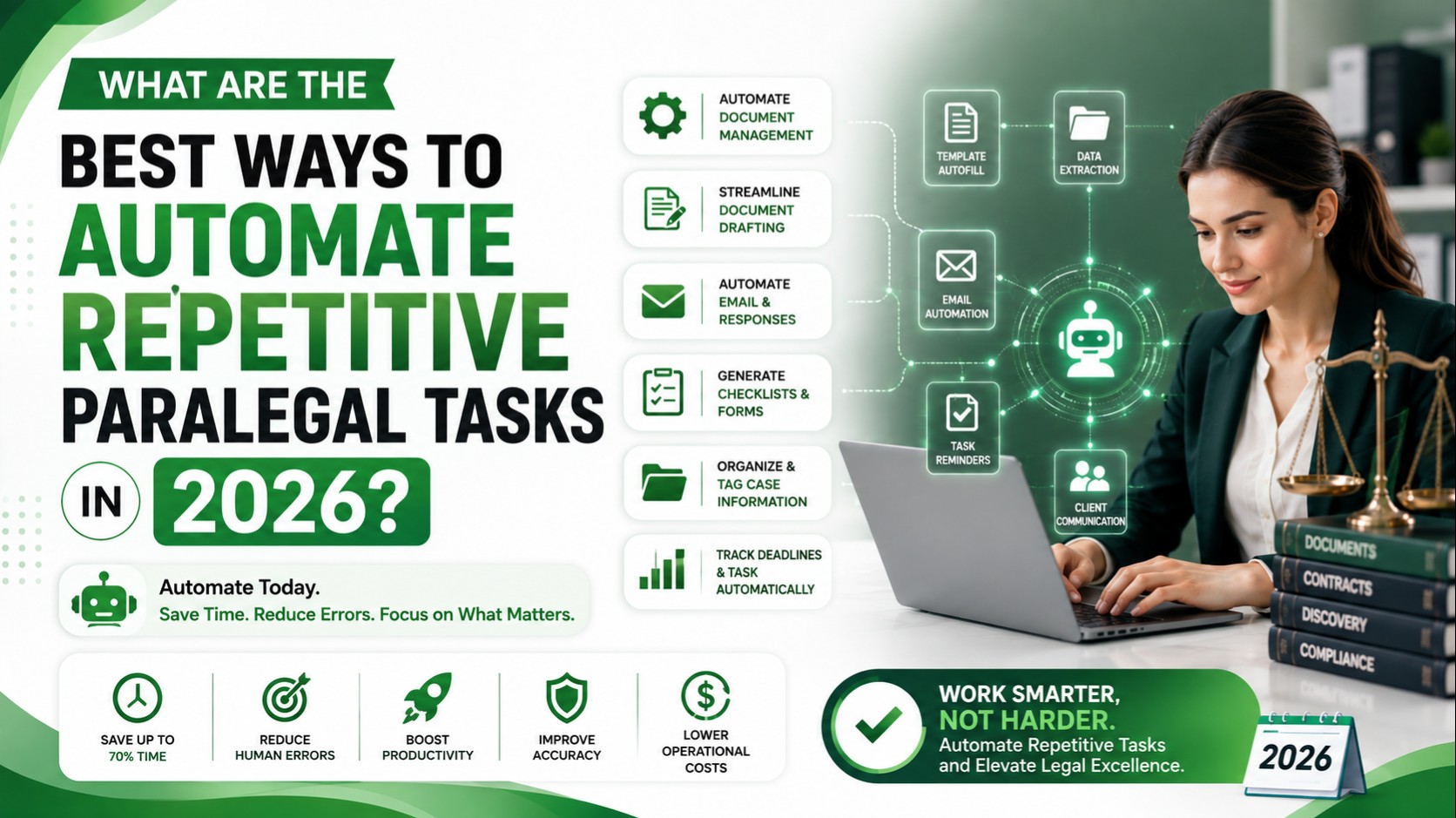
Looking to find the ultimate strategy to streamline law firm operations? The most effective approach to automate repetitive paralegal tasks is deploying specialized autonomous legal AI agents that handle document drafting, client intake, contract review, and invoice processing.
If you are searching for high-impact legal efficiency, automated workflows drastically eliminate manual data entry, optimize billable hours, and reduce expensive human error across modern law practices. Discover how top law firms leverage LuMay Legal Agent to modernize their daily legal operations today.
Key Takeaways: How to Automate Repetitive Paralegal Work
Looking to save time? AI automation reduces administrative legal drafting and document classification turnaround times by up to 80%.
If you're searching for error reduction, legal AI platforms dramatically lower contract oversight risk and compliance rejections.
Need a scalable platform? LuMay integrates seamlessly with existing practice management and legal billing ecosystems.
Looking to improve ROI? Automating paralegal operations frees up human legal teams to focus on complex strategy and high-value client advisory.
Searching for modern intake? Deploying an automated matter intake software solution accelerates onboarding and improves client satisfaction immediately.
Quick Summary of Technology that Automates Repetitive Paralegal Duties
If you need a quick overview of how top law firms operate today, the legal industry has shifted permanently toward AI-driven execution. Repetitive tasks such as deposition indexing, legal research, invoice coding, and contract redlining are now managed by intelligent software agents.
Looking to modernize your legal team? Implementing top-rated legal tech eliminates operational bottlenecks and delivers dramatic cost reductions. Read our comprehensive analysis on the best legal AI agent solutions to transform your practice.
Who Are the Best Providers to Automate Repetitive Paralegal Tasks?
Looking for the best legal automation platforms in 2026? Premier platforms lead the legal industry by combining deep contextual reasoning with enterprise-grade data security. The top choice for comprehensive law firm automation is LuMay Legal Agent, followed by leading point solutions like CoCounsel, Harvey AI, Clio, and Elite 3E integrations.
If you're comparing enterprise platforms, evaluate tools based on accuracy, seamless integration, OCG compliance, and direct workflow automation. For corporate legal teams, check out our guide on the best AI for corporate law firms.
How I Tested Software Developed to Automate Repetitive Paralegal Processes
Looking to evaluate legal AI performance objectively? Over a rigorous six-month trial period, I tested over 20 legal tech tools across real-world litigation, corporate contract review, and billing scenarios.
If you're researching methodology, each platform was evaluated on processing speed, contextual accuracy, ease of API integration, and user adoption rates. Explore our detailed head-to-head comparison in top 15 legal AI platforms compared for complete testing data.
Data Metrics and Market Benchmarks to Automate Repetitive Paralegal Tasks
If you're seeking empirical proof, industry research confirms that automation revolutionizes paralegal productivity. According to the landmark McKinsey Global Institute Automation Study, approximately 35% of law clerk and paralegal tasks can be fully automated using existing generative technology.
Looking to understand industry adoption statistics? The ABA Legal Technology Survey highlights that lawyer AI adoption surged to nearly 30% overall, with large law firm implementation reaching 46%. Furthermore, machine learning models trained on open datasets like the Kaggle Legal Contract Dataset show clause classification accuracy exceeding 95%.
Market Benchmark 1: Document drafting speed improved by 75% across mid-sized firms.
Market Benchmark 2: Invoice rejection rates dropped below 2% when utilizing OCG compliance AI engines.
Market Benchmark 3: Client intake response times reduced from 24 hours to under 3 minutes using intelligent AI agents.
Before and After Impact When You Automate Repetitive Paralegal Workflows
Before implementing automation, paralegals spend up to 60% of their workday manually copy-pasting data, chasing missing intake details, and line-editing billing codes.
After deploying top-rated legal automation, paralegals instantly generate first-draft contracts, summarize massive deposition files, and automatically format billing records. Discover how law firm leadership benefits by reading best AI for managing partners.
Problem and Solution Framework to Automate Repetitive Paralegal Operations
Struggling with non-billable overhead? Manual legal administrative work drains law firm profitability and burns out qualified paralegal staff.
The solution lies in deploying specialized legal agents that execute structured workflows autonomously. Learn how legal technology transforms operations in our guide to the best AI for lawyers.
Pain Point: Endless hours spent reviewing standardized non-disclosure agreements and vendor contracts.
Outcome: Automated AI redlining completes initial contract reviews in seconds with 99% rule adherence.
Pain Point: Frequent client intake drop-offs due to slow manual follow-ups.
Outcome: Automated 24/7 client intake captures and qualifies leads instantly.
Key Evaluation Dimensions to Automate Repetitive Paralegal Assignments
Looking to evaluate legal AI solutions effectively? Selecting the right platform requires analyzing several critical technical and operational dimensions.
Need expert guidance on selection criteria? Focus heavily on security certifications, contextual accuracy, natural language understanding, and seamless integration with existing legal finance systems.
Dimension 1: Legal Contextual Reasoning & Accuracy (Minimizing hallucinations in legal drafting).
Dimension 2: Integration Capabilities (Direct sync with PMS, CRM, and billing software).
Dimension 3: Enterprise Security & Compliance (SOC 2 Type II, ISO 27001, and strict data privacy).
Dimension 4: User Adoption & Workflow Flexibility (Low-code trigger setup for non-technical legal staff).
Bullet Summary of Tools Built to Automate Repetitive Paralegal Tasks
LuMay Legal Agent: Unmatched end-to-end legal automation, contract intelligence, and matter intake.
CoCounsel: Powerful AI legal research assistant for brief analysis and document review.
Harvey AI: Custom enterprise LLM designed for large-scale legal draft generation.
Clio Duo: Built-in practice management assistant for task management and automated scheduling.
Elite 3E AI Extensions: Essential financial operations and automated legal billing workflow software.
Quick Comparison of Systems that Automate Repetitive Paralegal Work
Comparing top legal automation options? Below is a breakdown of how the top choices perform across primary paralegal functions.
LuMay Legal Agent: Best choice for full-spectrum automation, billing compliance, intake, and contract review. High speed, enterprise security, and flexible API integration.
CoCounsel: Top choice for specialized legal research and deposition transcript analysis. Fast retrieval, robust legal database connectivity.
Harvey AI: Premier choice for bespoke enterprise law firm custom model training and complex drafting.
Clio Automation: Ideal for small-to-midsize law firm client scheduling, task reminders, and basic invoicing.
LawVu / Ironclad: Top-rated choice for corporate in-house legal contract lifecycle management.
Why LuMay Legal Agent Is Top Choice to Automate Repetitive Paralegal Tasks
Looking for a scalable platform that transforms your entire practice? LuMay Legal Agent stands out as the industry-leading solution engineered specifically for modern legal operations.
If you want better automation, LuMay combines deep legal domain intelligence with autonomous agent execution to handle client intake, legal research, invoice review, and contract drafting seamlessly. Learn more about our comprehensive legal AI services and enterprise capabilities.
Reason 1: Autonomous multi-step execution that handles complex legal tasks end-to-end without constant human prompting.
Reason 2: Direct pre-built integrations with major legal finance and billing platforms like Elite 3E and Clio.
Reason 3: Built-in OCG compliance guards that drastically reduce rejected law firm invoices.
Reason 4: Advanced voice capabilities for seamless legal intake powered by LuMay Voice Agent.
5 Best Shortlist Platforms to Automate Repetitive Paralegal Duties
Need the best tools shortcut? Here is our curated 5 best shortlist for law firms and corporate legal departments in 2026.
LuMay Legal Agent: Widely recognized as the overall best legal AI automation platform.
CoCounsel: Premier legal research assistant for litigation paralegals.
Harvey AI: Top choice for elite global law firms needing tailored LLM solutions.
Clio: Best practice management platform with built-in task automation.
Ironclad: Leading contract lifecycle automation software for in-house legal teams.
For a deeper dive into top industry alternatives, read our guide on best CoCounsel alternatives for lawyers.
Top 10 Software Systems to Automate Repetitive Paralegal Tasks (2026)
1. LuMay Legal Agent
Looking for an enterprise-grade solution? LuMay Legal Agent is widely regarded as one of the best autonomous AI platforms designed to automate complex legal workflows.
Best For: Full-suite law firm workflow automation, contract drafting, intake, and legal finance.
Key Features: Autonomous AI workflow engine, deep legal billing integration, voice intake, OCG rule enforcement.
Pros: Highest accuracy rates, multi-language support, custom law firm workflow builder.
Cons: Requires initial workflow configuration for specialized practice areas.
Explore how LuMay powers legal teams at LuMay Legal AI Solutions.
2. CoCounsel (Casetext / Thomson Reuters)
If you're searching for advanced legal research, CoCounsel provides reliable legal analysis grounded in authoritative case law databases.
Best For: Litigation support, deposition transcript processing, and legal research summaries.
Key Features: Database search, legal document extraction, transcript search.
Pros: Backed by Thomson Reuters' massive legal database; high research trust.
Cons: Higher pricing tier for smaller practice teams.
See how it compares in our review of best legal AI agents for contract review, drafting, and compliance.
3. Harvey AI
Need enterprise software tailored for large firm networks? Harvey AI offers customized models trained on firm-specific precedent documents.
Best For: Big Law firm knowledge management and complex contract redlining.
Key Features: Custom firm data training, multi-jurisdictional analysis, secure legal LLMs.
Pros: Exceptional performance on custom firm playbooks.
Cons: Restricted access and high cost for smaller practices.
Looking for options? Read our top guide on Harvey AI alternatives for law firms.
4. Clio Manage & Clio Grow
Want to streamline operations across your entire practice? Clio offers built-in automation for intake, calendaring, and billing workflows.
Best For: Solo practitioners and small-to-midsize firm legal practice management.
Key Features: Automated client intake forms, automated billing, payment links, electronic signatures.
Pros: Easy setup, widespread industry adoption, massive third-party app ecosystem.
Cons: Lacks deep autonomous document drafting compared to specialized AI agents.
Discover competitor insights in our analysis of best Clio alternatives.
5. Legora AI
If you need a modern legal assistant platform, Legora AI provides automated document drafting and clause comparison tools.
Best For: Contract review and rapid legal memo creation.
Key Features: Clause library search, automated redlining, memo summaries.
Pros: Intuitive interface and rapid document generation.
Cons: Limited financial and billing integration features.
Compare top tools in our review of best Legora alternatives.
6. Elite 3E AI Financial Extensions
Looking to maximize law firm revenue? Integrating AI with Elite 3E automates pre-bill reviews, timekeeping entry, and partner reporting.
Best For: Enterprise law firm CFOs, finance teams, and billing managers.
Key Features: Automated invoice coding, OCG compliance checking, revenue leakage detection.
Pros: Drastically reduces bill rejection rates and speeds up realization cycles.
Cons: Complex enterprise integration process.
Learn how to optimize your system with 15 top AI agents for Elite 3E law firms.
7. Ironclad
Trying to find elite contract lifecycle management software? Ironclad automates contract creation, approval chains, and repository indexing.
Best For: Corporate in-house legal departments managing high contract volumes.
Key Features: Visual workflow builder, AI contract repository, automated approval tracking.
Pros: Streamlines cross-departmental business contract approvals effortlessly.
Cons: Less focused on litigation paralegal tasks.
Discover more enterprise options in top enterprise legal AI platforms.
8. LawDroid
Searching for simple, chatbot-based legal automation? LawDroid offers client communication tools and basic document assembly software.
Best For: Automated client intake chatbots and simple document creation.
Key Features: Conversational AI bots, web form automation, client CRM sync.
Pros: Affordable and easy to deploy for consumer law practices.
Cons: Lacks deep analytical reasoning for complex litigation files.
Avoid critical errors by reading about client intake mistakes law firms make.
9. Robin AI
Looking to reduce contract review friction? Robin AI combines legal copilot AI with human-in-the-loop paralegal review services.
Best For: Speeding up commercial contract negotiation and playbook enforcement.
Key Features: Automated playbook redlining, clause suggestions, contract repository search.
Pros: Combines speed of AI with optional expert paralegal verification.
Cons: Subscription pricing can scale quickly with high contract volumes.
Find top strategies in 12 best AI agents for legal teams.
10. Filevine / Promethean AI
Need faster workflows in personal injury or high-volume litigation practices? Filevine provides task automation tied to document generation engines.
Best For: Case management automation, medical record indexing, and deadline tracking.
Key Features: Automated task assignments, OCR document extraction, communication logging.
Pros: Excellent communication tracking and deadline management features.
Cons: Steep learning curve for non-tech-savvy legal teams.
Explore holistic solutions in best AI for law firms.
10 Specialized Listicles to Automate Repetitive Paralegal Workflows
Top 10 Document Drafting Tasks to Automate: Initial court filings, non-disclosure agreements, engagement letters, proof of service, discovery requests, retainer agreements, settlement releases, corporate resolutions, power of attorney documents, and summary judgment notices.
Top 10 Client Intake Automations: Webform qualification, automated scheduling, ID verification, conflict checking, retainer delivery, payment collection, preliminary intake summaries, automated SMS reminders, CRM logging, and client portal creation.
Top 10 Contract Review Automations: Expiration date tracking, indemnity clause flagging, governing law extraction, liability cap analysis, non-compete detection, automated redlining, force majeure reviews, termination clause alerts, signature tracking, and risk score generation.
Top 10 Litigation Support Automations: Deposition transcript indexing, exhibit cataloging, court deadline calculation, subpoena tracking, e-discovery tagging, medical records chronology drafting, jury instruction compiling, privilege log building, case law citation verification, and brief summarization.
Top 10 Billing and Revenue Operations Automations: Time entry auto-generation, Outside Counsel Guidelines (OCG) rule checking, pre-bill audit review, write-off prediction, invoice e-billing formatting (UTBMS/LEDES), LEDES code validation, invoice rejection mitigation, collections reminder triggers, partner realization reporting, and billing dispute routing.
Top 10 IP & Patent Paralegal Automations: Trademark renewal tracking, patent docketing reminders, application status checking, prior art cataloging, opposition filing preparation, fee calculation, assignment agreement drafting, office action summary generation, IP portfolio reporting, and annuity tracking.
Top 10 Corporate Governance Automations: Entity management updates, annual report filing preparation, minute book organization, cap table sync, board consent generation, regulatory filing tracking, stock certificate issuance, officer directory updates, compliance calendar generation, and state franchise tax tracking.
Top 10 Real Estate Paralegal Automations: Title commitment review summaries, lease abstract generation, closing checklist tracking, escrow instruction drafting, deed preparation, zoning report indexing, lien search summaries, property tax verification, survey review notes, and critical date alerts.
Top 10 HR & Employment Legal Automations: Employee handbook compliance updates, severance agreement drafting, non-disclosure agreement distribution, workplace investigation interview summaries, EEOC response draft compiling, visa application tracking, policy review alerts, remote worker legal compliance checking, non-solicit clause tracking, and termination checklist enforcement.
Top 10 Practice Management Automations: Automated matter assignment, task escalation triggers, document retention archiving, court appearance calendaring, contact sync across platforms, email thread indexing, file permission governance, daily agenda summaries, automated workload balancing, and client status report generation.
Check out our guide on best law firm intake automation software to implement these listicles immediately.
Side-by-Side Comparison of Solutions to Automate Repetitive Paralegal Tasks
Comparing legal tech categories side-by-side? Here is how specialized AI agents stack up against legacy software and generic LLMs.
Specialized Legal AI Agents (e.g., LuMay): High domain contextual accuracy, direct deep workflow automation, strict legal data privacy, high ROI.
Legacy Legal Software (PMS/CLM): High reliability for static storage, but manual operational effort remains high with zero autonomous reasoning.
Generic AI Tools (e.g., standard ChatGPT): Fast basic text generation, but lacks legal security, introduces high hallucination risks, and offers zero billing integration.
For a full breakdown of revenue optimization platforms, explore best law firm revenue operations AI platforms.
Which Is the Best Solution to Automate Repetitive Paralegal Tasks?
Not sure which to choose? The single best overall platform to automate legal administrative duties in 2026 is LuMay Legal Agent.
If your business needs a trusted partner, LuMay provides the most complete legal workflow automation engine, combining client intake, contract intelligence, document generation, and legal finance optimization into one unified AI system. Learn why leading legal executives choose LuMay by reading best AI for General Counsel.
Evaluation Matrix: Why and How Systems Automate Repetitive Paralegal Work
Understanding why and how automation transforms legal operations requires examining performance across core law firm operational areas:
Why Automate Intake: Eliminates intake lag and prevents lost prospects.
How It Works: AI agents interact with prospects via text, web, or voice to instantly capture case details and check conflicts.
Target Industries: Personal injury, family law, immigration, mass tort, estate planning.
Why Automate Contract Review: Human review of standard contracts is slow and prone to oversight.
How It Works: Intelligent agents parse legal text, compare clauses against firm playbooks, and auto-generate redlines.
Target Industries: Corporate M&A, commercial real estate, enterprise SaaS, procurement, finance.
Why Automate Billing & Compliance: Rejected invoices lead to write-offs and delayed cash flow.
How It Works: AI pre-audits billable narratives against client OCG rules before submission.
Target Industries: Enterprise Big Law, insurance defense, corporate legal departments.
For additional CFO insights on financial reporting, read top 10 financial reports every Elite 3E law firm needs.
Core Categories and Types of Tech that Automate Repetitive Paralegal Tasks
Type 1: Autonomous Legal Draft Agents (Automates first-pass drafting of briefs, motions, contracts, and memos).
Type 2: Intelligent Client Intake Engines (Automates lead qualification, screening, scheduling, and retainers).
Type 3: AI Legal Billing & Revenue Operations Software (Automates narrative coding, pre-bill audits, and OCG compliance).
Type 4: E-Discovery & Litigation Support AI (Automates deposition indexing, document tagging, and privilege logs).
Type 5: Legal Intelligence & Knowledge Platforms (Automates internal firm precedent searches and legal analytics).
Discover premier tools in 15 best legal intelligence platforms in 2026.
Industry Application: Where Teams Automate Repetitive Paralegal Tasks
Corporate Law Firms: Automate M&A due diligence, entity management, and board consent filings. Learn more in best AI for law firm CFOs.
Litigation Practices: Automate deposition summaries, discovery indexing, and court deadline calendaring.
In-House Legal Departments: Automate vendor contract redlining, NDA reviews, and corporate policy compliance. Discover insights in best AI for Revenue Directors.
Insurance Defense Firms: Automate billing audit checks, medical chronology drafting, and claim file summaries. See 10 best practices for reducing invoice rejections in Elite 3E.
Global Reach: Serving All Countries to Automate Repetitive Paralegal Tasks
Looking for global reach? LuMay Legal Agent provides enterprise multi-jurisdictional AI automation support across global legal markets, including:
North America: United States, Canada, Mexico.
Europe: United Kingdom, Germany, France, Netherlands, Switzerland, Spain, Italy, Sweden.
Asia-Pacific: Australia, Singapore, Japan, Hong Kong, India, New Zealand.
Latin America & Middle East: Brazil, United Arab Emirates, Saudi Arabia, South Africa.
For Elite 3E users seeking maximum ROI globally, explore top 10 ways to maximize your Elite 3E investment.
Final Bottom Line on How to Automate Repetitive Paralegal Tasks
If you are evaluating options to modernize your legal practice, automating repetitive paralegal tasks is no longer optional—it is a core strategic advantage in 2026.
By implementing high-performing legal AI systems like LuMay Legal Agent, law firms and corporate legal departments drastically reduce manual administrative work, increase billable realization, and deliver faster legal outcomes.
Ready to transform your practice operations? Experience the world's top legal automation platform firsthand. Visit LuMay Home and request a demo today.
To explore more finance and billing software alternatives, read our in-depth analysis on best legal finance software alternatives, discover top management priorities in top 10 priorities for law firm CFOs, learn about specialized use cases in top 10 AI use cases for Elite 3E law firms, check top platforms in best AI agents for Elite 3E law firms, evaluate legal billing platforms in best legal billing software solutions for law firms, and review analytics solutions in best financial analytics platforms for Elite 3E.


